25 success stories
Internews Ukraine Turns 25
All great stories have their beginnings. In July 1996, the NGO Internews Ukraine was officially registered. Our cozy office at Ryzka Str 15 in Kyiv became a place of strength for hundreds of media professionals: the modern journalism of independent Ukraine got its start here.
Talented communications specialists, analysts, and project managers ready to change the country were also attracted here like a magnet. Many of them have been working in the organization for more than 10 (and sometimes 15 and 20) years. At the same time, we have people working with us today who are younger than the organization itself.
This symbiosis of experience and innovation has helped us to successfully implement more than 500 projects for the benefit of Ukrainian society, including media development, strategic communications, information security. To celebrate the 25th anniversary of Internews Ukraine, we look back at our brightest initiatives, productions, and achievements.
1. Women and Children’s Rights in Ukraine: Communications Component
During the Walk in Her Shoes event in 2011, men ran a race wearing high heels with baskets full of food at the Dream Town shopping mall in Kyiv. The event, hosted by iconic Ukrainian singer Olga Polyakova, was reported on by almost all Ukrainian TV channels. By making this event a success with our organization and public outreach, we were able to draw public attention to the problems of inequality, discrimination, and violence against women.
We also launched the Remain Human All-Ukrainian Bracelet Campaign Against Violence to encourage Ukrainians to reject domestic violence and to break the wall of silence around it. Volunteers distributed 500,000 crimson bracelets and 100,000 ‘help cards’ with hotline numbers for victims (which resulted in an increase in call volume by 30%).
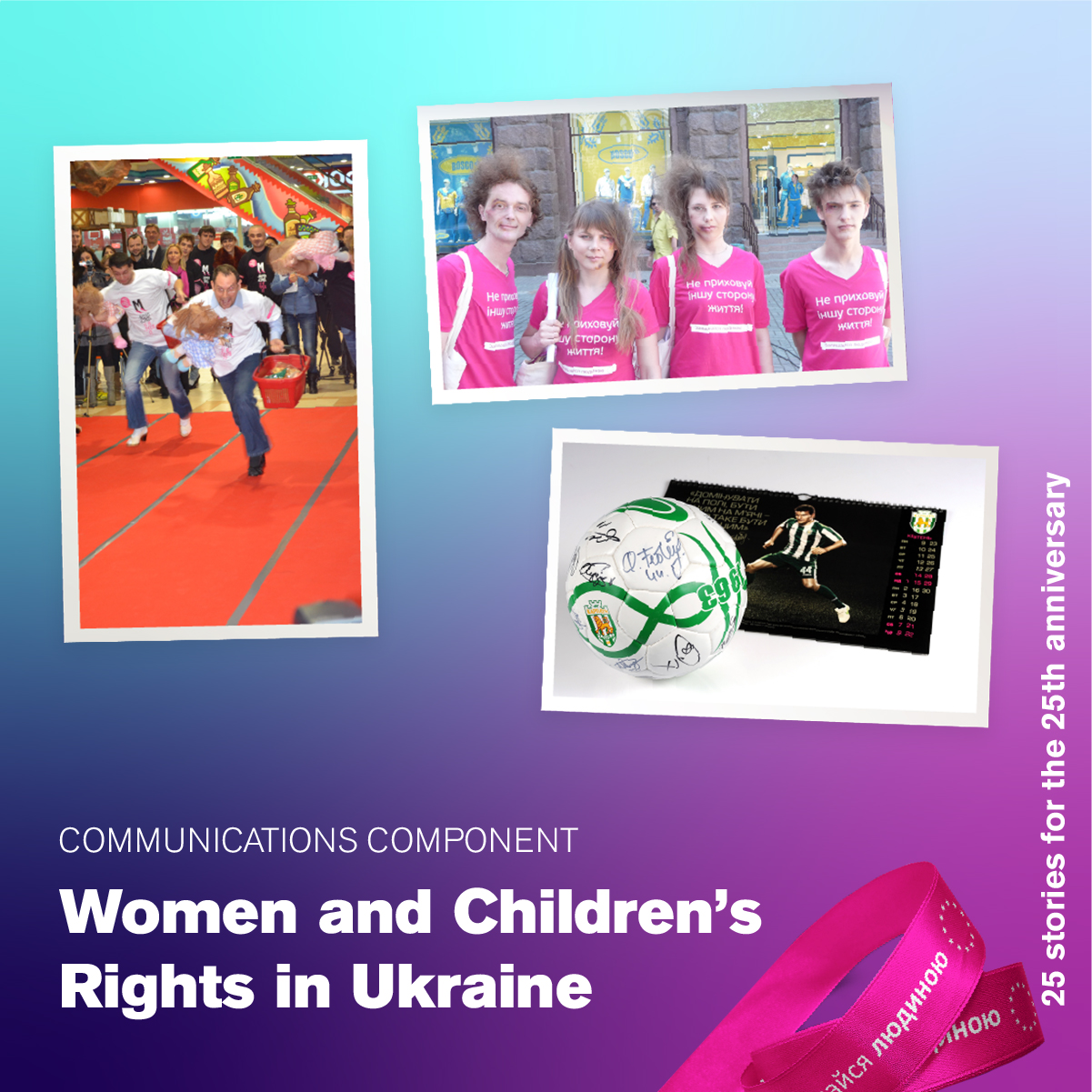
The campaign included outdoor and radio advertising, an online game on social media and various public events in 15 Ukrainian cities. In particular, we installed ‘monuments of humanity’ on the central streets of these cities – two inflatable hands held together symbolizing the unity of Ukrainians around overcoming the problem of domestic violence.
All these activities took place as part of our PR support for the European Union-funded project ‘Women and Children’s Rights in Ukraine: Communications Component (2009–2011).
We also produced and released a special calendar with players of FC Karpaty, which appealed to fans to reject violence (including messages like “Each of my shots is only for the benefit of my team” and “I hit the ball only”).
As part of the project, we organized and held a competition among companies called Equal Opportunities: Best Employer of the Year. The main goal of the competition was to push Ukrainian companies to ensure gender equality in their workplaces. After all, a company’s success does not depend on its employees’ gender.
2. MediaNext: From a New Media Project to a Community of Innovators
In the summer of 2011, more than 130 young applicants applied to the second MediaNext Summer School. Two gentlemen, Dmytro Pleshakov and Dmytro Bilash, then freshmen at the Faculty of Journalism of Kyiv National University, made it onto the waiting list, and they were accepted at the last moment, to our 5-day New Media School to learn the latest technologies in journalism. A year later, together with another student of the New Media School, Daryna Khimich, they launched the online magazine Brosko. However, the two friends’ real success was an artificial intelligence startup called Captain Growth founded in 2017, which they sold for $3.75 million to an Israeli company in 2019.
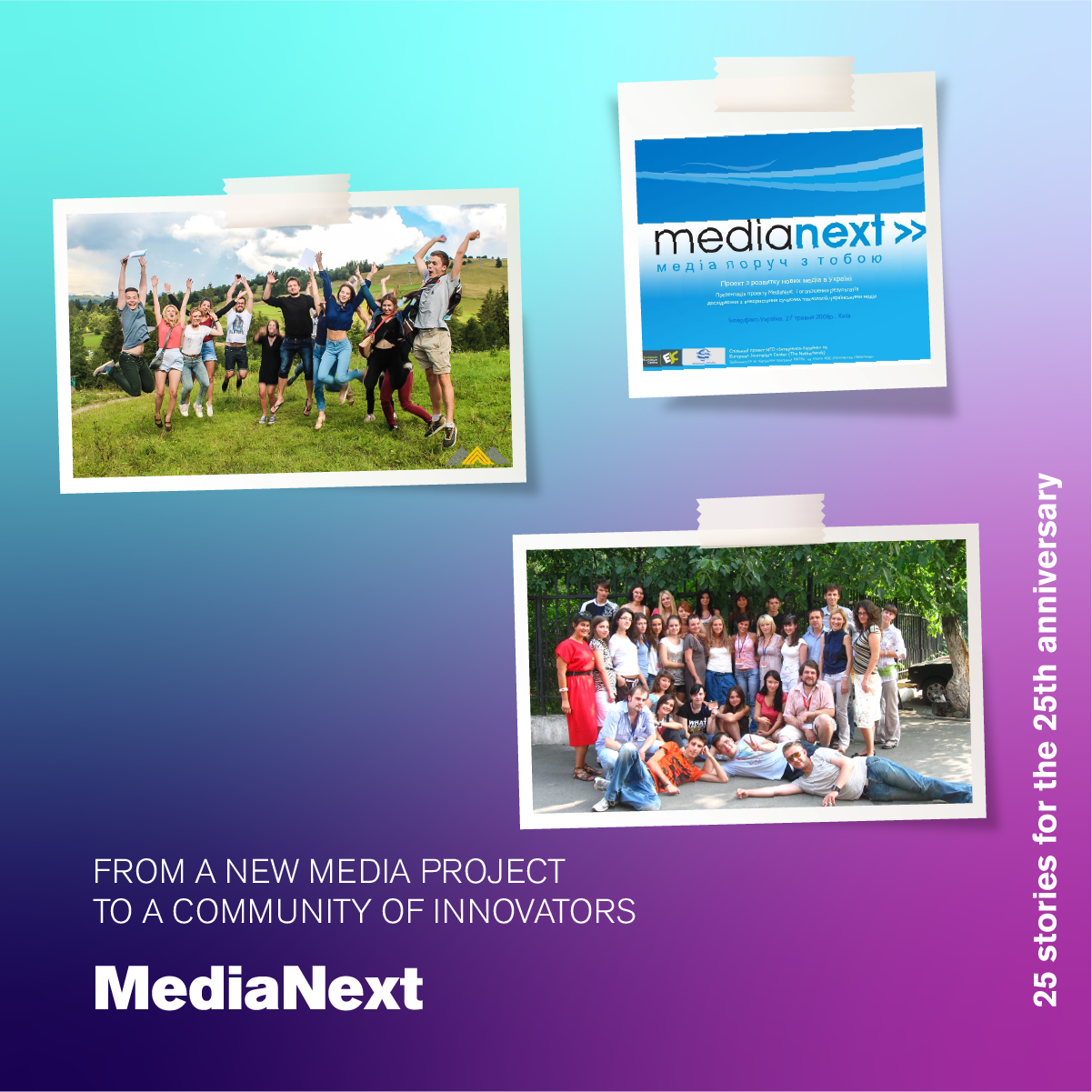
MediaNext started in 2009 and became the first large-scale project in Ukraine to help journalists get familiar with internet technologies and social media platforms, which were emerging at that time. We introduced media professionals to the unlimited potential of the online world, which today has become an integral part of our lives.
MediaNext members created a community of Ukrainian media innovators. They contributed to the use of Twitter during election observation in 2009–2015 (#elect_ua) and launched a series of creative ‘BarCamps’ called “Not-Conferences”. Members also took part in the #24hodyny hashtag campaign to create magazine issues in 24 hours at magazines including Bomjour, Bez Piaty, M&W and RE:STUDY. MediaNext created a generation of innovators who are successfully fulfilling their potential in many areas, from the media business to startups.
3. The #PrisonersVoice Augmented Reality App
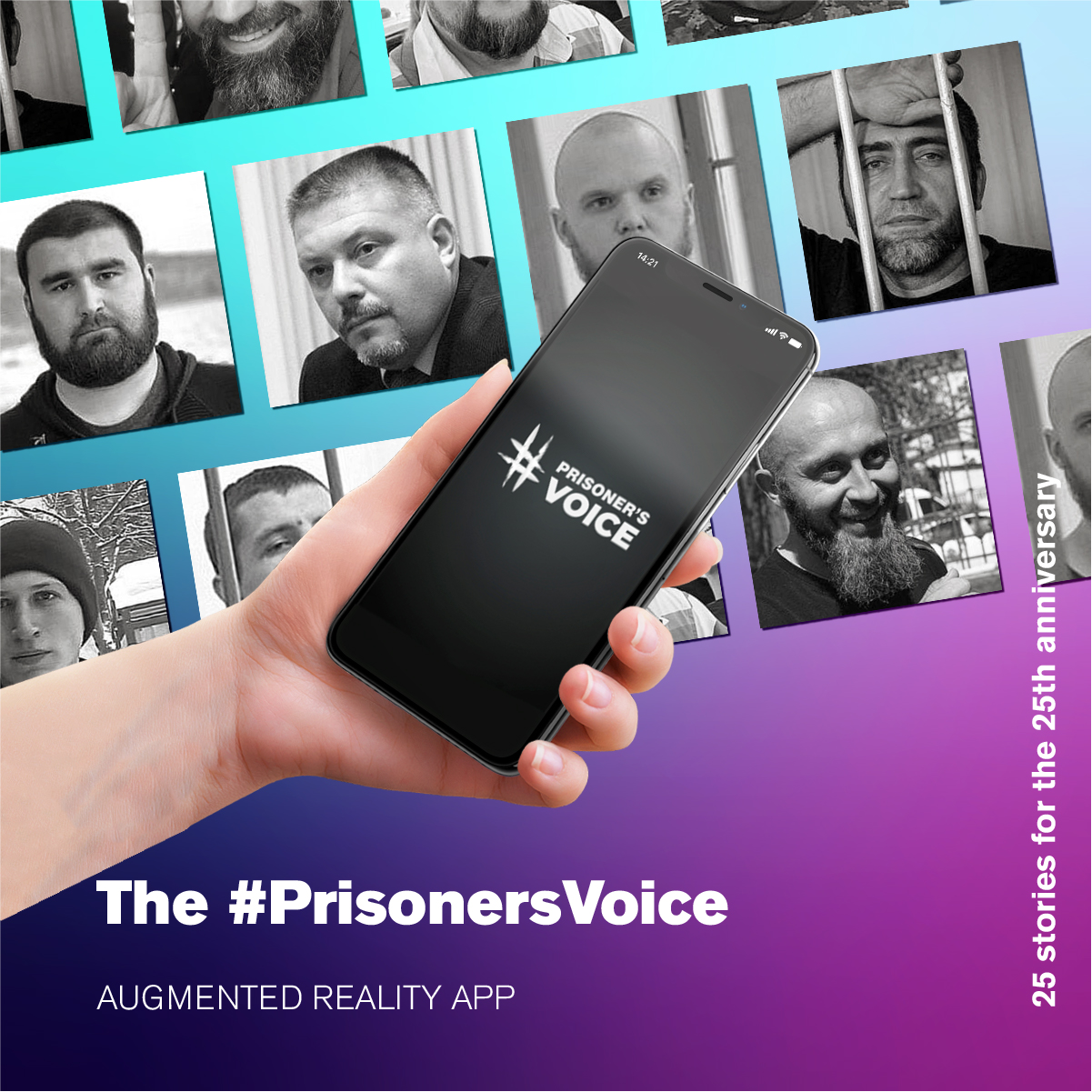
In 2020, the coronavirus became the world’s biggest issue. We decided to draw the world's attention to the Kremlin's prisoners, because the pandemic only worsened their situation. Oleg Sentsov, Volodymyr Balukh and Oleksandr Kolchenko, who went through the hell of Russian prisons, told us about their journeys from illegal detention back to Ukraine.
Their stories became the basis for the #PrisonersVoice augmented reality application. It is available in 5 languages (UA, EN, FR, PL, DE) on IOS and Android platforms at https://prisonersvoice.app/.
A powerful information campaign was launched around the application calling upon people to sign a petition in support of Ukrainian political prisoners. We reached 2.6 million users on social media, and European media outlets published 80 articles about the initiative. #PrisonersVoice is included in the list of the 15 best cultural projects of 2020 in Ukraine.
4. TrollessUA: Ruthless Hunting for FB-Trolls
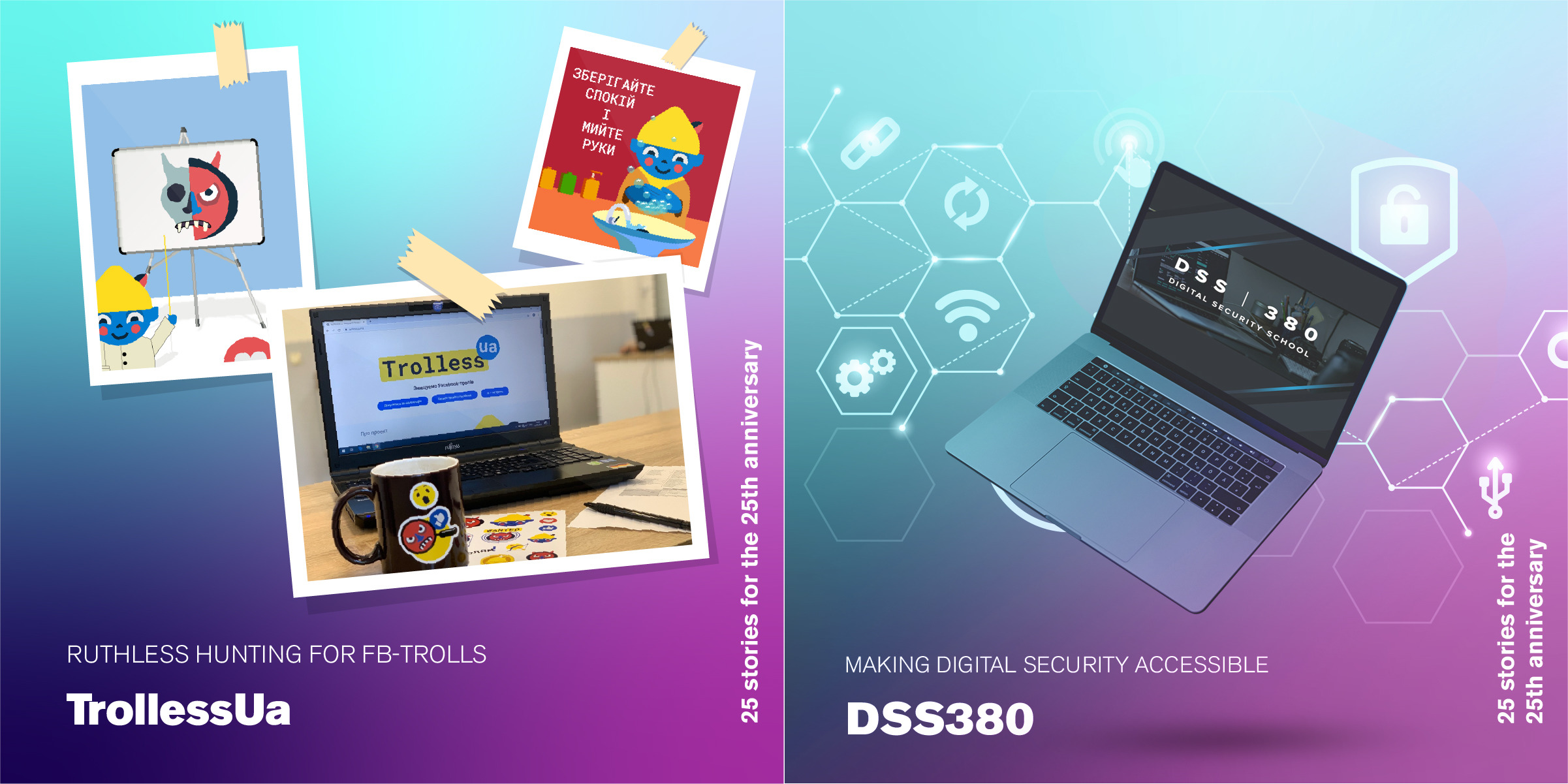
We firmly believe that manipulators, propagandists, fake accounts and bot farms need to disappear from our online space. That is why in 2019, we launched the TrollessUA initiative, aimed at cleaning up Ukrainian Facebook from trolls. We strive to achieve this goal with the help of:
- several hundred volunteers ‘cyber-elves’ who took an online troll detection course and contributed to a special database. As a result, we passed along 4.5 thousand malicious accounts to Facebook for deletion);
- A Google Chrome extension which warns users about informational threats from such accounts;
- A Facebook chatbot which helps to quickly check suspicious accounts and file complaints on them.
Since the start of the pandemic, the activity of anti-vaccine trolls has increased significantly. To combat them, we created an educational video. Please help us spread it, so we can take care of our information hygiene together!
5. DSS380: Making Digital Security Accessible
Pay by phone, work from home, shop online – the rapid development of digital technology has made our lives much easier. But the bad news is that life has also gotten easier for fraudsters. Data is the new currency of the 21st century, and it requires reliable protection.
In September 2015, we opened Ukraine’s first Digital Security School DSS380. We have taught hundreds of human rights activists and media professionals important digital skills and the know-how to protect their devices and accounts, safely communicate online and guard themselves against online harassment.
DSS380 experts have recorded an online course for a wide audience, they regularly conduct digital audits of Ukrainian newsrooms, offer comments for national media outlets and share useful tips on the Digital Security School 380 FB page.
6. Internet Freedom – Advocacy of Free Internet in Ukraine
30 million Ukrainians use the internet, representing two thirds of the country’s population. In addition to being a virtual space of freedom, the Internet has become a platform for abuse.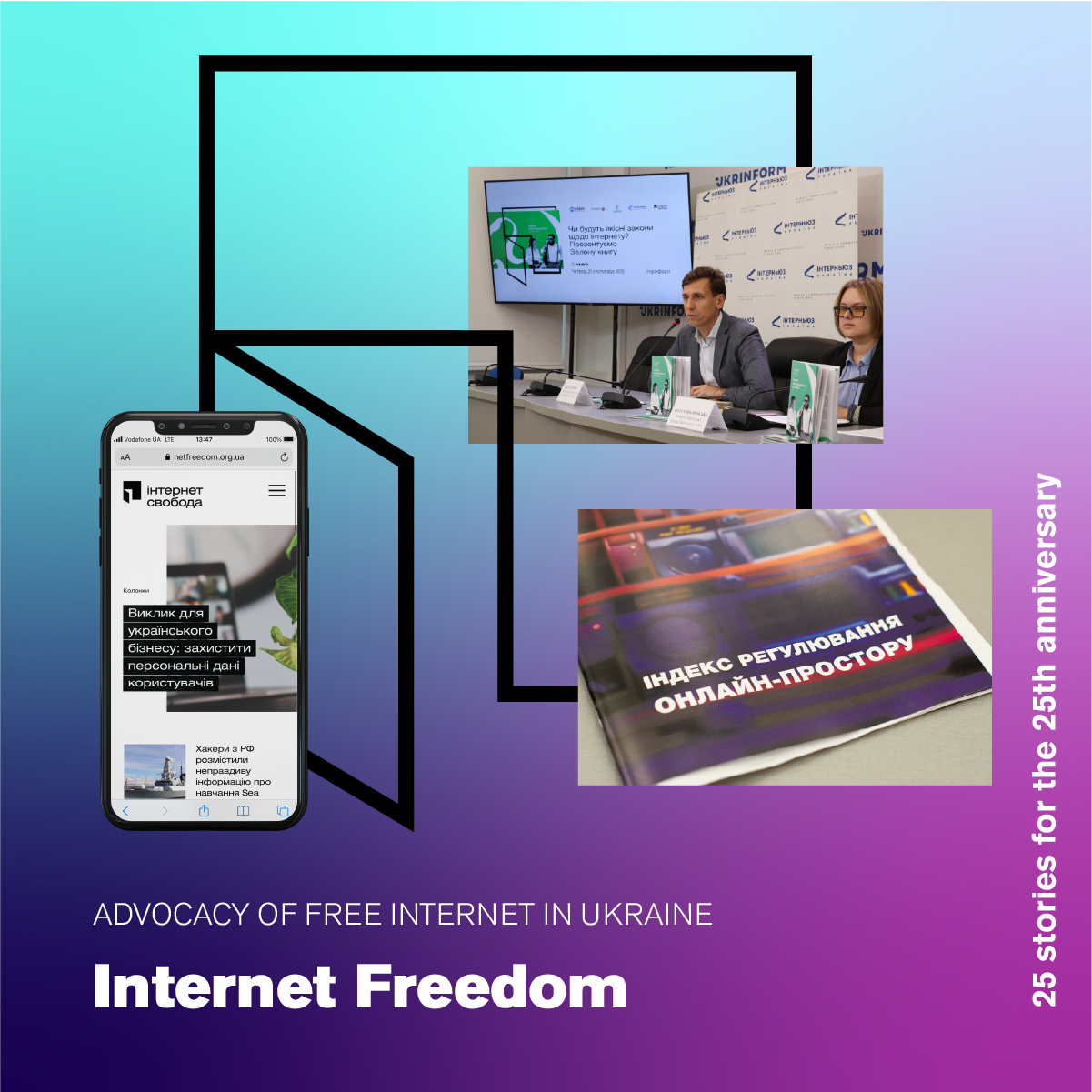
This is why there is a need for a "social pact" that regulates the behavior of users in the social networks and, at the same time, stands to protect their personal safety. In 2016, we launched the Internet Freedom project. Among its achievements:
- netfreedom.org.ua – the only web resource in Ukraine on Internet freedom;
- practical guidance on how to use the Internet in a way that avoids compromising sensitive military information on the front;
- development and signing of the Declaration of Free Internet in Ukraine;
- Successfully fighting against the scandalous bill №6688 (‘on censorship on the Internet’);
- development of the Legal Relations on the Internet green paper for legislators.
Subscribe to the Internet Freedom Ukraine FB page to help us promote the freedom of Ukraine’s internet!
7. Interactive Installation ‘Fit Your Life in a Valise’
In 2014-2015, thousands of people from Donbas were forced to leave their homes, fleeing into the unknown. Rebuilding their lives from scratch was full of difficulties, which often included prejudice from their countrymen. The topic of relations between internally displaced persons from the Crimea and Donbas and Ukrainians from peaceful territories is extremely sensitive, so we chose to take it on through art.
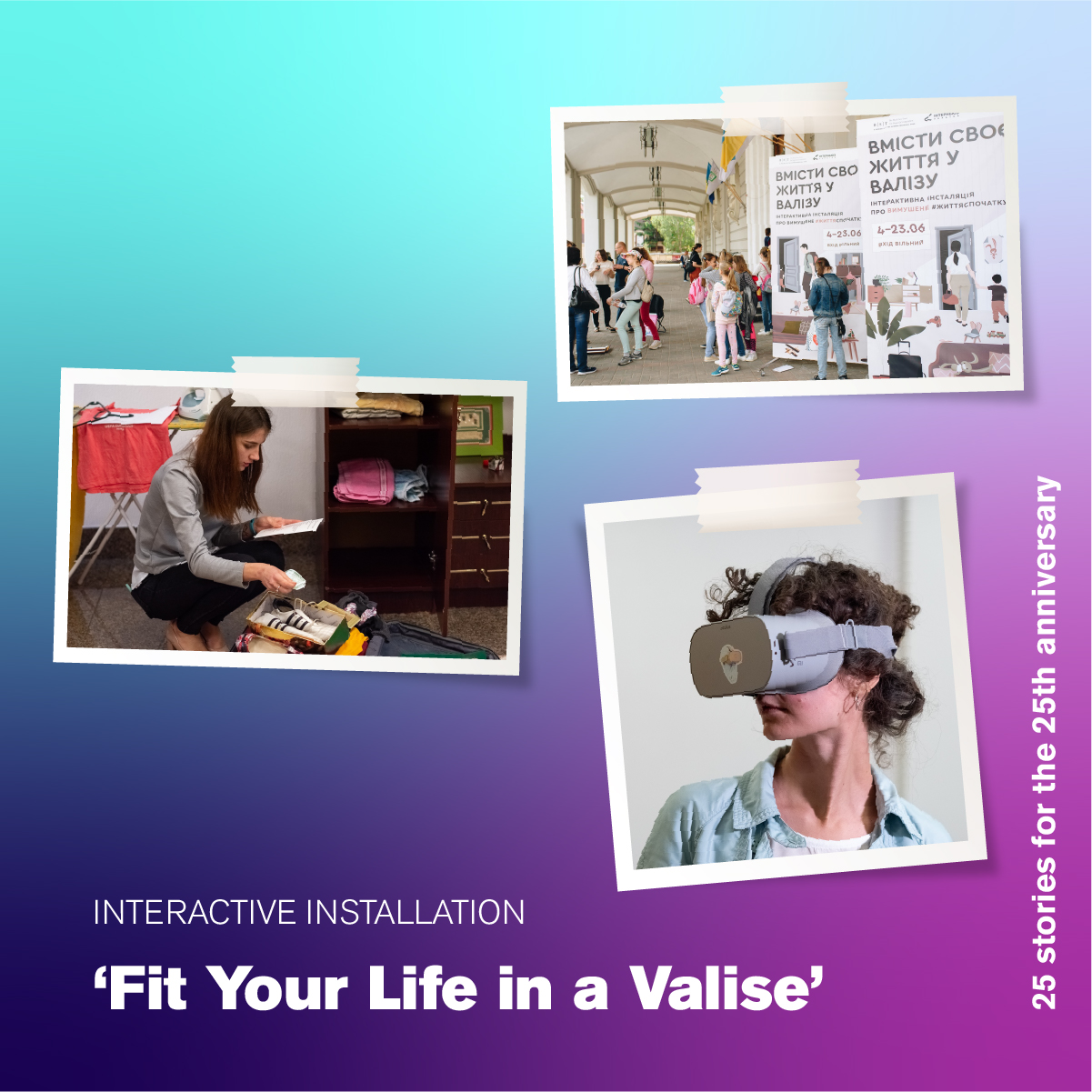
This is how we created the Fit Your Life in a Valise exhibition, which traveled through the cities of Kyiv, Lviv, Odesa, and Zaporizhia. Two interactive rooms created an effect of full immersion in the experience of IDPs. First, visitors had a limited period of time to collect a list of things to pack in their suitcase. After that, visitors used VR goggles to walk through typical locations that IDPs usually meet on their path: a government checkpoint, a train station, a social security office, a boarding house and finally a rented flat.
Due to the COVID-19 pandemic, the initiative had to move online. We adapted a 360 video so that everyone could feel the atmosphere of the installation virtually. Our Facebook campaign and 158 materials in the media reached more than 1 million users and brought the topic of IDPs back onto Ukraine’s public agenda.
8. Ukraine in Histories and Stories: Essay Collection
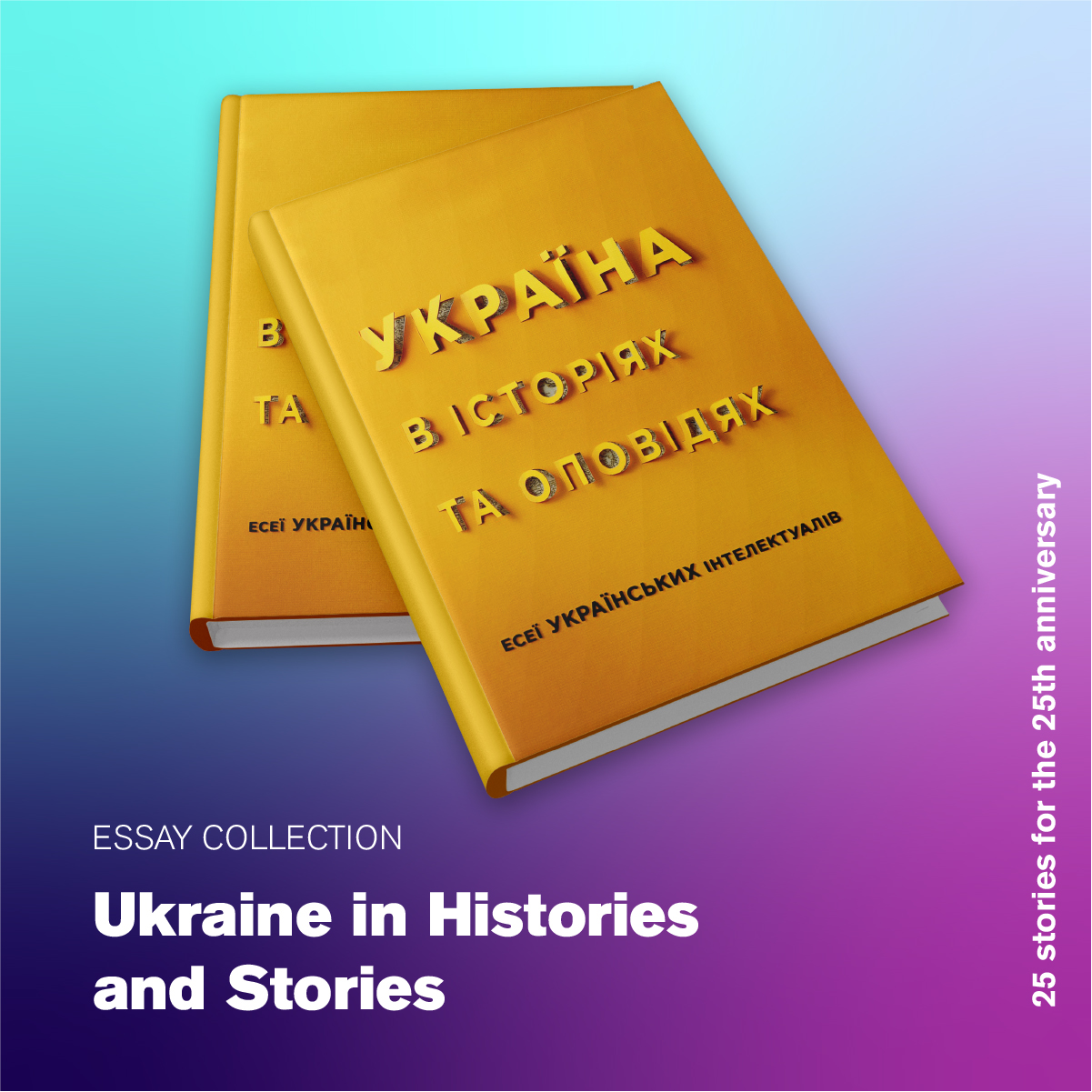
‘The book gives Ukrainians the opportunity to talk about their own country, and Ukraine appears extremely relevant at a time when so many countries are experiencing an identity crisis,’ wrote British author and commentator Peter Pomerantsev in his review of Ukraine in Histories and Stories.
We collected essays by Yaroslav Hrytsak, Yuriy Andrukhovych, Irena Karpa, Larysa Denysenko, Hanna Shelest, Volodymyr Yermolenko, Gaska Shiyan, Serhiy Plohiy and other Ukrainian intellectuals under one cover.
To make Ukraine more understandable to foreigners, we presented the book in nine European cities. Residents of London, Paris, Berlin, Brussels, Strasbourg, Warsaw, Frankfurt am Main, Frankfurt an der Oder and Kyiv were able to interact with the authors and receive a hard copy. The book is available in e-format in Ukrainian and English.
9. ‘The Limits of Waiting’, ‘The Return’: Documentaries
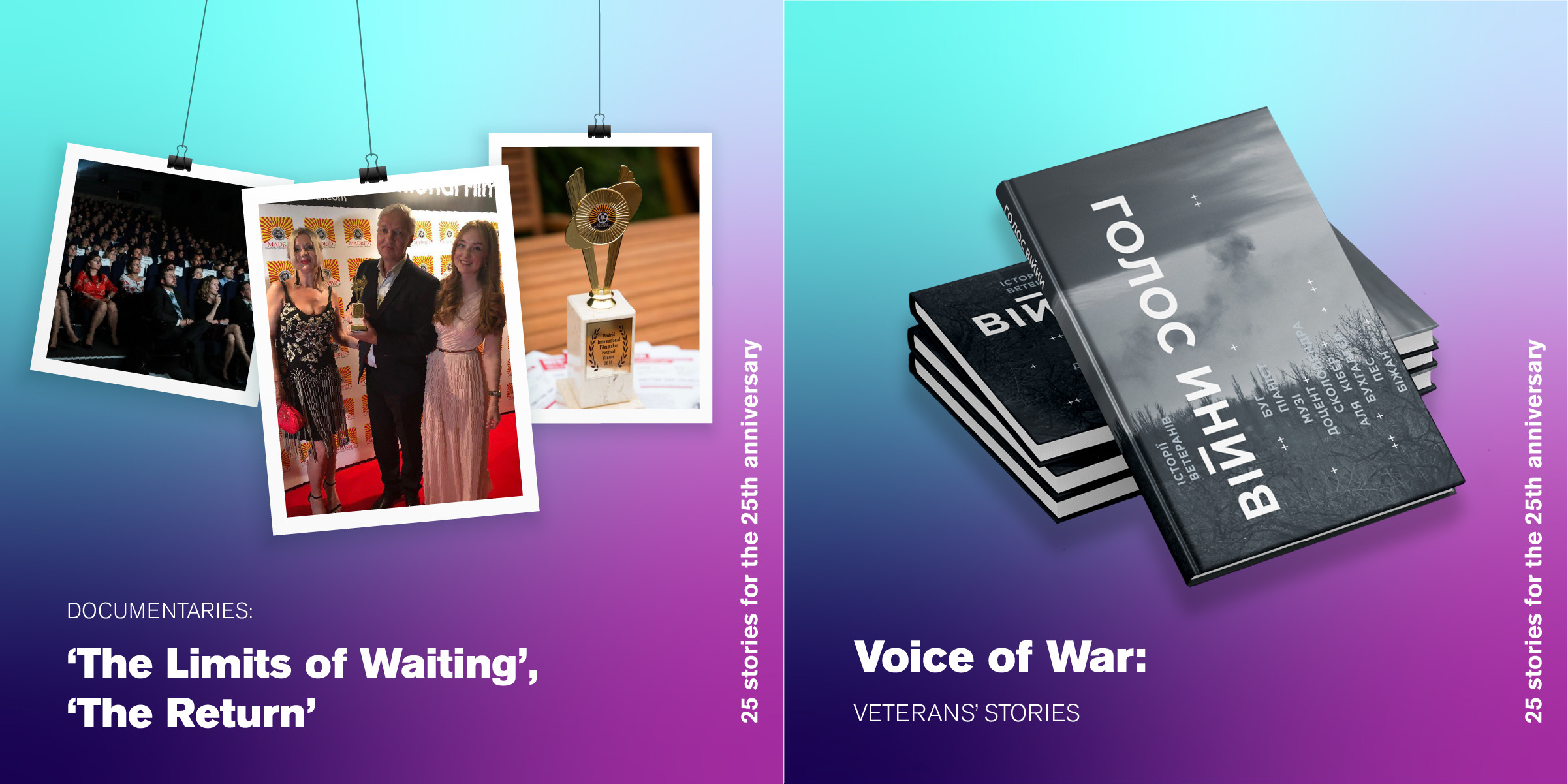
How do you return to normal life after war? How can you dream of the future when severe injuries and psychological trauma are now with you forever? The documentary series The Return tells four real stories from the lives of volunteers and veterans of the ATO who managed to overcome despair and find themselves after the hell of armed conflict.
In another film, The Limits of Waiting, we were one of the first groups to raise the problem of prisoners and missing persons in Donbas and Crimea as a result of Russian aggression. “I realized that someone had to start, to raise this issue, and that is why I agreed to go through all this pain again, regardless how difficult it was,” explained one of the film's subjects, Kateryna Khomyak, the mother of two missing brothers who defended Ukraine in Donbas.
Almost a year later, on July 12, 2018, the Verkhovna Rada passed an important and necessary law ‘On the Legal Status of Missing Persons’. Meanwhile, on July 28, 2018, The Limits of Waiting received international recognition, with director Stanislav Tsekhmistrenko winning at the 8th Madrid Film Festival’s prize for Best Foreign Language Documentary Director.
10. Voice of War: Veterans’ Stories
The public often does not understand what veterans of military actions in Donbas have been through. Sometimes, we are simply afraid to ask. In 2017, we decided to create an opportunity for veterans to speak, and for society to hear about the war without filters. This is how our project, Voice of War: School of Journalism for ATO Veterans, got started.
We developed a special writing course for veterans. Among the trainers were Serhiy Zhadan, Kateryna Babkina, Rostyslav Semkiv, Michael Schur, and Roman Zinenko. After two months of training, the veterans completed their own stories, and we published 29 of them in the book Voice of War: Veterans’ Stories.
The book gave Ukrainians the opportunity to learn more about the people who defended them. The voices of the veterans were honest and without distortion. The book didn’t appear only in Ukraine: in Spring 2018, it was presented at the International Book Salon (Salon du livre) in Paris. The e-book is available in PDF and EPUB formats.
11. VR-installation Propagandarium
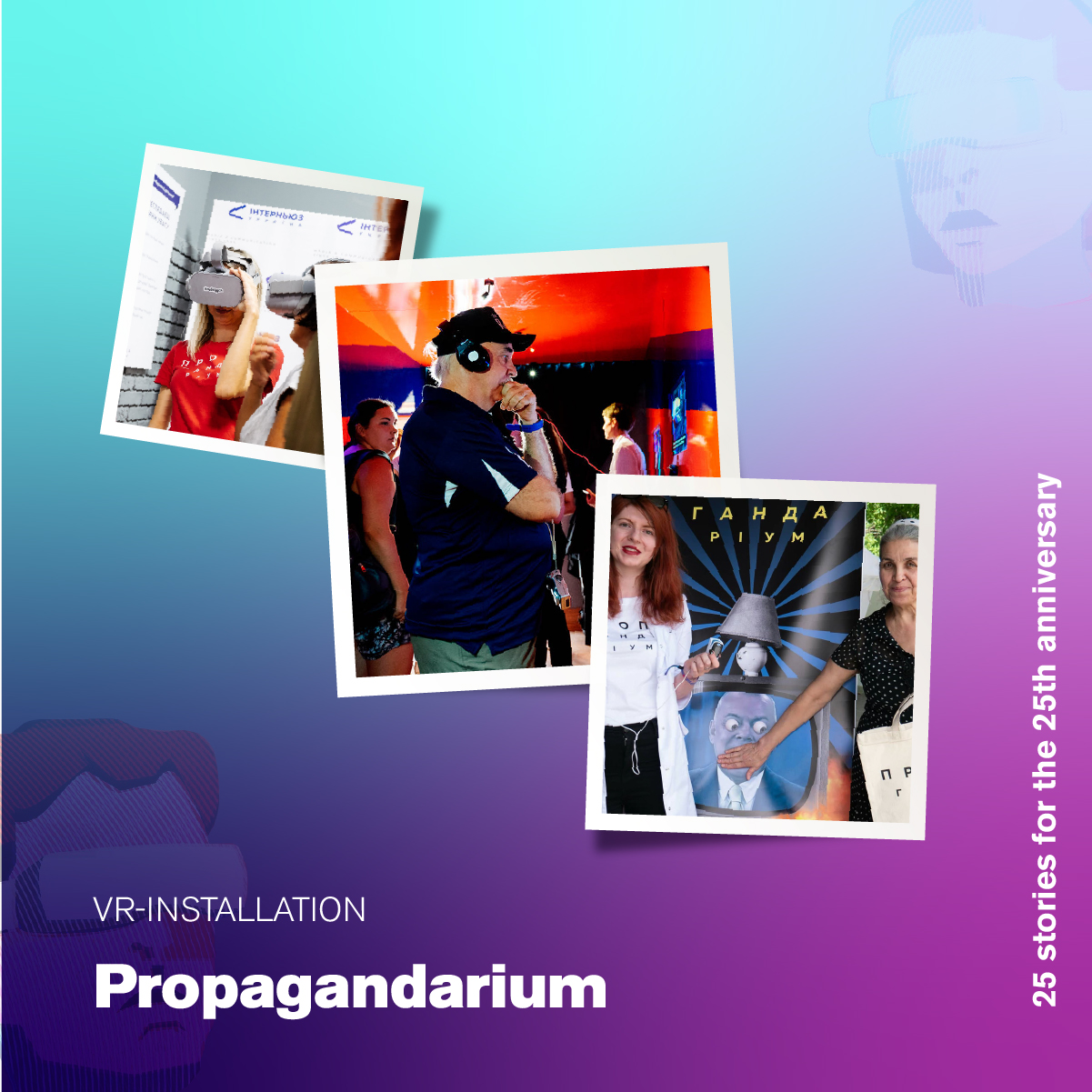
Russia's hybrid aggression requires Ukraine to protect not only its borders, but also its information space. In order to popularize media literacy, we chose to use infotainment (information and entertainment). Thus arose our Propagandarium installation with two interactive rooms: a Museum of Propaganda and a Media Literacy Room.
The installation was staffed by “fakeologists.” Using a “fake-ometer”, they measured visitors’ disinformation exposure in units called “Kiseliovs” (named for Dmitry Kiseliov, Russian media’s most prolific disinformer). The joke put visitors at ease and encouraged a more positive perception of information. Using VR goggles, they watched 360-video, explaining the narratives of Russian propaganda about Ukraine.
More than 2300 guests visited our interactive VR installation in 7 cities of Ukraine. 114 pieces about the project were published in media outlets, including 17 TV stories. In an easy and entertaining way, we were able to teach Ukrainians about the features of fakes and the rules of media hygiene.
12. ‘Words and Wars’, ‘Taming the Hydra’: Ukraine's experience for the world
‘This book will help me explain to British politicians and public opinion leaders things that Ukrainians now understand very well’, British Times columnist and former Economist editor Edward Lucas said about the book ‘Words and Wars: Ukraine Fighting Kremlin Propaganda’.
This book was published in December 2017 and presented at the Council of Europe (in Strasbourg) and for institutions and experts of the European Union (in Brussels). For the international community, this is the first practical manual based on Ukraine’s experience as a country currently going through a prolonged information attack.
The book was followed up by the publication ‘Taming the Hydra: How to Resist the Kremlin’s Information Aggression’, We presented it in Kyiv, Brussels and Berlin. This document proposes systemic steps to be taken at the international and national levels to counter Russia's information attacks.
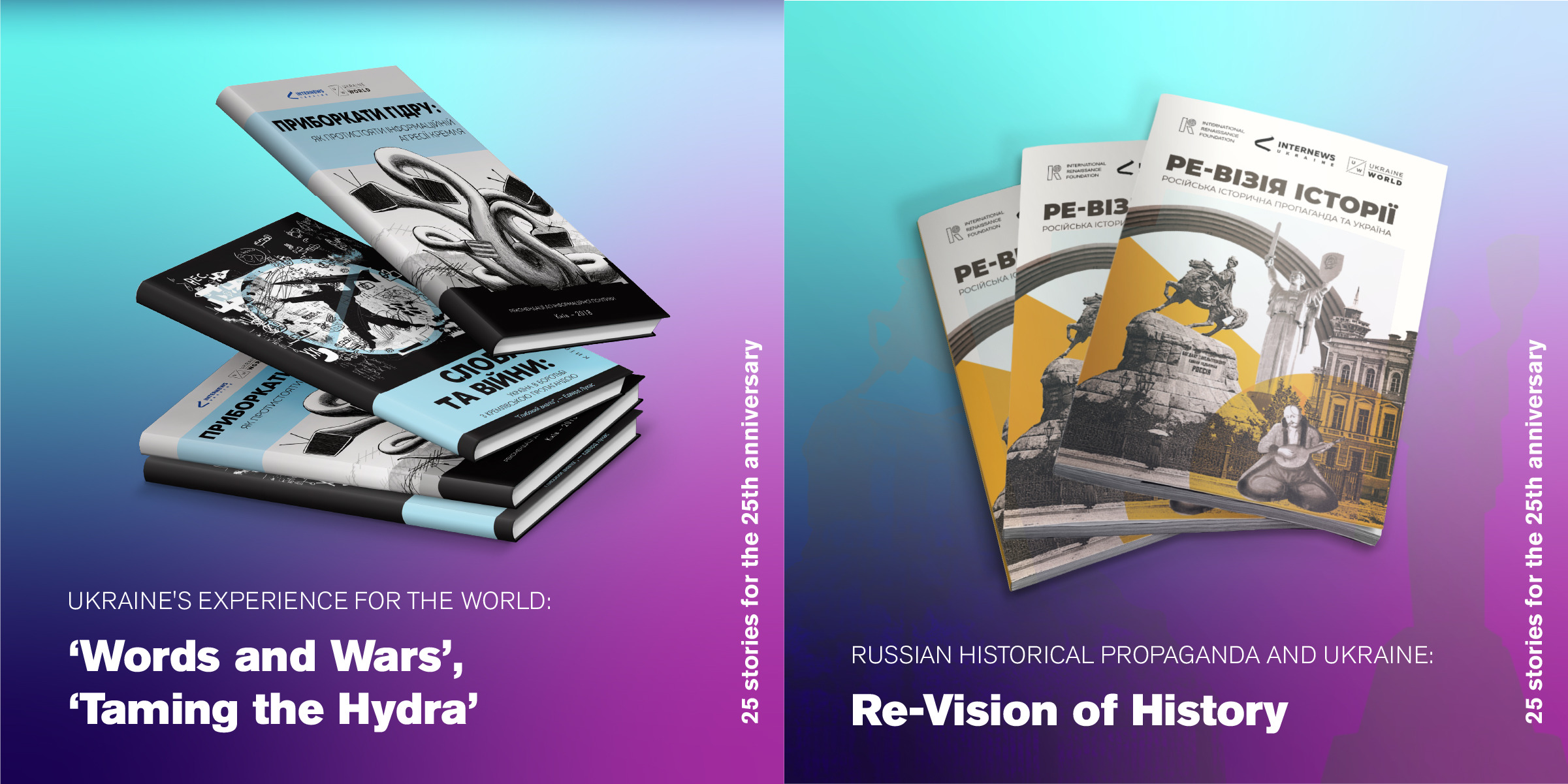
13. Re-Vision of History: Russian Historical Propaganda and Ukraine
Trying to rewrite history and explain it for their own purposes, Russian propaganda uses outright lies, manipulations and fake narratives. Some of their favorites include "Ukraine is an artificial project of the West", "All Ukrainian nationalists were fascists", and "Crimea has always been a part of Russia".
We analyzed more than 850 thousand posts from VKontakte and 16 thousand posts from Facebook to identify the main narratives of Russian propaganda and analyze them, relying entirely on historical facts. For this purpose, we asked Ukrainian historians – Yaroslav Hrytsak and participants of the project ‘LikBez. Historical front’ – to comment on Russia’s narratives. All these were included in the book ‘Re-Vision of History: Russian Historical Propaganda and Ukraine’. The e-version is available in Ukrainian and English.
To make the project interesting for ordinary social network users, we prepared an interactive online test. It has been taken by almost 100 thousand visitors to the website. In addition, the #HistoryReVision Facebook campaign has reached about 50,000 users.
14. Memocracy: Social Media Research During Elections
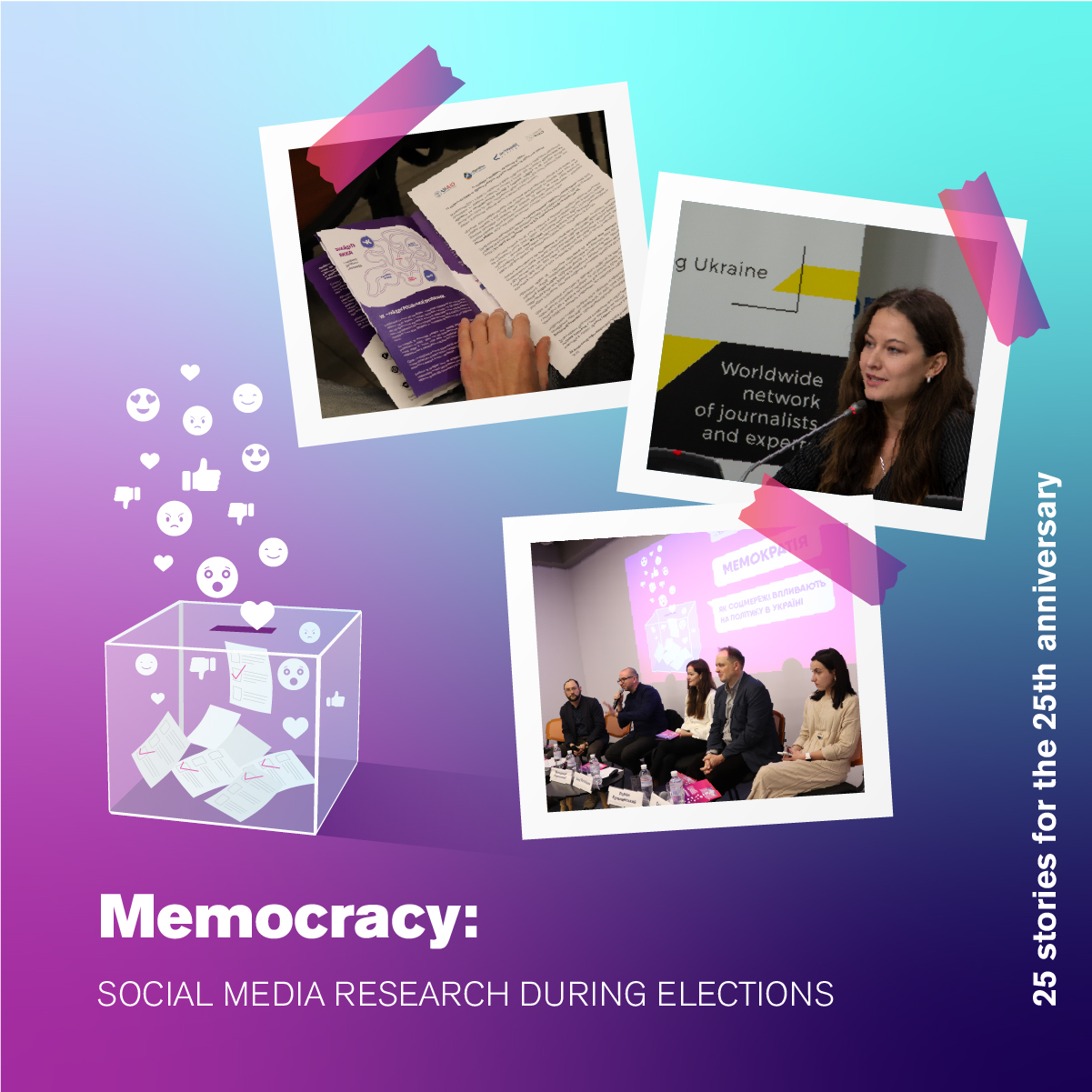
2019 was a big year for elections in Ukraine, with two rounds of presidential voting and then voting for the parliament. We decided to investigate how the online activity of Ukrainian users of Facebook, Instagram and VK affected election results. To do this, we analyzed tens of thousands of posts about politicians, parties, the 2019 elections and the work of the Verkhovna Rada. Our data was collected using neural networks and artificial intelligence.
- Facebook turned out to be the most politicized, as every 8th Ukrainian wrote something about the elections there.
- Facebook was also the most polarized during the election campaign.
- VK was dominated by pro-Russian forces and hate speech against everything Ukrainian.
- The Zelensky campaign handily surpassed other parties in popularity on Instagram.
- All social media platforms created bubbles that intensified polarization.
See more of our findings in our video.
We held three presentations on the results of our research for different periods and discussed them with political communication specialists and analysts. The project received 137 mentions in the media and 125,000 coverage on social media.
15. Crisis as an opportunity: online course for editorial offices
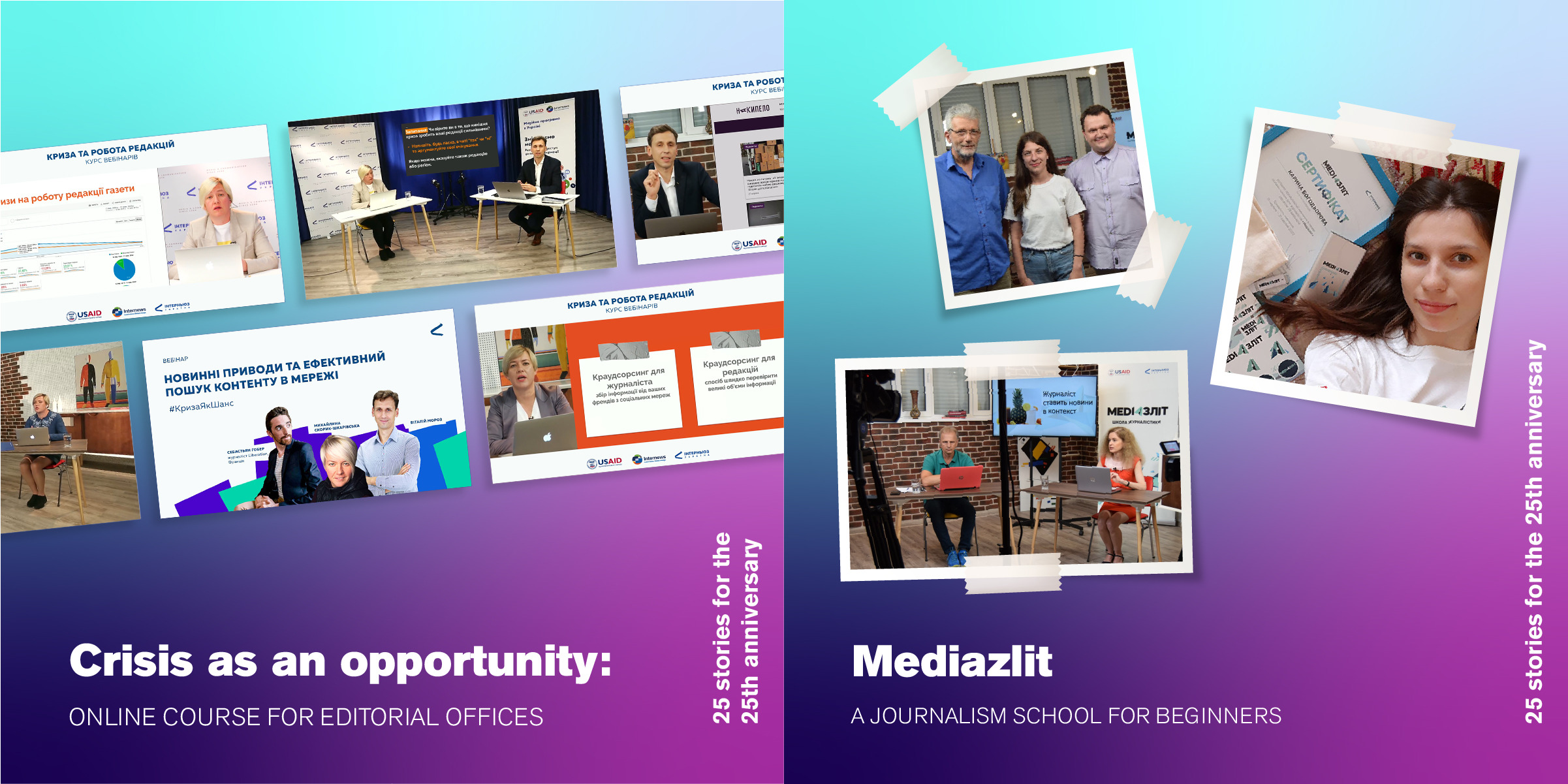
In 2020, the COVID-19 pandemic forced media outlets into a dramatically new reality. Advertisers reduced budgets, lockdowns made it difficult to prepare TV spots, and working from home became the new norm. To help newsrooms adapt to the new conditions, we developed and organized an online course called Crisis and the Work of Editorial Offices: Implementing Opportunities for Journalists.
Course trainers and journalists from the BBC, Figaro, Liberation, Voice of America, Deutsche Welle, and RFE shared their experience of working during the pandemic. 172 media workers immersed themselves in topics like monetization, new content formats, work with social media platforms and other topics relevant to making journalism work during the pandemic.
All 24 video tutorials are available online and have already received over 80,000 views. We are extremely happy that our online course has been able to help journalists to work around the pandemic crisis and emerge as stronger professionals.
16. Mediazlit: a journalism school for beginners
Regional journalists in eastern Ukraine play an important role in preserving the country’s information space. To support them professionally, we organized a summer online school called Mediazlit (MediaRise) in 2020.
29 experienced media experts and well-known journalists conducted 29 webinars for the participants with a total duration of 65 hours. One of the most popular was a workshop by Roman Vintoniv (Michael Schur), which reached more than 75,000 Facebook users.
In addition to training, participants successfully prepared media materials with the support of mentors. 45 beginner journalists graduated from the Mediazlit online school. One of the participants got a job at Bahmut.in.ua after publishing her course material there, and another student has been developing her own podcast.
Ukrainian journalism is really taking off, and we are delighted to be playing a role.
17. Ukrainian Regional Media Guide
We have 25 years of history, relationships and expertise in working with Ukraine’s regional media, so we decided to share these things with the world by creating our Ukrainian Regional Media Guide (2020, 2021).
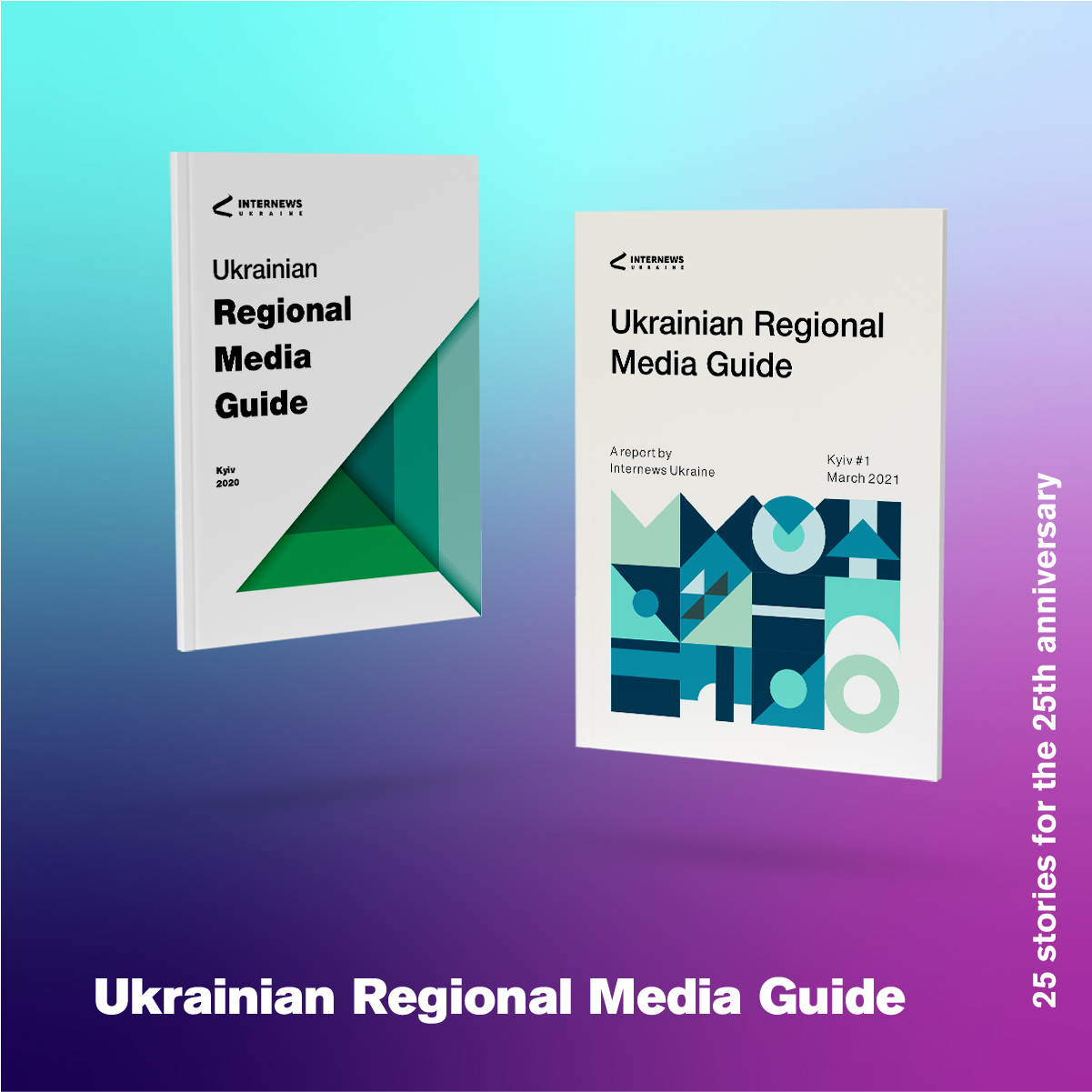
It is based on a review of more than 400 regional media outlets in all 24 regions of Ukraine, including the temporarily occupied territories.
The document contains exclusive information about official media owners and individuals who influence the work of regional media in Ukraine. It also features new regional newsrooms that have emerged or become more popular in recent years.
In separate thematic reviews, our analysts examined the impact of the coronavirus pandemic on the media landscape of Ukraine, as well as how politicians used social media platforms during the 2020 local elections.
18. European Integration for All: Building Europe in Ukraine
The Revolution of Dignity made Ukraine’s course towards European integration irreversible. On September 16, 2014, the European Parliament and the Verkhovna Rada of Ukraine simultaneously ratified the Association Agreement between Ukraine and the EU. The content of this 2,000-page document was poorly understood by Ukrainians. That is why our experts
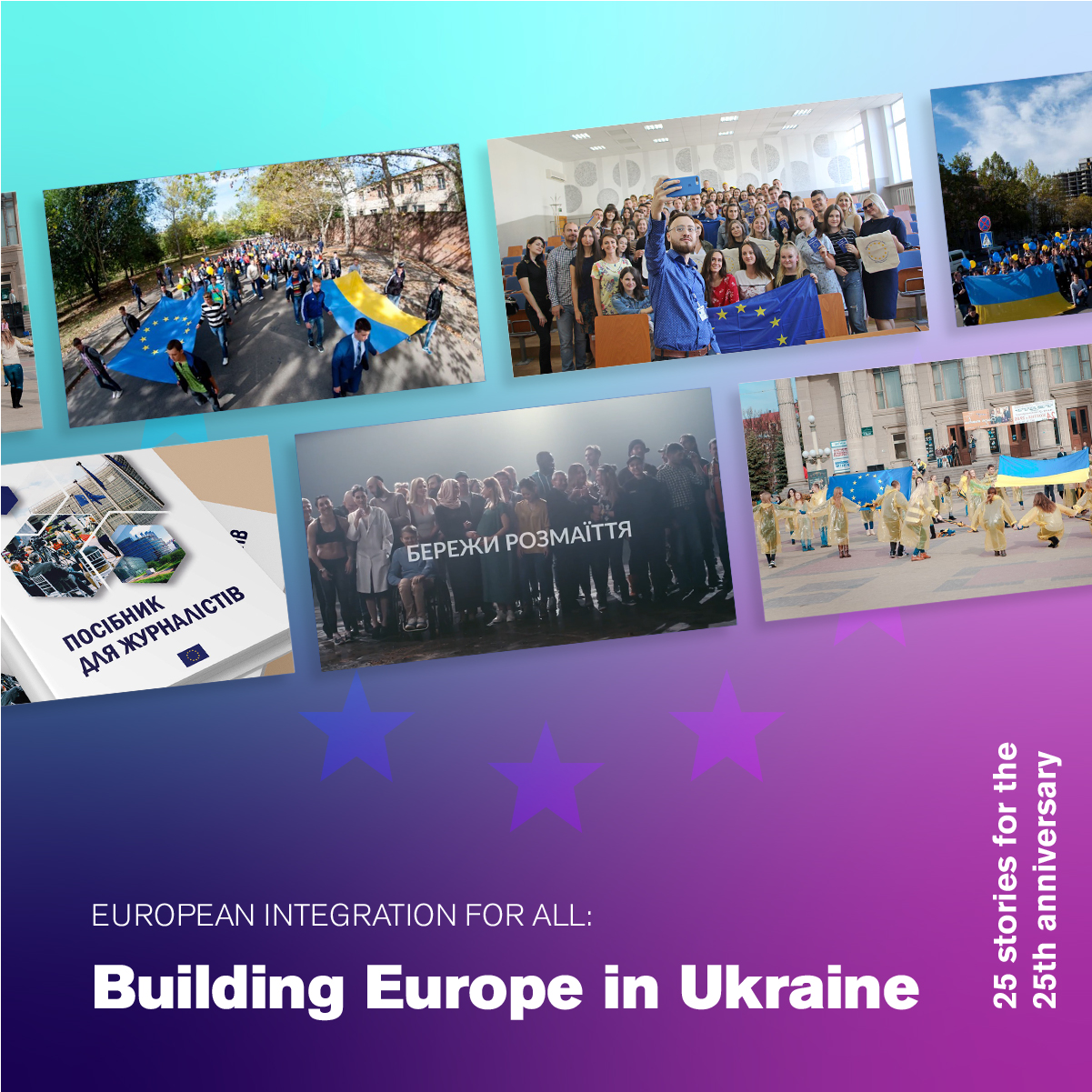
- explained to the public the essence of the Agreement along with regional journalists, producing 500 media items;
- developed the Strategy for Communicating Ukraine's European Integration, which formed the basis of a government document.
For 7 years, the Building Europe in Ukraine project traveled in various formats to regional centers and small towns, so that as many Ukrainians as possible learned about the opportunities of the EU. We held hashtag campaigns, hackathons and street events for the public, as well as seminars, lectures and round tables for local authorities, businessmen, journalists, educators and students in all parts of the country.
In order to inspire Ukrainians to follow European values, we prepared a series of motivational videos. One of these videos – Respect Diversity: Different But Equal – went viral, gathering more than 100,000 views on Facebook.
19. UkraineWorld: Explaining Ukraine to the World
After the annexation of Crimea, the start of aggression in Donbas and the downing of MH17, Russia’s propaganda machine became especially active, spreading falsehoods about Ukraine around the world. In 2014, we launched an international analytical group called UkraineWorld. This volunteer initiative united key Ukrainian and international experts and journalists interested in covering the situation in Ukraine objectively.
Discussions from this volunteer group resulted in the creation of the English-language outlet UkraineWorld.org, which publishes articles, infographics, video materials, and podcasts about Ukraine. Articles and comments by UkraineWorld journalists are regularly published in foreign media outlets, including The New York Times, Atlantic Council, Radio Free Europe/Radio Liberty, New Eastern Europe, Novator.az, Arqument.az, newsday.ge, and Ukraine Verstehen.
We strive to explain Ukraine to the world, and you can always help us with your likes and shares. Join the 18,000 users who have already followed UkraineWorld's Facebook, Twitter and Instagram pages.
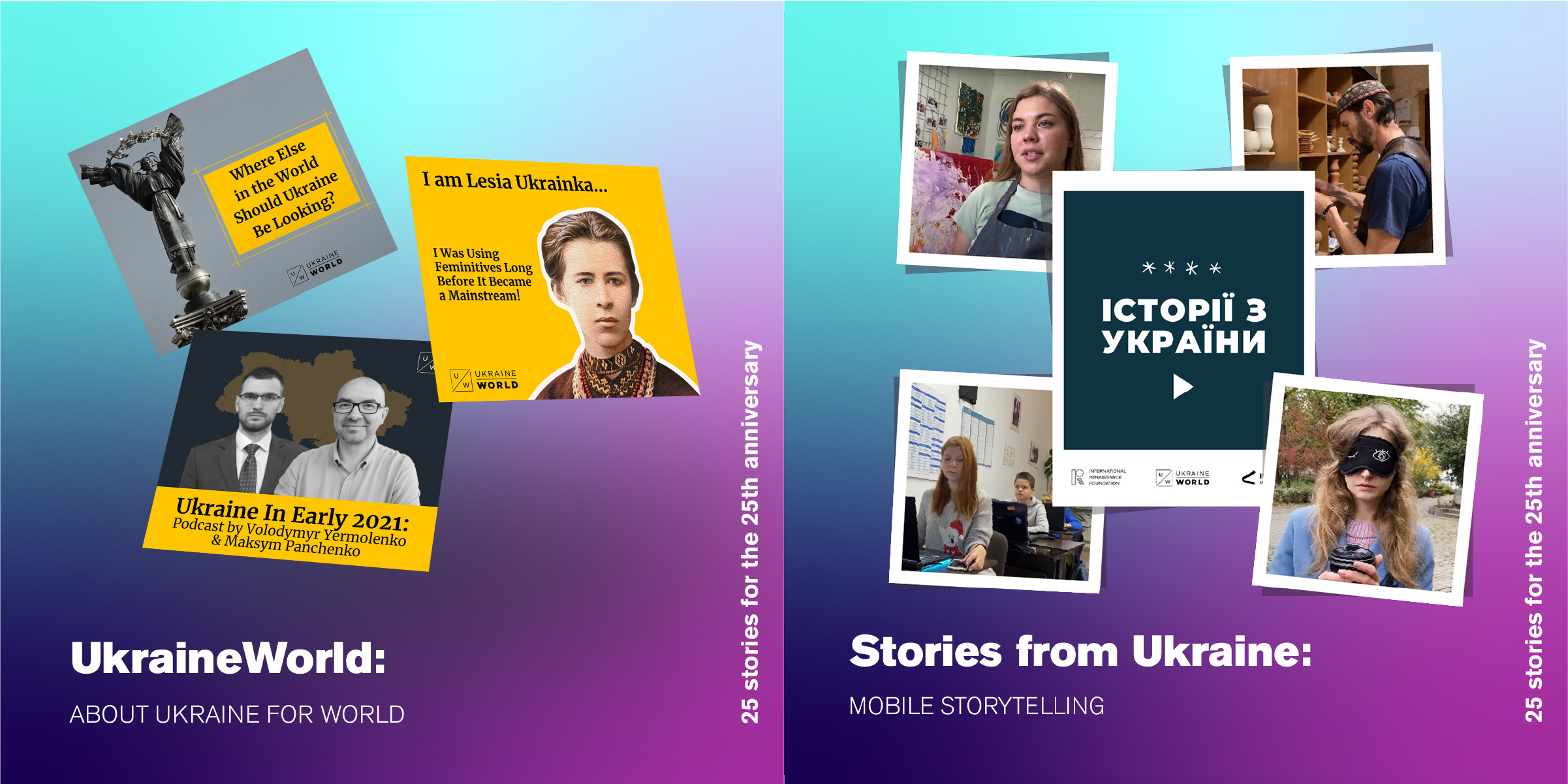
20. Stories from Ukraine: Mobile Storytelling
Unfortunately, for many foreigners, Ukraine is synonymous with war, corruption, poverty and Chornobyl. To break the stereotypes and negative perceptions of Ukraine abroad, we launched a mobile storytelling project called #StoriesFromUkraine.
Its goal is to show the world that Ukraine is a country of amazing people, a free and proactive youth, technological development, anti-corruption and environmental initiatives, protection of human rights, and fighting for freedom and success. We showed all these things in 60 videos, which are available on Facebook.
An Odesan making creative things from plastic waste; a Donbas band opening the world of music for visually impaired people; A man from Lviv founding a food bank for the poor – these are just some stories about ordinary Ukrainians who are doing extraordinary things. See these and other stories on our YouTube channel.
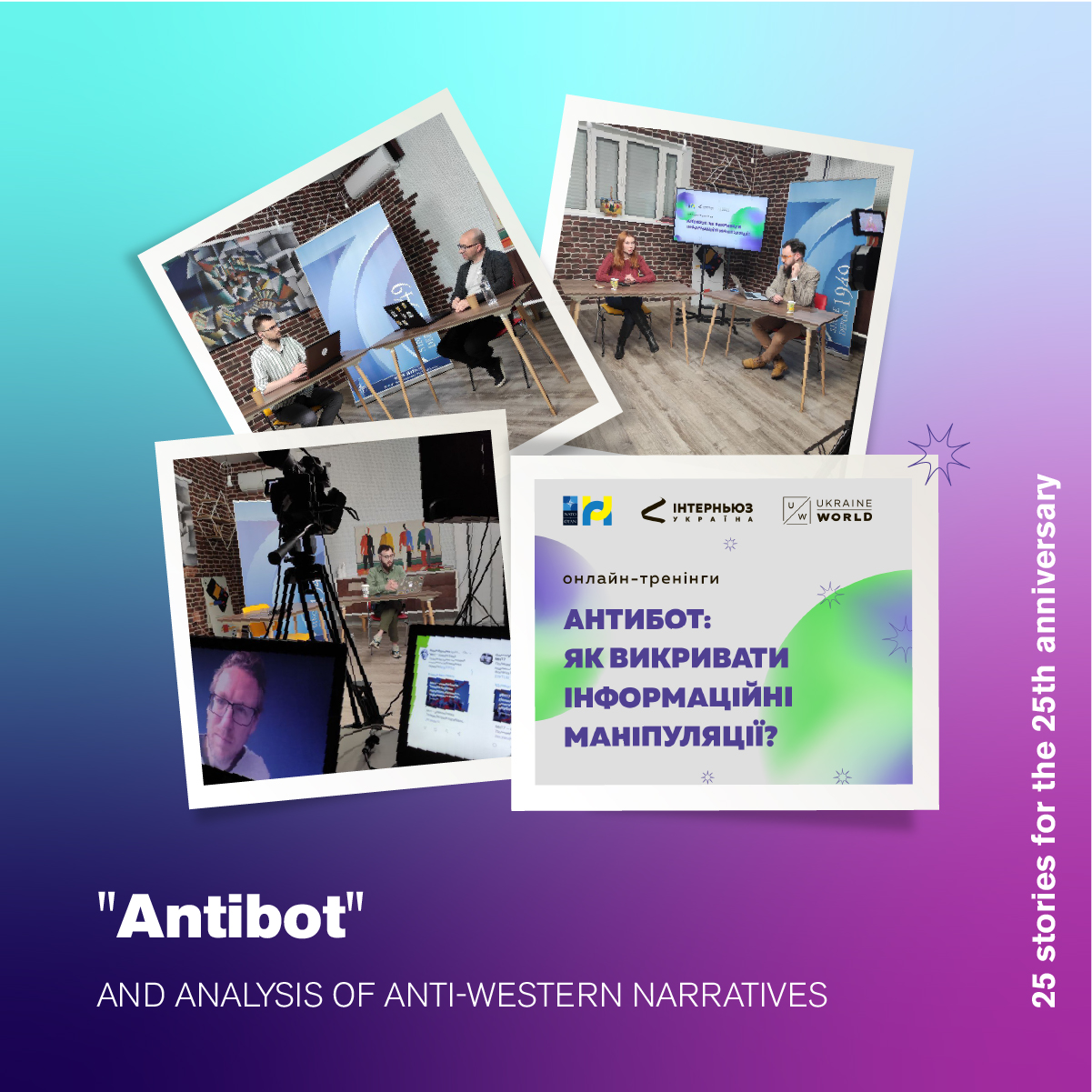
21. "Antibot" and Analysis of Anti-Western Narratives
"Soros and the IMF are trying to plunder Ukrainian lands!" "US Biolaboratories in Ukraine are conducting experiments on humans!" Fakes like these have been actively spreading in the Ukrainian information space in recent years. Our analysts thoroughly study anti-Western narratives in Ukraine and regularly publish their own research:
- How Anti-Western Actors in Ukraine Are Using Pro-Russian Troll Armies to Push Their Agenda;
- How Kremlin Fans Are Trying To Discredit the MH17 Investigation On Twitter;
- What Anti-Western Actors in Ukraine Are Saying About the Protests In Belarus;
- Why Conspiratorial Propaganda Works and What We Can Do About It.
Also, our experts developed an "Antibot" instructional module to combat fake news and disinformation. Experienced instructors from the Czech Republic, the Netherlands, Lithuania, and Ukraine train Ukrainian journalists and analysts to professionally uncover bots, fakes, and manipulation campaigns (particularly those of Kremlin origin). Based on the training content, we prepared a detailed summary with useful tips and tools.
22. Communicating Reforms: Making the Complex Simple
Explaining reforms is no less important than implementing them. After all, without good communication, we can’t hope to garner support for changes. Our experts know how to be clear and convincing when it comes to transforming the way Ukraine works. We are proud that our communication support has contributed to the success of:
- public administration reform;
- the "New Ukrainian School" reform;
- parliamentary reform (strengthening the communication capacity of the Verkhovna Rada’s committees);
- reform of the non-banking financial sector;
- decentralization reform (in terms of impact on national minorities);
- European integration processes.
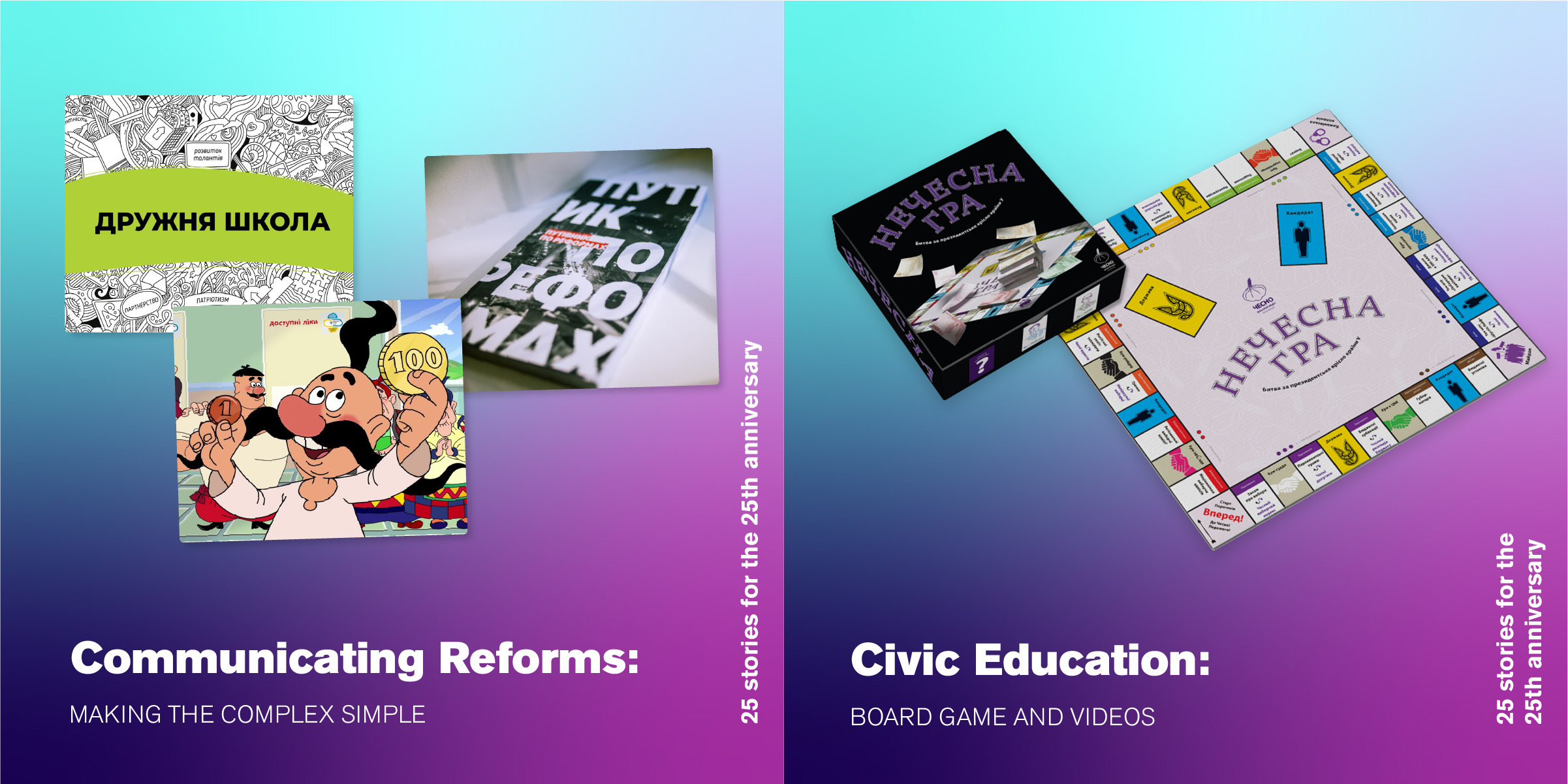
With the help of characters from the popular cartoon How Cossacks…, we explained Ukraine’s health care and energy reforms. The campaign reached around 60% of the entire country and helped boost support for reforms in the society. In 2017, we published our comprehensive Reform Guide with analysis of 17 key transformations in Ukraine.
As part of the EU project PRAVO-Justice, we prepared a communication strategy for the Ministry of Justice based on psychosemantic research. With a light and refreshing style, we explain to people such complex topics as the probation service and private executors.
23. Civic Education: Board Game and Videos
In 2011, we helped initiate the CHESNO Movement and were responsible for its communications activity. To show the manipulativeness of election technology in Ukraine at that time, we chose a creative way and created a board game, "Unfair game. The battle for the presidency of country U".
Players compete for influence over various "assets": government institutions, media outlets and law enforcement agencies, which are united in "syndicate", as well as for access to less-than-legitimate instruments of influence. Candidates are able to connect with influential (but often dishonest) godparents who can be useful at the right time. The game helps people see the need for radical state reforms and the change of Ukraine’s political elites.
To encourage Ukrainians to vote in the presidential election and make an informed choice, we shot mobilization videos in both 2014 and in 2019.
24. Russian propaganda on Tomos: Media Analysis in 4 Countries
The granting of autocephaly to the Ukrainian Orthodox Church in early 2019 caused an explosive reaction among Russian propagandists. They broadcast narratives in Russia and neighboring countries like “the Ecumenical Patriarchate is a slave of the West, which is being used to split Orthodoxy” and “Poroshenko gave Patriarch Bartholomew a bribe to get Tomos”.
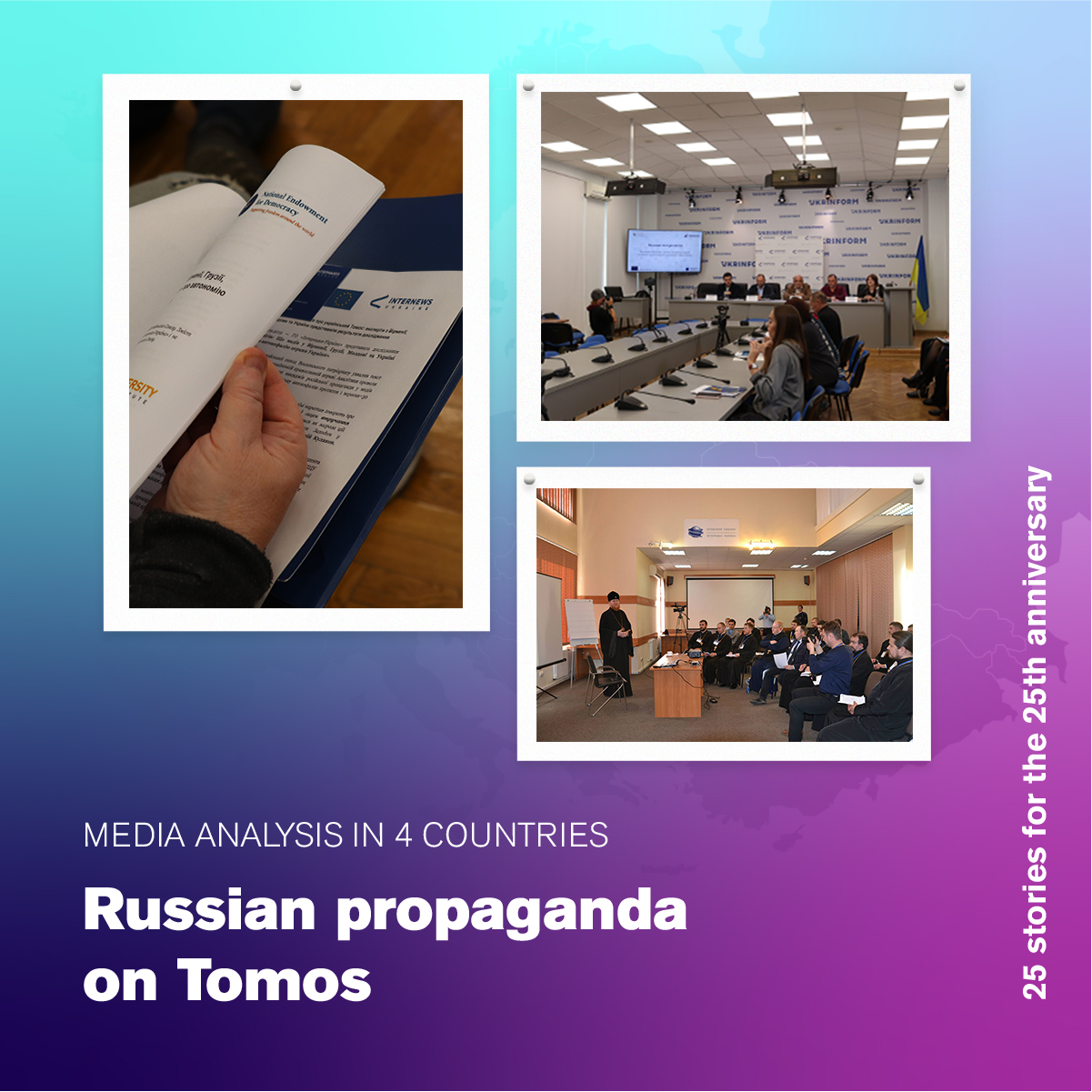
Along with foreign colleagues, we researched media outlets from Ukraine, Georgia, Moldova and Armenia to understand how the issues of Tomos were covered in these places and whether the Kremlin’s propaganda had a significant impact. We published an article with key conclusions and recommendations to counter the efforts of the Russian Federation.
As a result of the project, 21 articles were published in the media, and social media coverage reached more than 73,000 people. Pro-Russian news websites did not miss the study either, as they were quick to sling mud at our analysts. We clearly hit a sensitive spot!
25. #2022WithoutTobacco: developing advocacy campaign
On June 4, 2021, the Verkhovna Rada passed comprehensive anti-tobacco legislation in the form of bill №4358. 339 deputies voted to protect Ukrainians, especially children, from the harm of tobacco and electronic smoking devices.
Among the key changes:
- the use of tobacco heating devices like e-cigarettes will be prohibited in all enclosed public spaces, as is the case with cigarettes;
- medical warnings on cigarette packs will become up to 65% bigger;
- a ban on the sale of cigarettes and tobacco for self-rolling with different flavors (fruits, sweets);
- outlawing the sale of tobacco heating systems to minors.
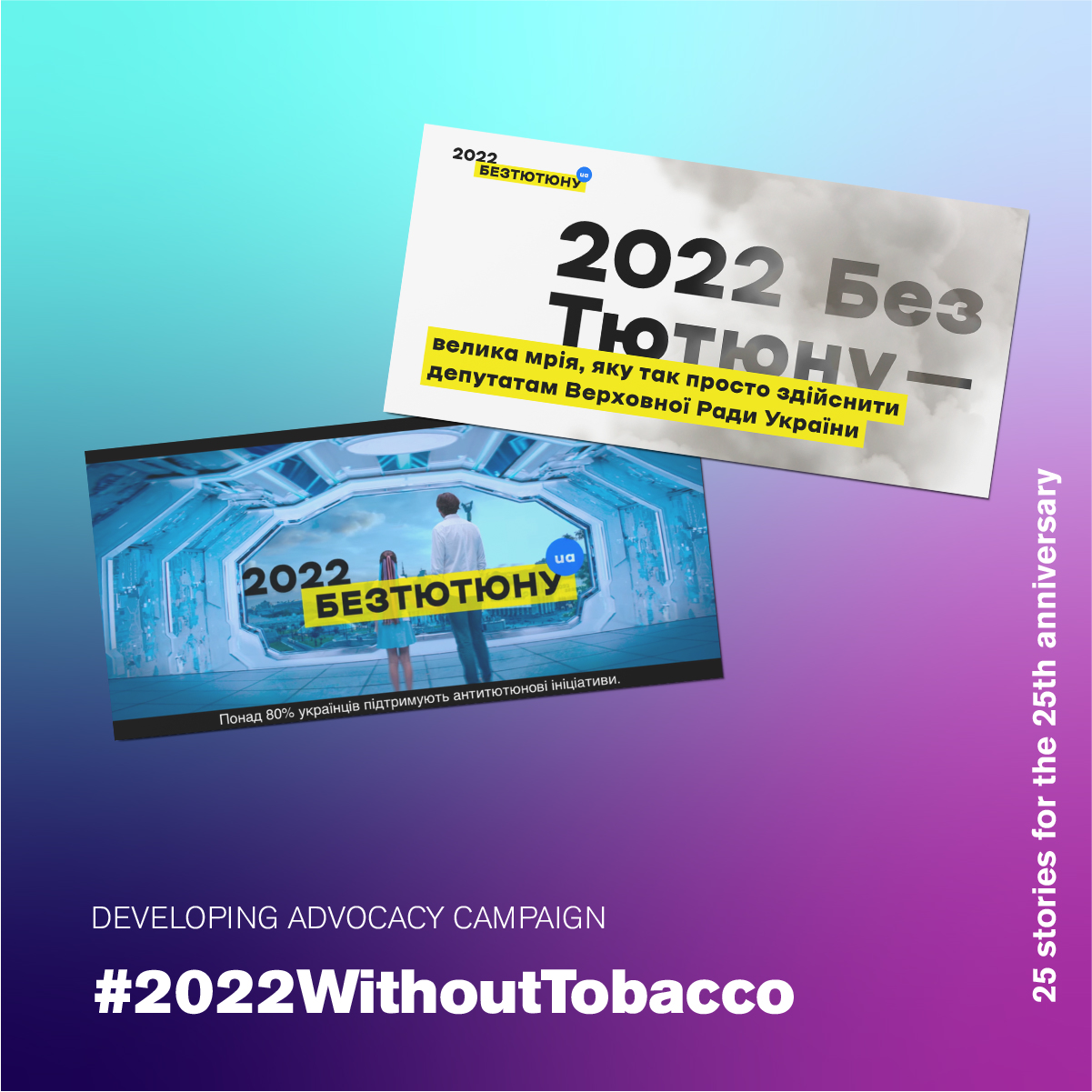
This was preceded by the #2022WithoutTobacco campaign, developed by us for the Life Center for Civic Representation. First, we tested the campaign’s messages in focus groups (including deputies and opinion leaders). On the basis of those results, we created key products for the campaign, including a video for TV and social media, the landing page for 2022notobacco.in.ua, posters, animated banners, and infographics.
All this was done to draw public attention to these stunning facts of tobacco use in Ukraine:
- 85,000 Ukrainians are killed each year by smoking-related diseases;
- more than 50% of teenagers in Ukraine have tried e-cigarettes;
- In 2019, for the first time in the last 10 years, the prevalence of smoking among young people increased.
We are proud of this victory and of our involvement in changes that will save the lives and health of Ukrainians for many years to come!
Events and News
How social networks affect politics? Offline chat with analysts and political stakeholders
On November 28, NGO Internews Ukraine will hold an offline discussion and present the study "Memocracy: How Social Networks Affect Politics in Ukraine".
The UkraineWorld.org media project has no relation to the Ukraine World News TV channel
The NGO Internews Ukraine, which launched the UkraineWorld.org platform in 2014, strongly condemns attempts to use its recognized and respected brand, which has earned trust, authority, and popularity among the international community.
Related projects

Made in...
We developed branding and conducted a large-scale advertising campaign for local manufacturers in Zhytomyr, Ivano-Frankivsk, Kamianets-Podilskyi, and Uzhhorod. The campaign achieved a reach of over 10 million!

Effective communications for 100 medical institutions
Over 100 clinics, hospitals, maternity wards, and other healthcare institutions across Ukraine enhanced communication capacities. We helped them build their brands and attract new patients.

Hromadas communications: a new strategy
We provided 30 municipalities with roadmaps for high‑quality engagement with residents, held 60 consultations, and developed Ukraine’s first manual to designing a communications strategy for local self‑government bodies.