Building dialogue between local authorities and residents
Hromadas communications: a new strategy
сhallenge
Hromadas lack effective communication for development in wartime
“I trust the leadership of my hromada” — in 2024, only 39% of Ukrainians could say this. Full‑scale war has brought new challenges to every locality in Ukraine: constant threat of shelling, a sharp decline in local budget revenues, and the need to restore destroyed infrastructure. In such conditions, doubt and mistrust toward local self‑government bodies spread easily. To address these difficulties effectively, authorities and residents need to act together — but how?
Research shows that in many hromadas, there are vulnerabilities in how local leaders interact with residents. Authorities often only inform people without receiving feedback. Residents of remote villages are left out of communication, and public information is not always transparent. Such gaps, especially in wartime, are dangerous: they can fuel disinformation, undermine effective governance, and slow recovery.
solution
Providing local authorities with tools for effective engagement with residents
To help communities build effective communication, we launched the “Communication Strategies for Territorial Hromadas” project. With support from USAID HOVERLA, our team worked with 30 hromadas in 10 regions: Chernihiv, Lviv, Mykolaiv, Odesa, Poltava, Rivne, Sumy, Volyn, Zakarpattia and Zhytomyr.
We began by “diagnosing” each hromada: we reviewed its development strategies and conducted a communications audit. This helped us understand who local authorities communicate with and how, as well as the resources and competencies of staff in local self‑government bodies.
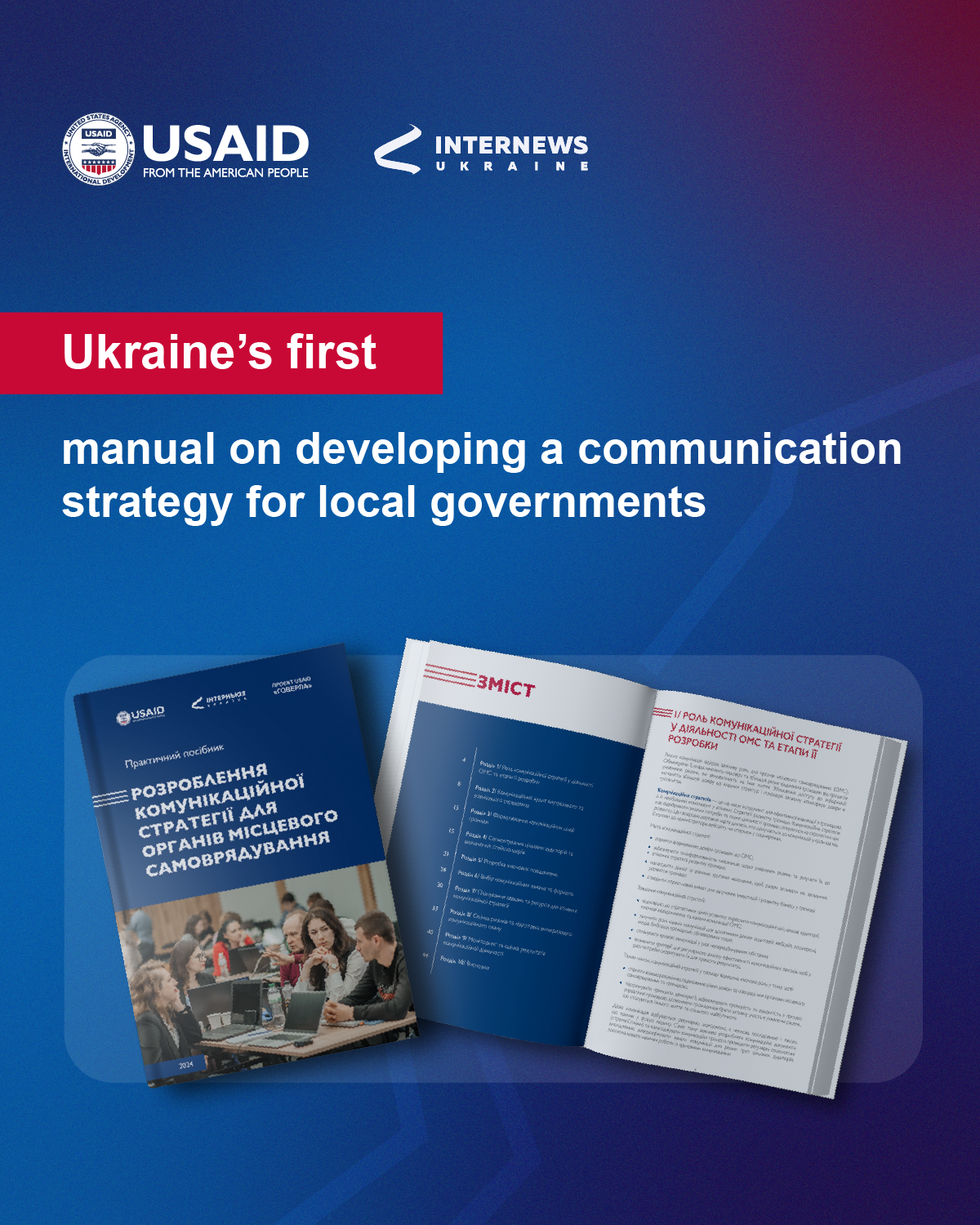
Based on this research, we developed Ukraine’s first manual to designing a communications strategy for local self‑government bodies. It is a step‑by‑step manual with 15 practical templates and an example of a complete strategy.
We also held 61 strategic sessions, during which, together with hromada representatives, we planned their communications step by step. First, we defined objectives and key messages for different resident groups. Then we selected the most effective communication channels and planned concrete activities.
The result was tailored three‑year communication strategies for each participating hromada. These documents covered all key aspects of communication:
- analysis of the current state of internal and external communications in hromada;
- identification and segmentation of target audiences;
- development of key messages for different population groups;
- selection of optimal communication channels and formats;
- planning of resources needed for strategy implementation;
- risk assessment and crisis‑communication mechanisms;
- monitoring and evaluation of results.
For each strategy, we also developed a one‑year implementation plan. To help communities respond more effectively to crises, experts prepared crisis‑communication plans for them.
We did not leave local self‑government bodies alone with newly created documents, but helped them build the skills needed to successfully implement the strategies. A total of 156 officials received training in internal and crisis communication, as well as basic design, video editing, and social media management. In total, 60 consultations were held for communities.
results
Steady steps toward effective communication
The first positive changes appeared early in the project. After the strategic sessions, 90% of participants noted that their communication approaches had improved.
For example, officials of the Brody hromada in Lviv oblast said they now communicate more confidently on sensitive topics and have learned how to respond to critical comments. The Bushtyno hromada in Zakarpattia expanded its capacity by involving young people in developing a communications strategy for a local summer camp.
The manual we developed generated significant interest. Its online presentation brought together 185 participants, including 112 officials. The Facebook livestream gained 2,693 views.
“This is a huge support for communications professionals. Now, everyone who attended the presentation knows that in their daily work, they are not alone; they have an effective adviser — the manual. And that is extremely valuable!” emphasized Nataliia Yankovchuk, representative of Koziatyn City Council.
The manual quickly found practical application. Twenty out of thirty hromadas reported that they regularly refer to its methodological materials. Vynohradiv hromada uses the crisis‑communication tips to handle comments, while Artsyz hromada applies them to content planning and survey design.
The developed communication strategies have also been well received. Fifteen hromadas plan to officially adopt them or have already done so (for example, Korosten hromada).
“I am glad that we have a strategy we can follow, instead of just learning from our mistakes and doing whatever feels right. Occasionally, you really need someone from the outside to give advice and help strengthen your skills,” commented Anastasiia Kovalchuk, representative of Kostopil City Council.
Expert consultations delivered quick results. Experts from the Rava-Ruska hromada developed a logo for their website and launched a YouTube channel. The Myrhorod and Veselynove hromadas stepped up the work on their information platforms.
Changes in resident engagement were particularly noticeable. Dykanka hromada reported a 15% increase in social media followers, while Chudniv hromada recorded an 18% rise.
Fifty‑three percent of communities said the project gave them a push to improve and expand their communication channels. Zhydachiv hromada ran several social media campaigns showcasing local achievements and successes. In Ostroh, the team launched video digests featuring the mayor answering residents’ questions; these two‑minute videos reach up to 5,000 views.
Events and News
How social networks affect politics? Offline chat with analysts and political stakeholders
On November 28, NGO Internews Ukraine will hold an offline discussion and present the study "Memocracy: How Social Networks Affect Politics in Ukraine".
The UkraineWorld.org media project has no relation to the Ukraine World News TV channel
The NGO Internews Ukraine, which launched the UkraineWorld.org platform in 2014, strongly condemns attempts to use its recognized and respected brand, which has earned trust, authority, and popularity among the international community.
Related projects

Internews Ukraine Turns 25
To celebrate the 25th anniversary of Internews Ukraine, we look back at our brightest initiatives, productions, and achievements.

Made in...
We developed branding and conducted a large-scale advertising campaign for local manufacturers in Zhytomyr, Ivano-Frankivsk, Kamianets-Podilskyi, and Uzhhorod. The campaign achieved a reach of over 10 million!

Effective communications for 100 medical institutions
Over 100 clinics, hospitals, maternity wards, and other healthcare institutions across Ukraine enhanced communication capacities. We helped them build their brands and attract new patients.