
Strengthening the expertise of regional journalists
Eco-journalism in Ukraine
challenge
War against nature
Russia's full-scale invasion of Ukraine has severe environmental consequences. Burnt military equipment, artillery shells, fires, and increased fuel consumption — all contribute to air pollution with chemical reactions and groundwater contamination.
The destruction of Ukraine's infrastructure has already led to numerous environmental disasters. A power outage caused the flooding of the Zolote mine in the Luhansk region. Avdiivka Coke and Chemical Plant was shelled by Grads. Oil depots were burned in Luhansk, Rivne, Volyn, Lviv, and other regions. And the Russian bombing of the Kakhovka HPP on June 6, 2023, was an act of ecocide crime.
Professional media coverage has a vital role in documenting such acts against Ukraine's environment committed by the Russian army.
solution
Eco-direction for Ukrainian journalists
In 2022, we were among the first in Ukraine to raise awareness about the importance of media coverage of the war's impact on the environment. To do this, two initiatives were implemented.
Project 1. Protecting the environment is especially "on time"
The project was executed with the support of the European organization Journalism Fund. The Internews-Ukraine team contributed in highlighting the disastrous impact the war has on the environment through online discussions and a small media grant programs.
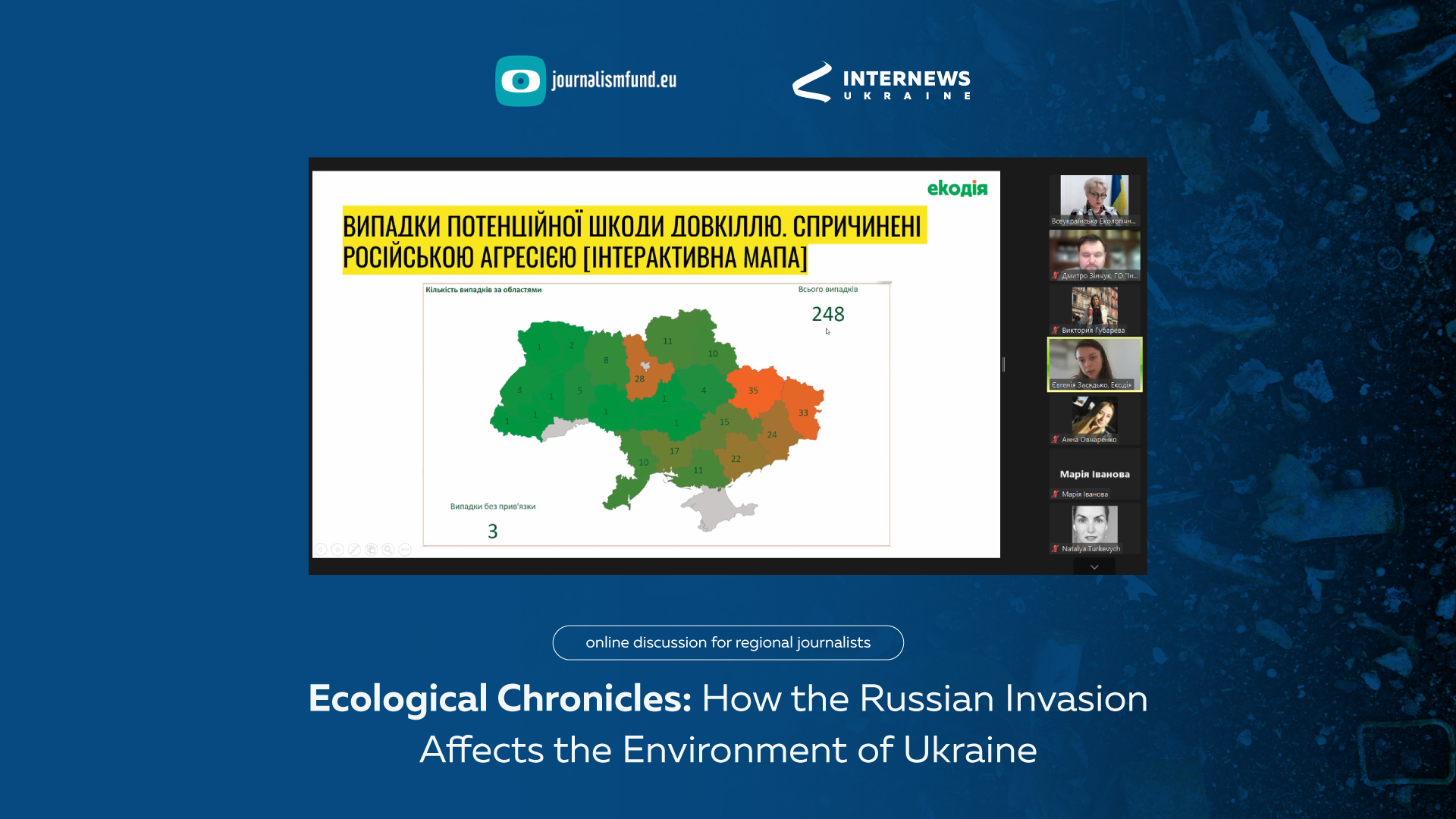
In May 2022, we held an online discussion for regional journalists, "Ecological Chronicles: How the Russian Invasion Affects the Environment of Ukraine". Among the speakers were:
- Tetiana Tymochko, Advisor to the Minister of Ecology and Natural Resources of Ukraine;
- Oleksii Vasyliuk, Chairman of the Board of the Ukrainian Environmental Group;
- Yevheniia Zasiadko, Head of the Climate Department of the NGO "Ecodiya";
- Mariana Sych, investigative journalist.
The participants of the online discussion took part in the small grants program for the media with the support of the Journalism Fund. As a result, 16 journalists prepared and published 48 various materials concerning the war's impact on Ukraine's environment.
In 2023, we continued the project, with more than 50 media professionals participating in the three-day training program "Environmental Chronicles of War: Record, Investigate, Tell". The majority of participants represented the eastern, southern and northern regions of Ukraine that were most affected by the fighting. After the course, 5 media outlets were awarded scholarships and published 25 materials. Among the issues raised were the negative impact of the Russian invasion on national parks and reserves in the temporarily occupied territories, chemical pollution of soil and groundwater, the impact of the war on the Kakhovka reservoir, the reduction of biodiversity and flora, and the prospect of post-war green reconstruction.
"I believe that topics on ecology need to be raised more actively. We see great damage to nature in the Kherson Oblast, particularly in how the flora and fauna have been damaged. And so, we need to document what is happening now so that we can predict the challenges that may arise in the future. Thank you for participating in this project," said one of the participants.
Project 2. Teach the media to talk about eco-crimes
In early 2023, we developed and conducted an educational program on eco-journalism with the support of the United Nations Development Programme (UNDP). The aim was to draw attention to Russia's environmental crimes in Ukraine and lay the groundwork to bring the perpetrators to justice in the future. Our partners included environmental organizations, such as the Ukrainian Association of Environmental Professionals and the Zero Waste Alliance of Ukraine, etc.
The "Eco-journalism without garbage" training course lasted nine days and over 35 training hours. As part of the program, journalists gained skills in collecting, verifying, creating, and disseminating information about current events, trends, and problems related to ecology and environmental protection. Developing knowledge and skills necessary for conducting environmental investigations and preparing materials in the genre of decision journalism was given a high priority.
result
Materials for change
Project 1. Actualization of environmental issues in Ukraine
Larysa Romaniuk, a journalist of the regional media "Gre4ka," wrote an article titiled "Drop by drop: how dirty water kills" sparked a considerable amount of discussion on social networks. This article discusses the dangers of drinking water in Kropyvnytskyi from local wells and other water sources. The editorial office was approached by many readers, including mothers of children, telling journalists that in the maternity hospital, they were even forced to sign a special document that obliges mothers to give newborns only filtered water due to water pollution in Kropyvnytskyi springs and wells. In the end, journalists prepared an additional explanatory article on this issue, including special comments from the State Service of Ukraine for Food Safety and Consumer Protection. These materials received more than 15,000 views on the website Gre4ka.info.
Video "Environmental Challenges. Mariupol Azovstal", prepared by the TV-7 channel, received 3.5 thousand views on the YouTube page of this media. Another video about Mariupol reached more than 568 thousand users on UkraineWorld's Facebook page.
Thanks to the project, we help to increase the capacity of regional media, so that it could cover the negative impacts the war has on Ukraine's environment, all whilst recording the cases of ecocide committed by the Russian Federation.
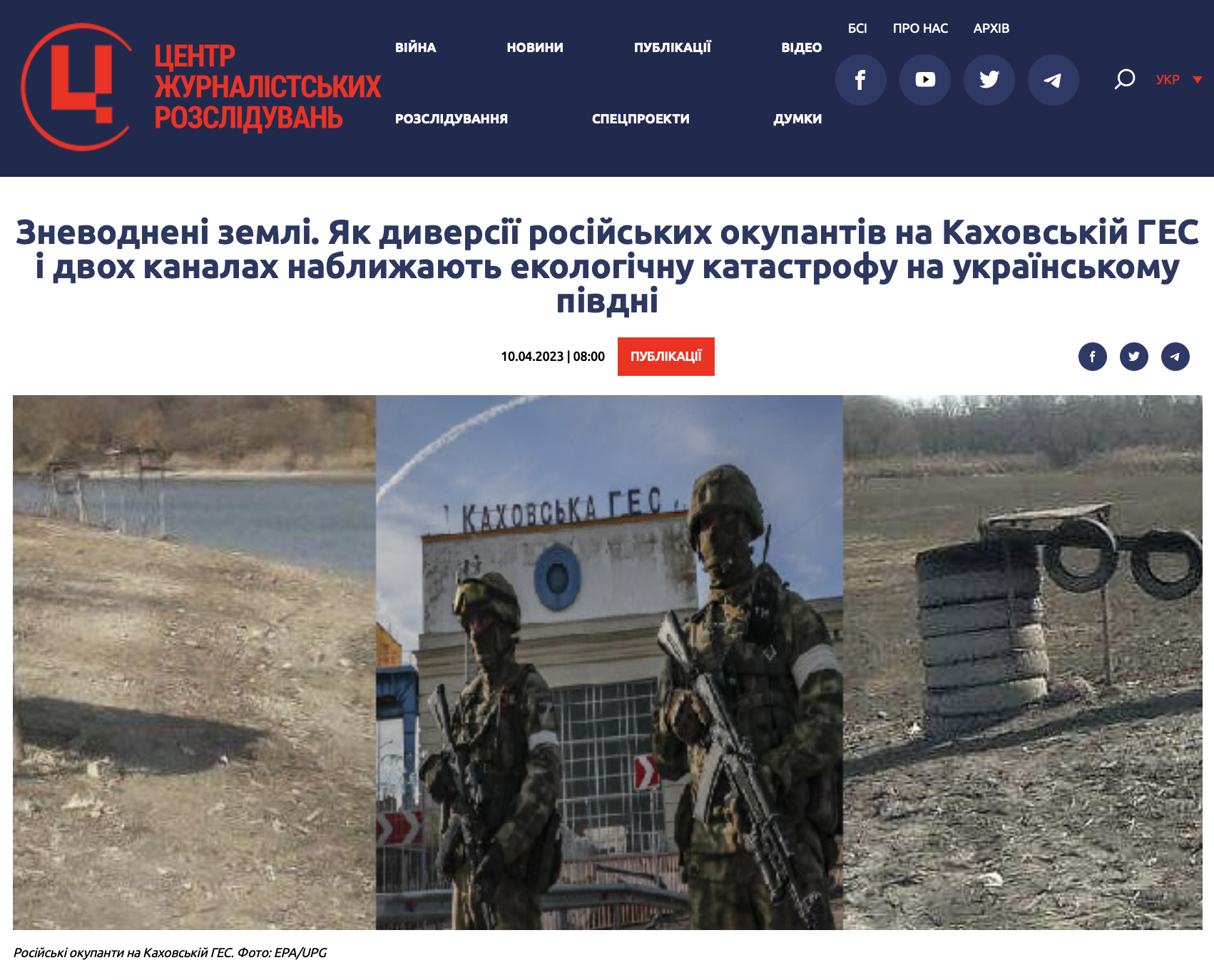
In particular, Oleg Baturin prepared material published on April 10, 2023, and which discussed the potential disaster the destruction of the Kakhovka HPP could cause, drawing the attention of the appropriate Ukrainian ministry. Unfortunately, on June 6, 2023, the Russian army blew up the hydroelectric power plant and 600 square kilometers were flooded. The article's author became a frequent guest and commentator for the media on the disaster related to the Kakhovka HPP.
Article "Battlefield: when will the farmers of Donetsk region be able to work on their land again?" received 51 thousand views on the "Shidnyy Variant" page on Facebook. And during the creation of the material "Dolphins: what is known about the causes of death of the Black Sea cetaceans", the author Tatiana Milimko turned to the European laboratories of Germany and Italy, which study dolphin samples from Ukraine. The samples were taken from dead Black Sea dolphins that were washed ashore. The findings confirmed that the dolphins died as a result of Russia's invasion of Ukraine. Thus, the material proved to be of high quality and expertise.
Project 2. Even more knowledge on eco-journalism
Graduates of the course "Eco-journalism without garbage" received the necessary knowledge and skills for professional coverage of environmental topics, as well as made useful contacts among colleagues and experts to improve their journalistic materials.
The results of the program include:
- 110 applications for participation in the training course confirmed the topic's relevance and the request among journalists.
- 90 participants from 18 regions of Ukraine took part in nine webinars.
- Within the training course, 14 topics were covered, and presented by 22 trainers and speakers.
- The video "How to start writing about ecology as a journalist?" offers practical advice for those only just starting to write about ecology. The video helped explain the fudamental principles of eco-journalism to a broader range of media professionals.
- The video "Eco-journalism in conditions of war" provides statistics on environmental damage caused by Russian aggression in Ukraine.\ Publications of the program participants on social networks, partnering websites, and media reached nearly a million users. Thus, we managed to raise public awareness of the environmental consequences of the war and the crimes of the Russian army.
"The course was useful and informative. The speakers immersed themselves so much into their material, knowledge, experience, and practical work that it is difficult now to choose only just direction in the topic!", shared Oleksandra Tron, editor of "Suspilne Dnipro".