Results of pro-Russian information manipulation and disinformation monitoring targeting the EU-Ukraine relations in March – May 2026
“Renewal of Austria-Hungary”, “Energy Crisis” and the European Parliament Calling to “Terminate Support for Ukraine”
Ukraine’s European integration and the EU-Ukraine relations remain a target for Russian and pro-Russian propagandists. During the spring of 2026, they attacked Ukraine's regional information environment with new false messages and information manipulations.
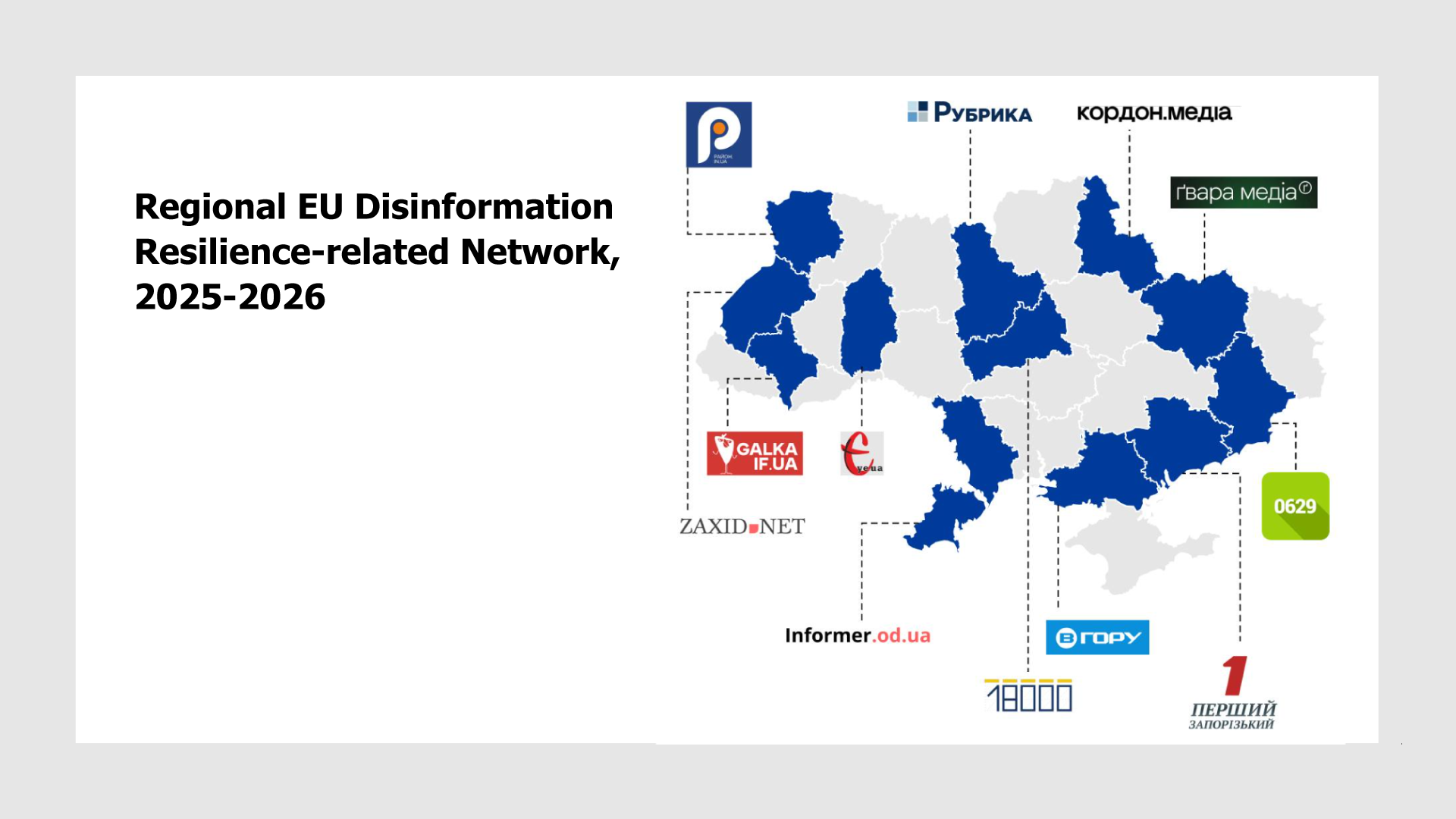
Responding to information warfare threats, the Regional EU Disinformation Resilience-related Network of Journalists, in collaboration with the DARE project team, monitors the disinformation narratives targeting European integration and EU’s support for Ukraine.
Key Takeaways
- Propagandists used the external social and political events as a background for their disinformation campaigns. As for spring 2026, these included the escalation of the conflict in the Middle East, the parliamentary elections in Hungary and even this year’s Eurovision song contest. Regarding the conflict in the Middle East, propagandists attempted to convince people that the EU is weak because of anti-Russian sanctions. In addition, they argued for “inevitable end of support for Ukraine” caused by “the loss of interest and energy crisis” across EU Member States. These narratives represent a curious shift in Russian propaganda. Since 2014, pro-Kremlin propagandists have been convinced of the futility of anti-Russian sanctions and of Russia`s independence from the West. However, in 2026, they modified their own claims and began to present the Russian energy sources as a way to “save Europe” from the energy crisis, and the EU elites were portrayed as “Russophobes” who put the EU Member States under pressure. In its turn, the Eurovision song contest has been accused of prejudice towards Russia and “Satanism”, the victory of Bulgarian singer Dara was presented as “the achievement of the Russian entertainment industry”.
- False claims about the EU allegedly “planning to deport all the Ukrainians of military age and leave them without social benefits” have become visible during the monitoring period. Such messages were detected in Volyn, Rivne, Ivano-Frankivsk, Chernivtsi, Kyiv, Zhytomyr, Khmelnytskyi, Vinnytsia, Cherkasy and Kirovohrad regions. Propagandists extensively speculated on the topic of mobilisation in Ukraine, trying to accuse EU Member States of double standards and discrimination.
- Other disinformation narratives included discreditation of the EU aid to Ukraine and the general EU integration process, disinformation about the state of Ukrainian refugees in EU Member States, accusations of the EU’s further militarisation and getting ready to direct war with Russia. Additionally, in spring 2026, pro-Russian and pseudopatriotic resources began a mass dissemination of false claims about alleged plans of “replacement of Ukrainians with migrants from Asia and Africa”, imposing xenophobic and anti-EU attitudes on Ukrainians.
- Messages undermining Ukraine-Hungary relations have appeared in Volyn, Rivne and Kharkiv regions. Particularly, pro-Russian resources of Kharkiv Region have disseminated the false video of the pig head allegedly brought to Ukraine’s embassy in Budapest, “in response to blackmail towards Orban”. In turn, messages accusing Hungary's new Prime Minister, Peter Magyar, of plans to occupy Transcarpathia, Bukovyna, and Galicia to renew Austria-Hungary appeared in Volyn and Rivne regions.
- Numerous manipulative and false claims about the state of Ukrainian refugees in EU Member States have been detected in Khmelnytskyi, Vinnytsia, Kharkiv regions and on the TOT of Zaporizhzhia. On the one hand, the authors of publications were insisting on the “powerlessness” of Ukrainians in the EU. For example, in the Khmelnytskyi region, there were publications about the registration of the draft law in the Polish Sejm that will make it possible to deport Ukrainians for two minor violations. In its turn, the accusations of Ukrainians of mass sexual crimes against women in EU Member States and the claims about the brutality of the French police towards the participants of the anti-Ukrainian protest in Paris appeared in Kharkiv Region.
- Pro-Kremlin propagandists keep using video fakes as a tool of their FIMI activity. Particularly during the monitoring period, this was manifested in publications appearing in the TOT of Zaporizhzhia alleging that German firefighters created a parody video based on the work of the Ukrainian Territorial Centres of Recruitment and Social Support to mock Ukraine. In reality, the original humorous video has been torn out of its context. It aimed to popularise the voluntary fire service in the German city without any mention of Ukraine or mobilisation.
Key Monitoring Results
“Ukrainians of military age will be forcibly returned to Ukraine from EU Member States”
In spring 2026, propagandists began to accuse the EU Member States of plans to conduct mass forced return of Ukrainians of military age, leave them without current social benefits and completely close the borders for men. Similar messages were detected in “national” and regional Telegram channels and social media groups, particularly in Volyn, Rivne, Ivano-Frankivsk, Chernivtsi, Kyiv, Zhytomyr, Khmelnytskyi, Vinnytsia, Cherkasy and Kirovohrad regions.
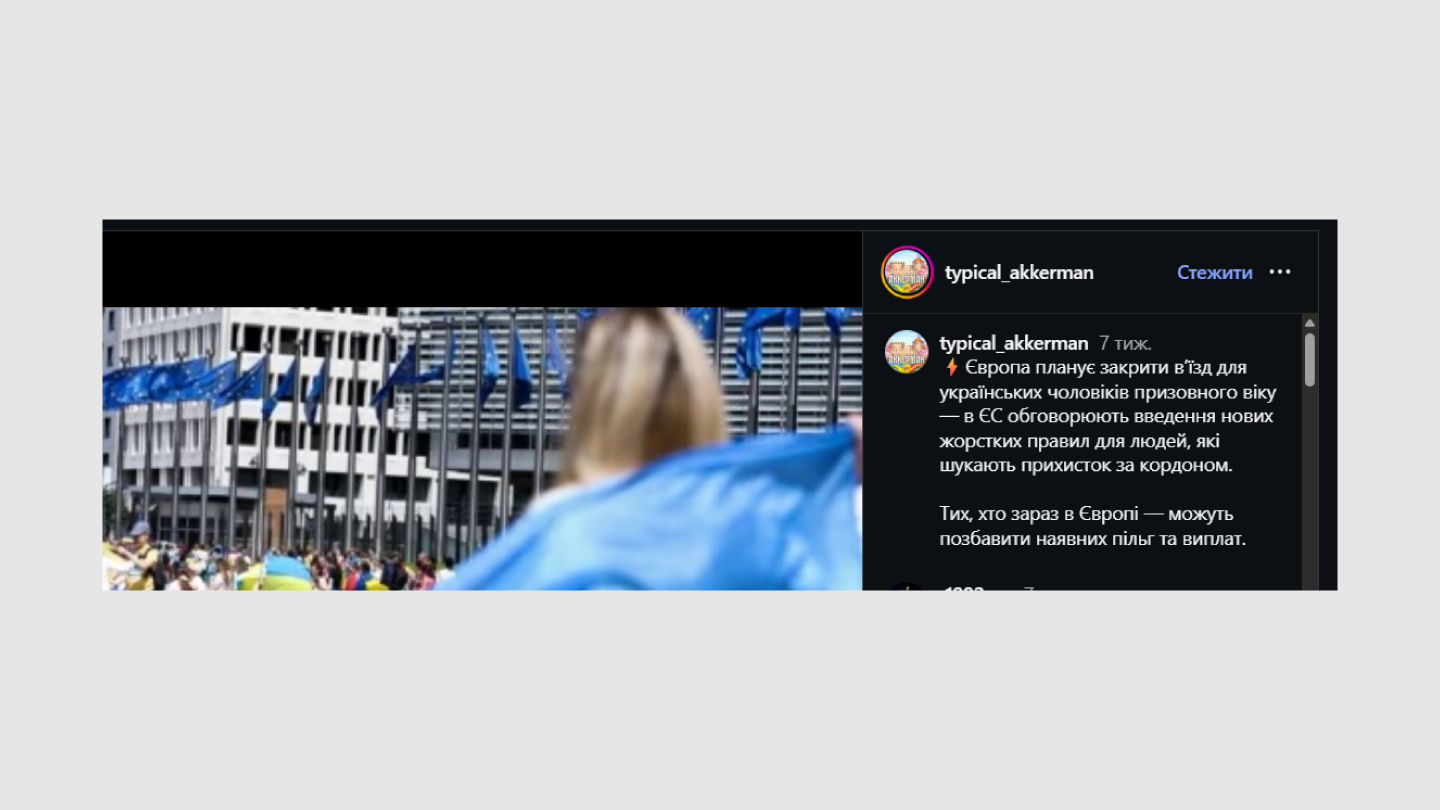 Source: Galka.if.ua
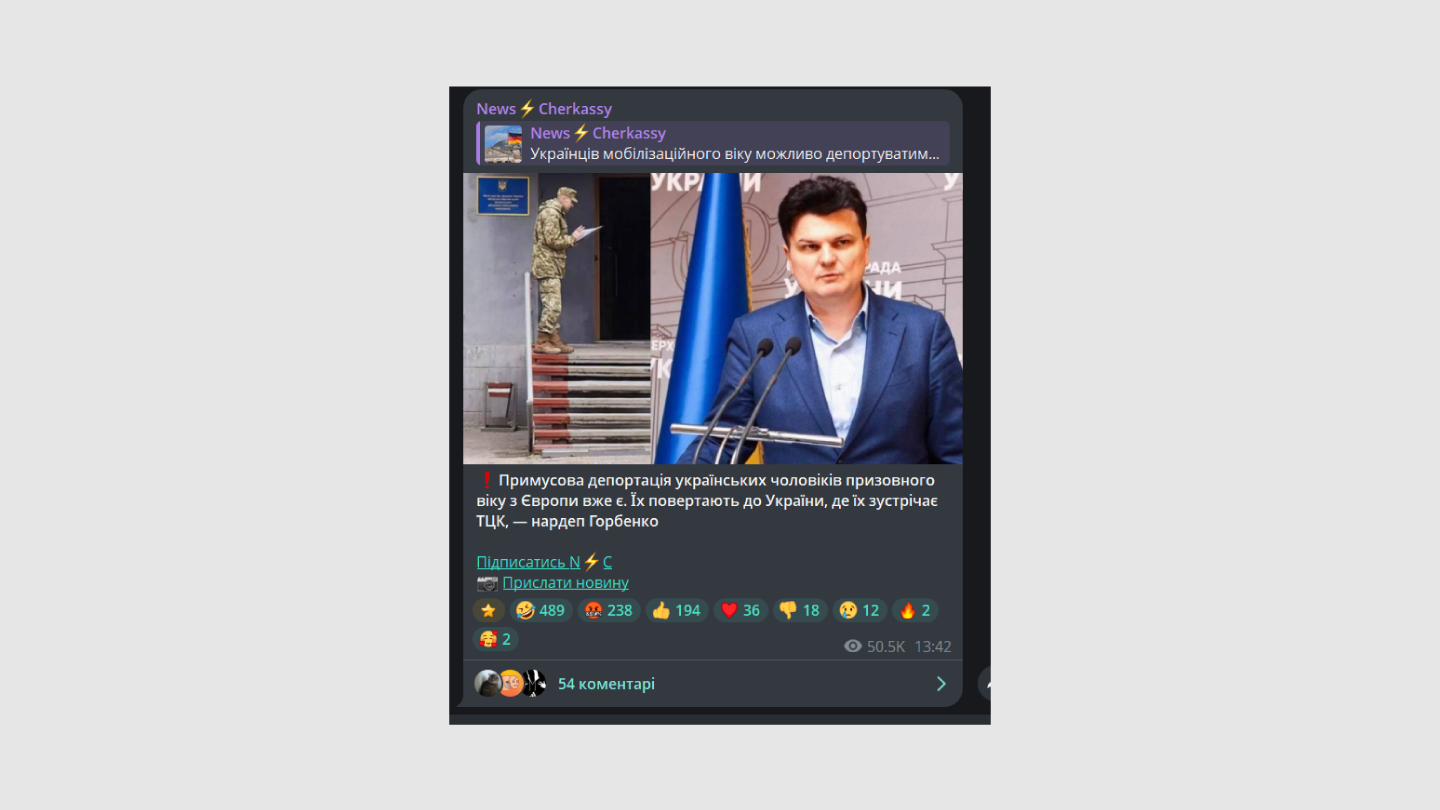 Source: 18000
Despite loud claims, the EU does not have any official decision to ban entry or to cancel the temporary protection provision for men of military age. Instead, there are ongoing discussions on the future of the temporary protection for Ukrainians after March 2027.
On 26 June, the European Commission published the proposal on the continuation of the temporary protection till March 2028 with the restriction of the access to asylum for newly arrived men of military age, men who voluntarily joined the AFU before the age of 23, women liable for military service and men who left Ukraine illegally. Therefore, applicants would be required to provide documentary proof of the legal departure from the country. These amendments do not apply to Ukrainians who have gained the temporary protection status before the updated rules take effect. Additionally, this proposal has not yet been approved. Therefore, there is no question of closing the entry for men or forced deportations.
Propagandists manipulate the topic of mobilisation to provoke negative attitudes toward EU Member States among Ukrainians and to accuse the EU of discrimination and double standards. However, such claims do not correspond to reality.
“The EU is getting prepared for war with Russia”
«“Accuse others of their own crimes to shift the responsibility” — this has been the principle of Russian propaganda since 2014. After the beginning of the full-scale invasion, the Kremlin propagandists have repeatedly blamed Ukraine and the so-called "collective West" for aggression against Russia. This continues ever since, except that now they have shifted their focus to accusing the EU Member States of preparing for war against Russia or even of direct involvement in the warfare.
Such claims appeared across various social media sources in the Lviv, Ternopil, Kherson, Donetsk, Odesa, Mykolaiv, and Zaporizhzhia regions.
 Source: Vhoru
For example, the presenter of the propagandistic TV programme on TOT of Kherson Region has been stating that Germany is allegedly conducting militarisation to prepare for a direct war with Russia. In reality, he has simply torn out of context the quote of Germany’s Minister of Defence, Boris Pistorius, for the programme “60 Minutes”. The politician stated that Russia is renewing its army and may accumulate forces for the attack on the NATO Eastern flank in 2028-2029. Therefore, EU and NATO Member States have to be prepared for escalation from Russia's side and continue investing in defence. Russian propagandists have misquoted these words instead and presented them as proof of the EU's preparation for the war.
The Lviv information environment has been affected by the pro-Russian blogger and pseudo-activist Ostap Stakhiv. In his video referring to an article by “Le Soir”, he stated that the EU aims to prolong the war in Ukraine for its own safety. In the publication, he also quoted Belgium's Chief of General Staff, Frederic Vansin, who stated that the EU must be prepared for war with Russia.
In reality, Vansin said that EU Member States must strengthen their defence capacity by 2030 and that, as of now, only the bravery of Ukrainians gives these countries time. Therefore, the EU supports Ukraine.
Stakhiv's claim that European weapon manufacturers have a vested interest in prolonging the war because they would lose profits if it ended is also manipulative, given that the EU has been helping arm Ukraine since the beginning of the full-scale invasion. One example of such assistance is a €90 billion support package, with €30 billion earmarked for budgetary support in exchange for reforms and €60 billion allocated to military needs. In addition, the Ukraine Facility provides support to maintain macroeconomic stability and fund pensions and salaries. The EU has also provided additional multibillion aid packages through ERA loans.
In its turn, the authors of the Odesa pro-Russian Telegram channel misquoted the words of the Czech president Petr Pawel, claiming that he allegedly suggested that Russia attack the Baltic states to “test the reaction and effectiveness of NATO”.
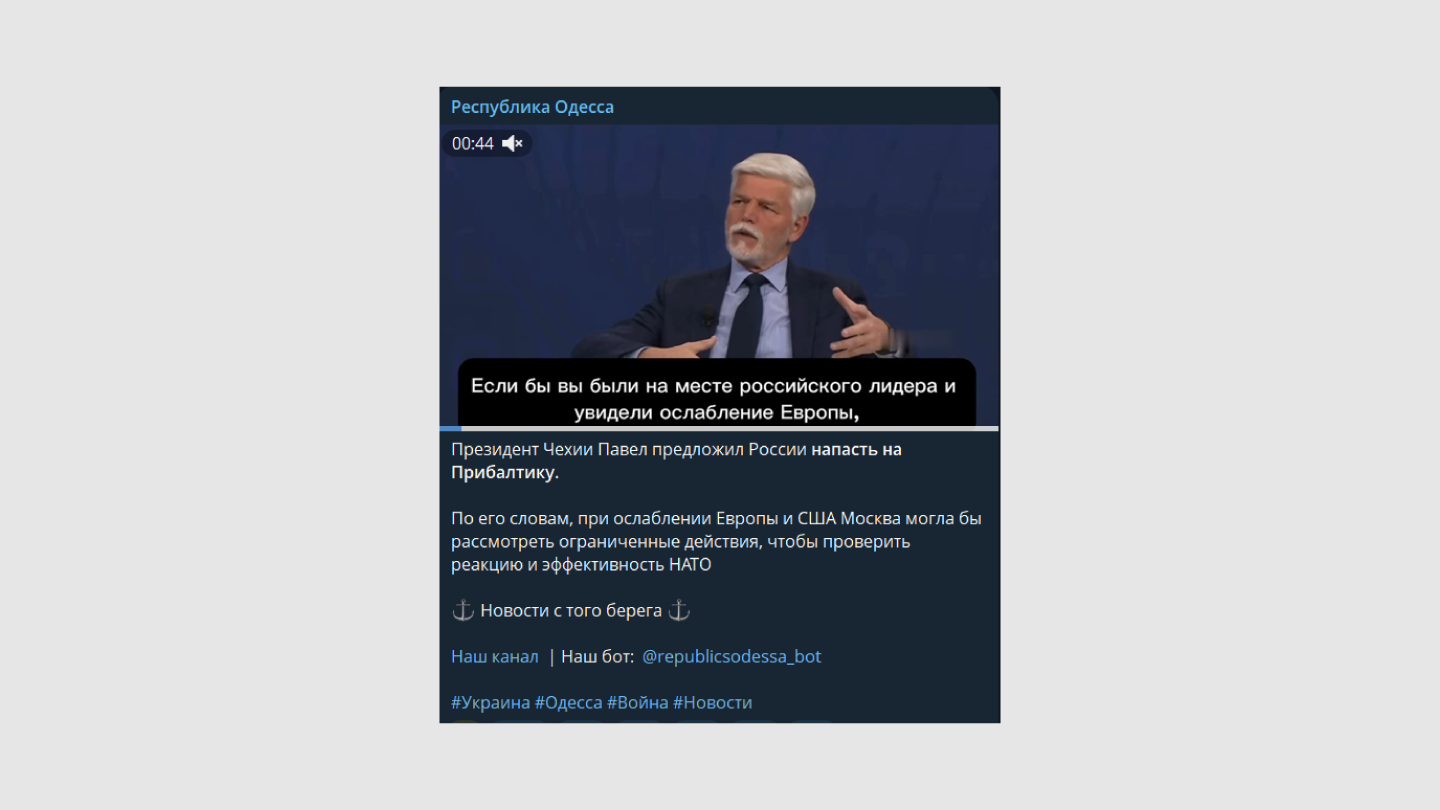 Source: Informer
In reality, Pawel was discussing possible scenarios for Russia's reaction to the weakening of the USA and the EU, and therefore suggested conducting limited military operations in the Baltic states. These words are a warning based on the risk and vulnerability assessment of the NATO Eastern flank conducted by a person with a background as the Chief of the General Staff of the Czech Republic and the Chairman of the NATO Military Committee. However, the propagandists have presented them as a call for war from the EU leaders and legitimisation of the entire idea of military aggression against countries neighbouring Russia.
Lastly, the authors of Telegram channels on TOT of Zaporizhzhia Region were persuading that the EU Member States plan to attack Russia and open “the second front” around Kaliningrad and the so-called Suwalki Gap.
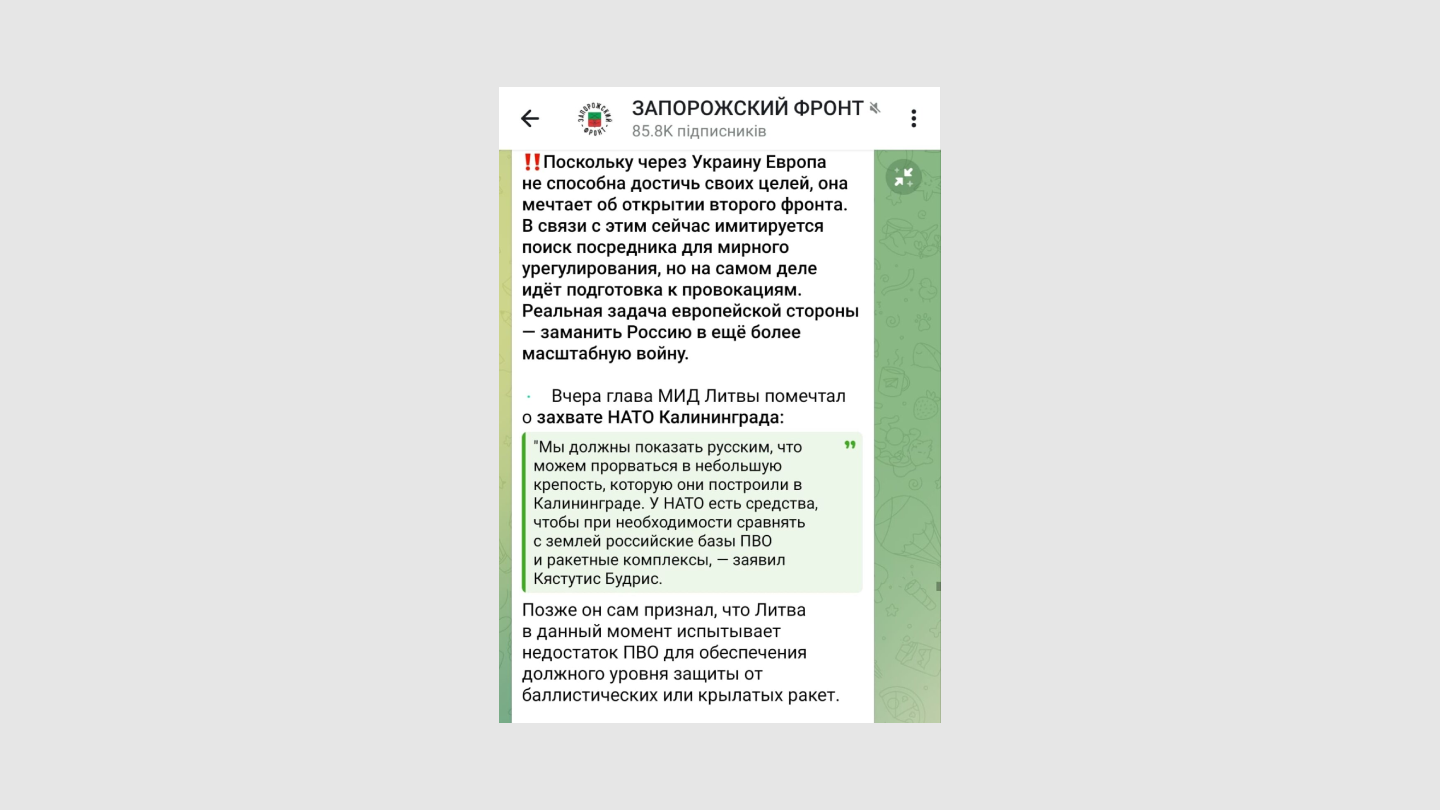 Source: Pershyi Zaporizkyi
Moreover, the propagandists accused the EU of plans to develop its own nuclear weapon for future confrontation with Russia, referring to the data of the Russia’s Foreign Intelligence Service.
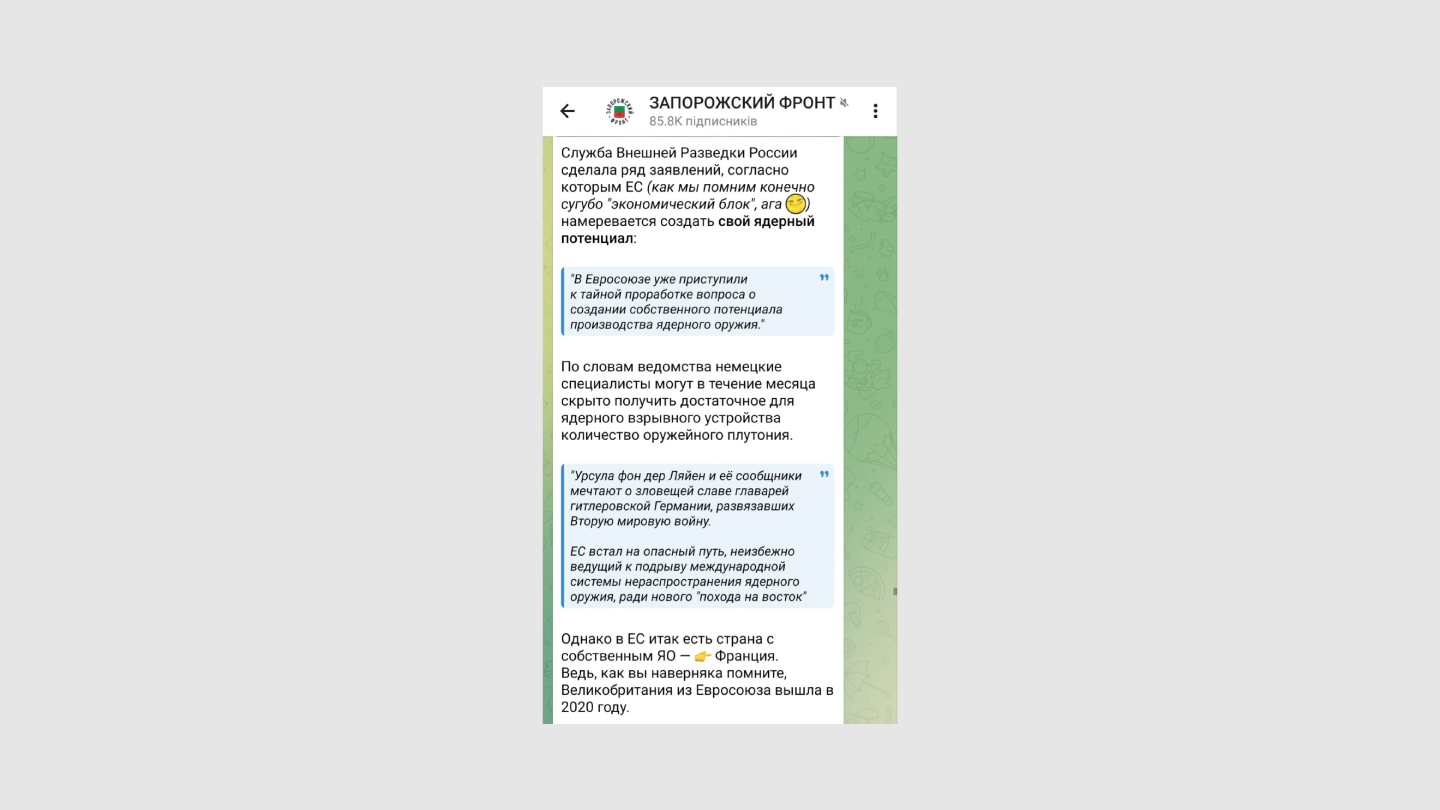 Source: Pershyi Zaporizkyi
In reality, such claims have nothing in common with reality and only aim at shifting the responsibility for the war in Ukraine from Russia and at presenting its aggressive military policy as “self-defence”. The interview with Lithuania's Minister of Foreign Affairs, Kęstutis Budrys, focused on defence and deterrence in response to Russia's escalation.
There is no proof of the EU's preparation for the creation of nuclear weapons. The EU does not have its own nuclear weapon and keeps to the non-proliferation regime. The only EU Member State with a nuclear arsenal is France. In fact, discussions about European nuclear deterrence are rather focused on the possible expansion of France's “nuclear umbrella” than on the development of a “secret weapon”.
“Migrants will replace Ukrainians”
Xenophobia and prejudice based on ethnicity, race, sexual orientation or gender identity remain the place of manipulations for the Russian propaganda. By exploiting strong emotions and intolerance, propagandists can more easily push narratives that serve Russia's interests while simultaneously alienating Ukrainians from European values — equality, human dignity, human rights, freedom, and democracy.
The spring of 2026 was not an exception, as it became a period of mass disinformation about the alleged arrival of migrants to Ukraine and plans of the EU and Ukrainian elites on “replacement of Ukraine’s population”.
For example, on the TOT of Donetsk Region, messages about Ukraine “opening the doors” to migrants from Asia and Africa appeared, aimed at covering the deficit in the working-age population. The propagandists estimated it to be over 8 million people.
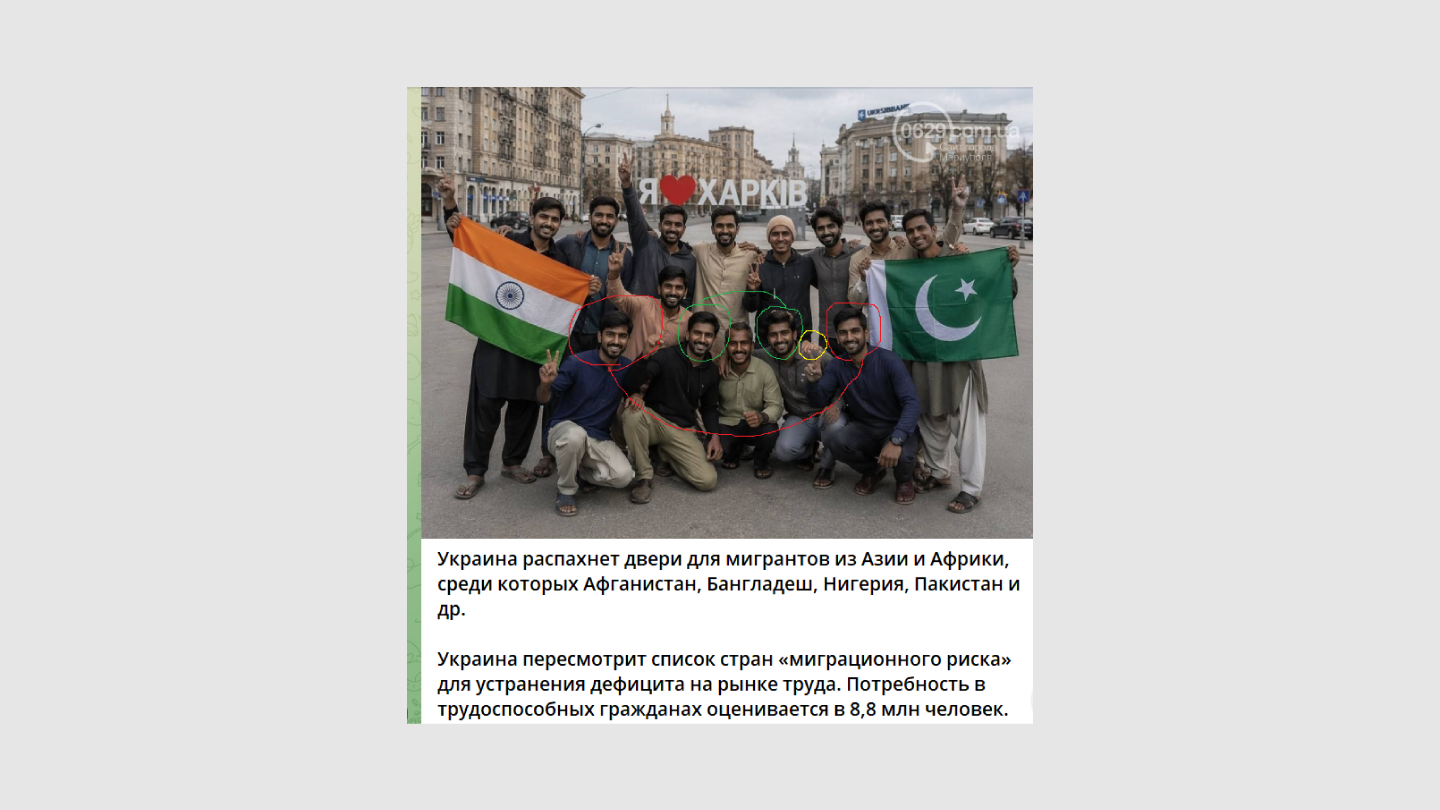 Source: 0629.com.ua
In reality, this “news” is the classic example of manipulation. The image presented as a “proof” of the presence of migrants in Ukraine has been AI-generated. Due to the demographic crisis caused by the war, Ukraine is indeed considering bringing in workers from other countries, particularly by simplifying the process of issuing work visas to citizens of Afghanistan, Bangladesh, Nigeria, Pakistan, India, and other countries. However, these changes do not mean that citizens of these countries will want to work in Ukraine, where there are no social or security guarantees, compared with wealthier countries. Therefore, the manipulations about “thousands of migrants on the streets of Ukrainian cities” do not correspond to reality.
The estimated need for workers is also false. While Russian propaganda disseminated the number of 8 million people, according to open sources, the deficit is estimated at 4-5 million workers.
Disinformation about the state of Ukrainian refugees in EU Member States
Russian propaganda has been targeting Ukrainians abroad since 2022, aiming to convince them of the uselessness of Ukraine and EU Member States, as well as to strengthen the feeling of frustration and insecurity in the face of discrimination and rights violations. At the same time, propagandists keep convincing the EU citizens that Ukrainian refugees threaten their safety and welfare, therefore playing on common fears and xenophobia. The manifestations of coordinated targeted disinformation campaigns can be seen in Poland, the Czech Republic, Germany, Ireland and other countries that provided shelter to Ukrainians. The malign impacts result in social tension and polarisation that are later turned into a place for manipulations by pro-Russian and Russian FIMI-actors. During the monitoring, disinformation and manipulative claims related to the state of Ukrainian refugees abroad were detected in Khmelnytskyi, Vinnytsia, Kyiv, Zhytomyr and Kharkiv regions.
For example, one of the Khmelnytskyi Telegram channels published a post stating that a draft law allegedly allowing deportations of Ukrainians for minor violations has been registered in Poland. According to the publication, exceeding the speed limit, improper parking, not fastening seat belts, crossing the road in inappropriate places, making noise at night, littering, consuming alcohol in a public place, walking a dog without a leash, petty theft, or fare evasion may result in deportation from the country.
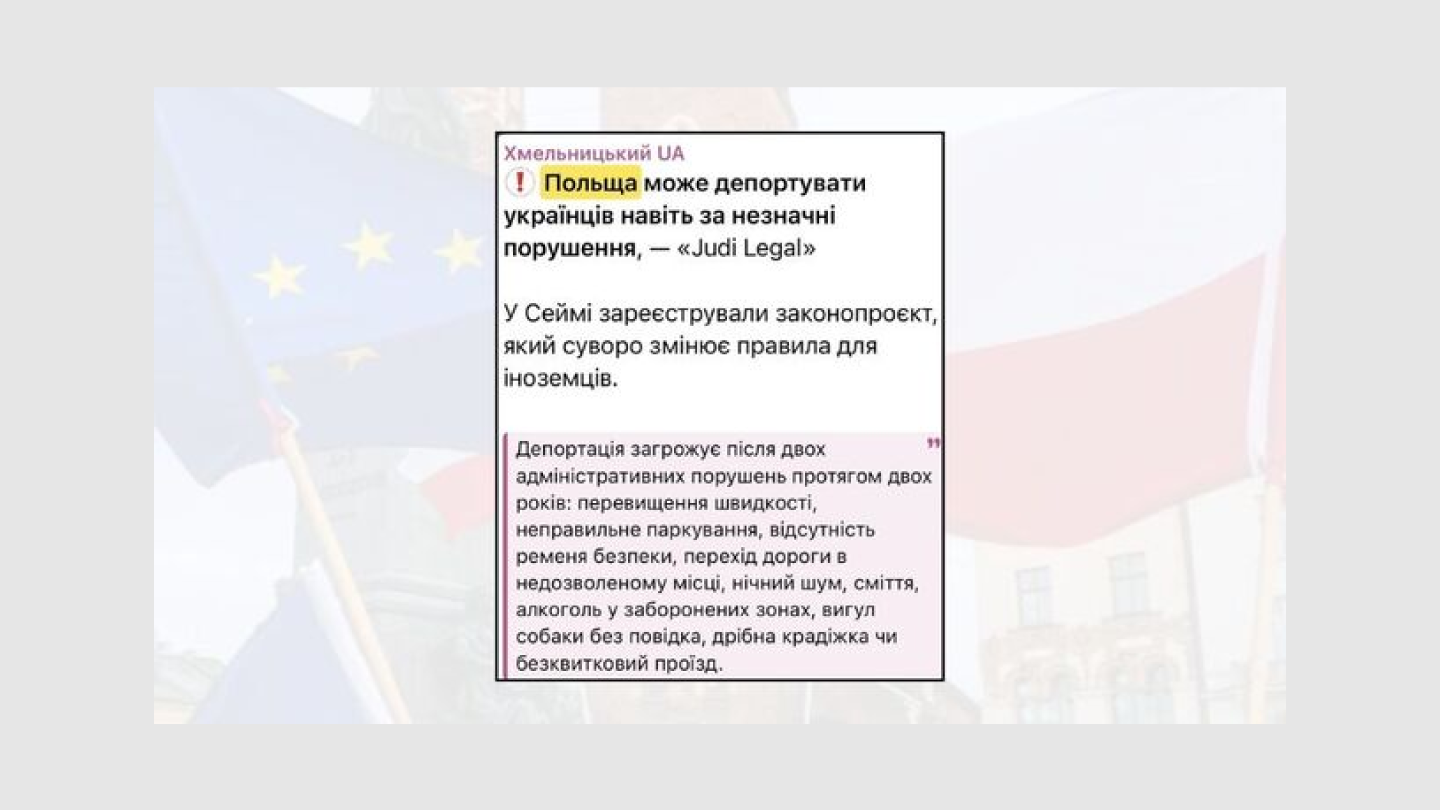 Source: Ye.ua
Though these claims are manipulative, the proposed draft law refers to all the migrants, not only Ukrainians. Additionally, for now, the document has not been considered by the Sejm and is therefore not in force.
On the other side, pro-Russian resources operating in Kharkiv Region disseminated information that the French police had allegedly shot the participant of an anti-Ukrainian protest, causing him to lose a leg. Similar messages could have been disseminated in other pro-Russian sources, particularly targeting the French population to strengthen anti-Ukrainian attitudes.
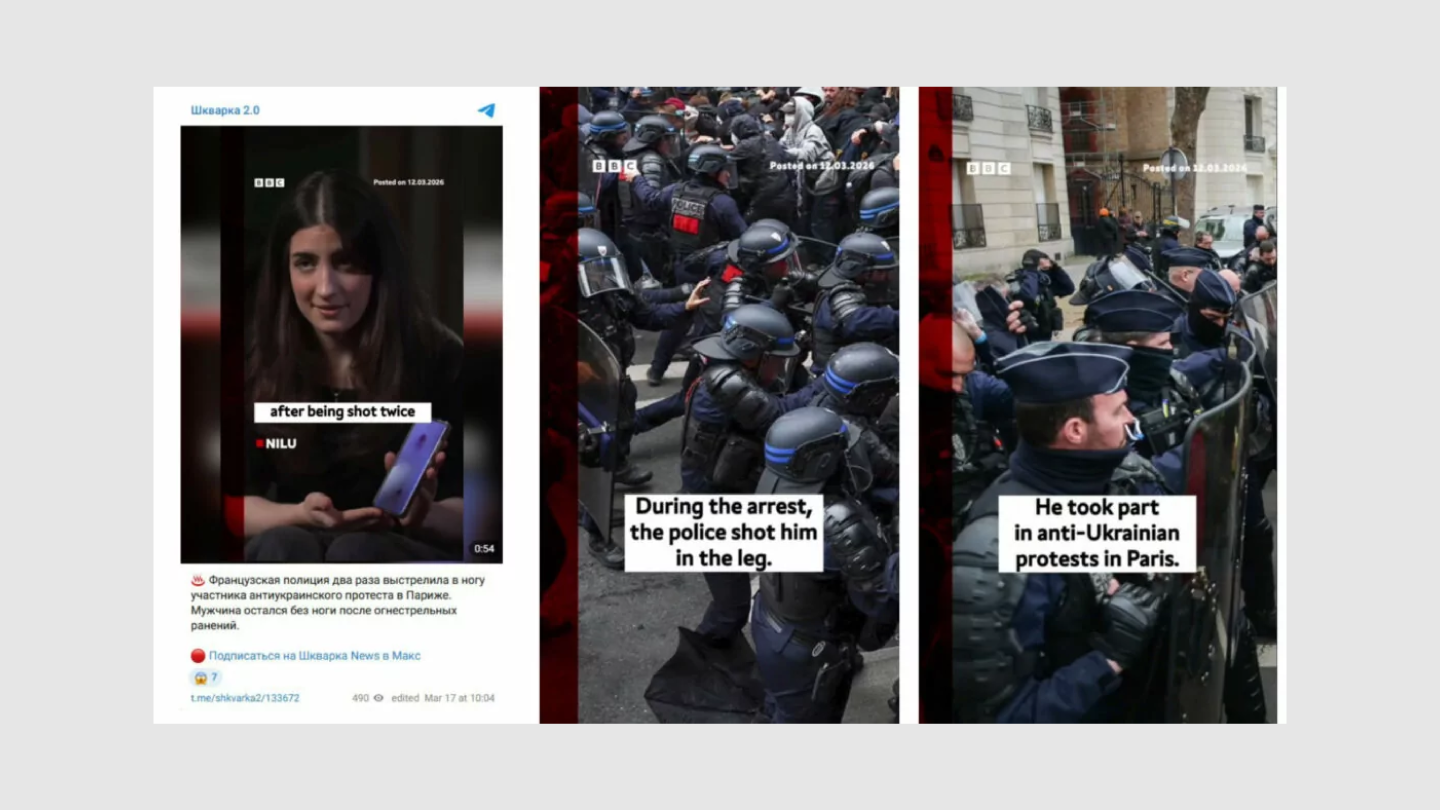 Source: Gwara Media
In reality, this news is completely false. Firstly, there is no information about any anti-Ukrainian protest in Paris since the beginning of 2026. Secondly, the video added to the post is fake too. Propagandists used the original BBC video dated 13 March 2026, where a woman was telling about her boyfriend who had gone missing during the anti-governmental protests in Iran.
The accusations of Ukrainian refugees committing one-third of sexual crimes in the EU and the UK are another fake news targeting Ukrainian and foreign audiences.
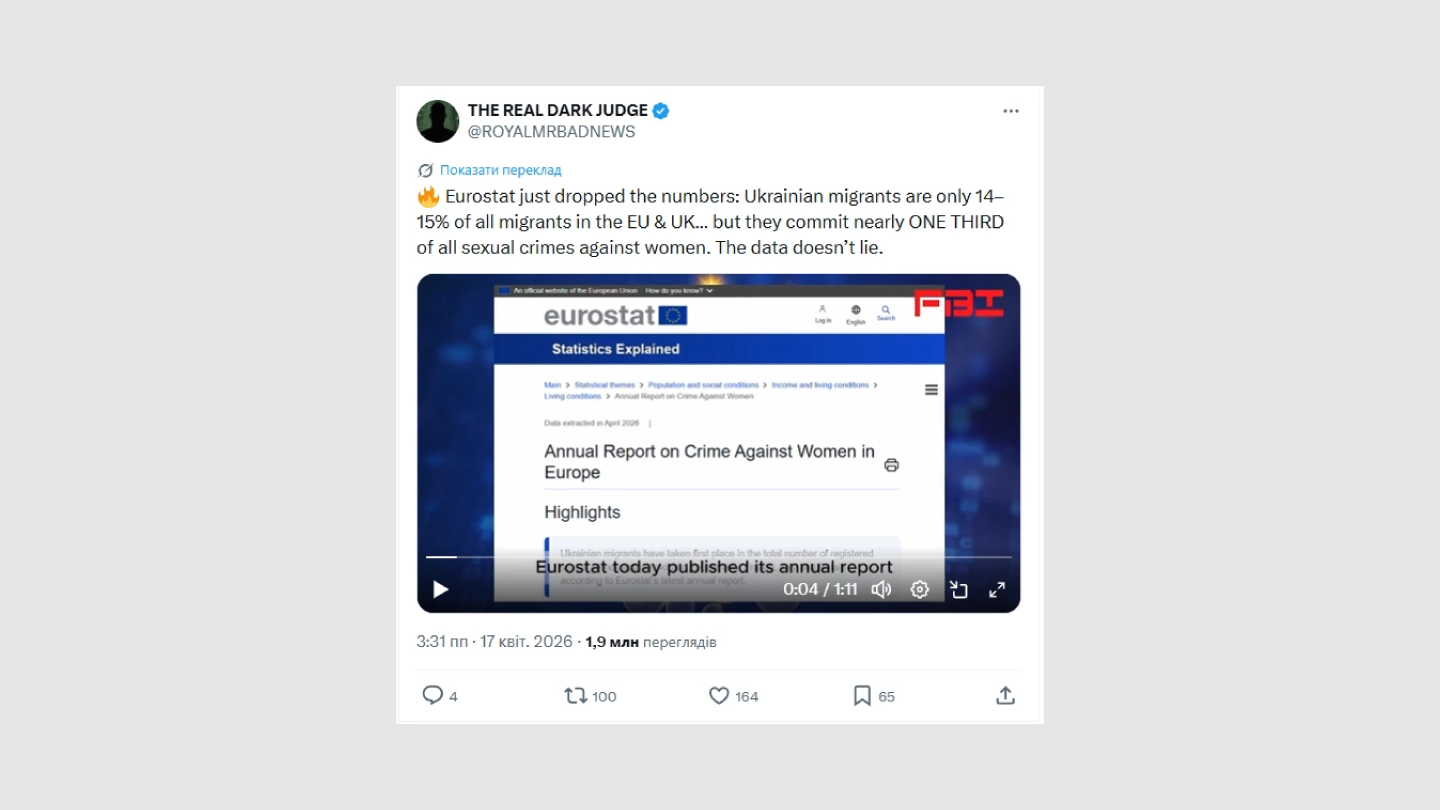 Source: Gwara Media
Factcheckers have discovered that the video with the logo “FBI” belongs to the so-called “Foundation to Battle Injustice” (R-FBI), a Russian pseudo-human rights NGO that deliberately disseminates disinformation against Ukraine and EU Member States under the guise of “human rights activity”. The “Foundation” was founded by Yevgeniy Prigozhin and is now linked to the activity of the disinformation network “Shtorm-1516”.
Despite the presence of screenshots of alleged Eurostat reports, there is no such material on the official website. The agency’s press service also responded that Eurostat does not publish statistics on crime rates broken down by the citizenship or country of individuals involved in offences. Therefore, this publication is a good example of FIMI activity aimed at strengthening fear and anti-Ukrainian sentiments among EU citizens.
Discreditation of EU support for Ukraine
Creators of false news are also trying to undermine the efforts of EU Member States aiming at supporting Ukraine during the war, as well as to accuse the EU and Ukrainian elites of corruption and stealing the aid.
In particular, messages accusing the Ukrainian authorities of embezzling EU aid packages were circulated in the TOT of Donetsk Region. These included a €90 billion loan, which was formally approved in April 2026. In reality, such claims are just speculations of Russian officials — in this case, of Russia's Permanent Representative to the UN, Vasiliy Nebenzia. At the same time, the EU uses audit, monitoring, and anti-corruption mechanisms as conditions for providing macro-financial assistance to Ukraine. As of May 2026, there had been no statements suggesting even a hypothetical suspension of EU financial aid to Ukraine.
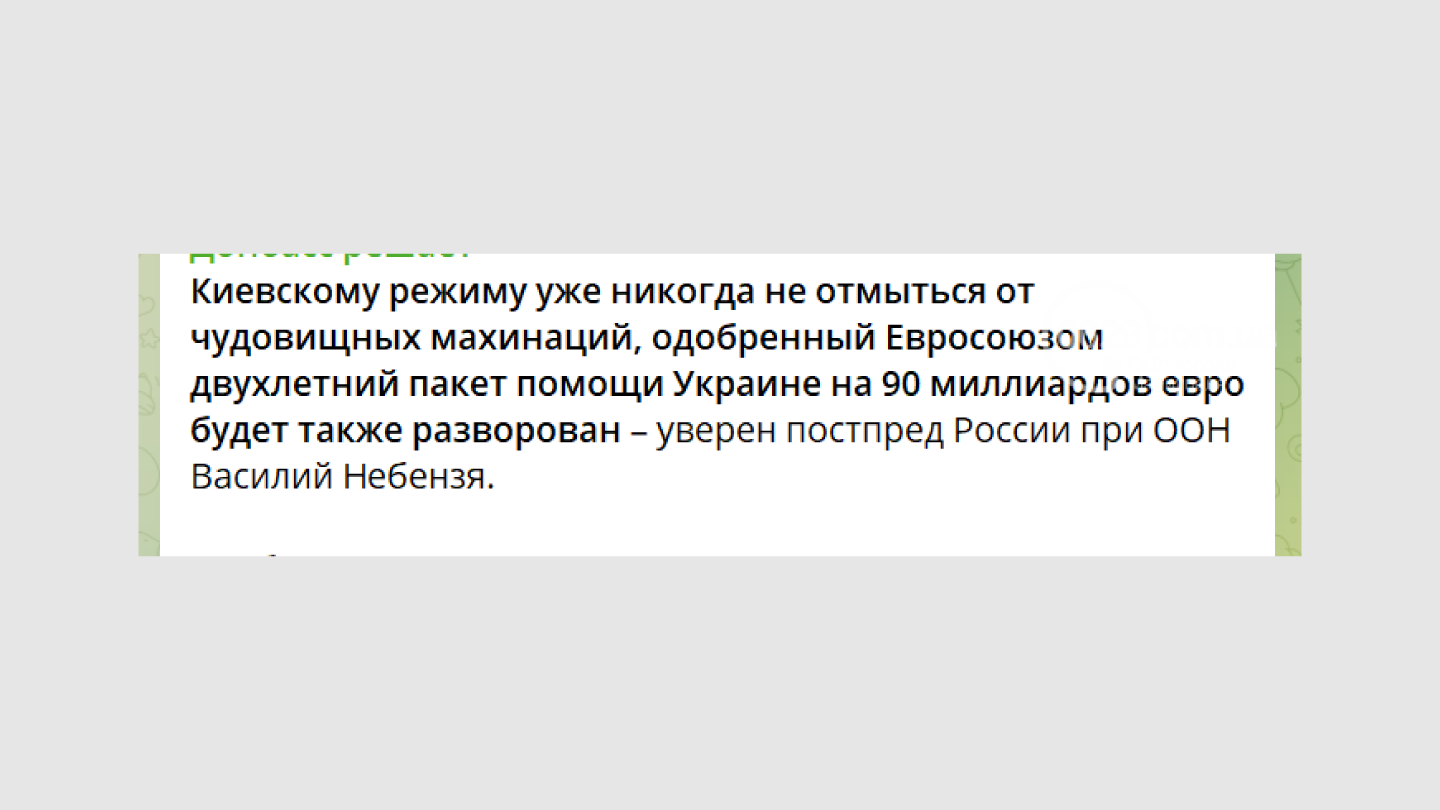 Source: 0629.com.ua
The topic of stealing EU aid was not overlooked by the authors of propagandistic resources on the TOT of Zaporizhzhia Region. In posts published on local Telegram channels, they stated that the EU sees Ukraine as a “mafia structure” that does not meet the expectations of an EU candidate country.
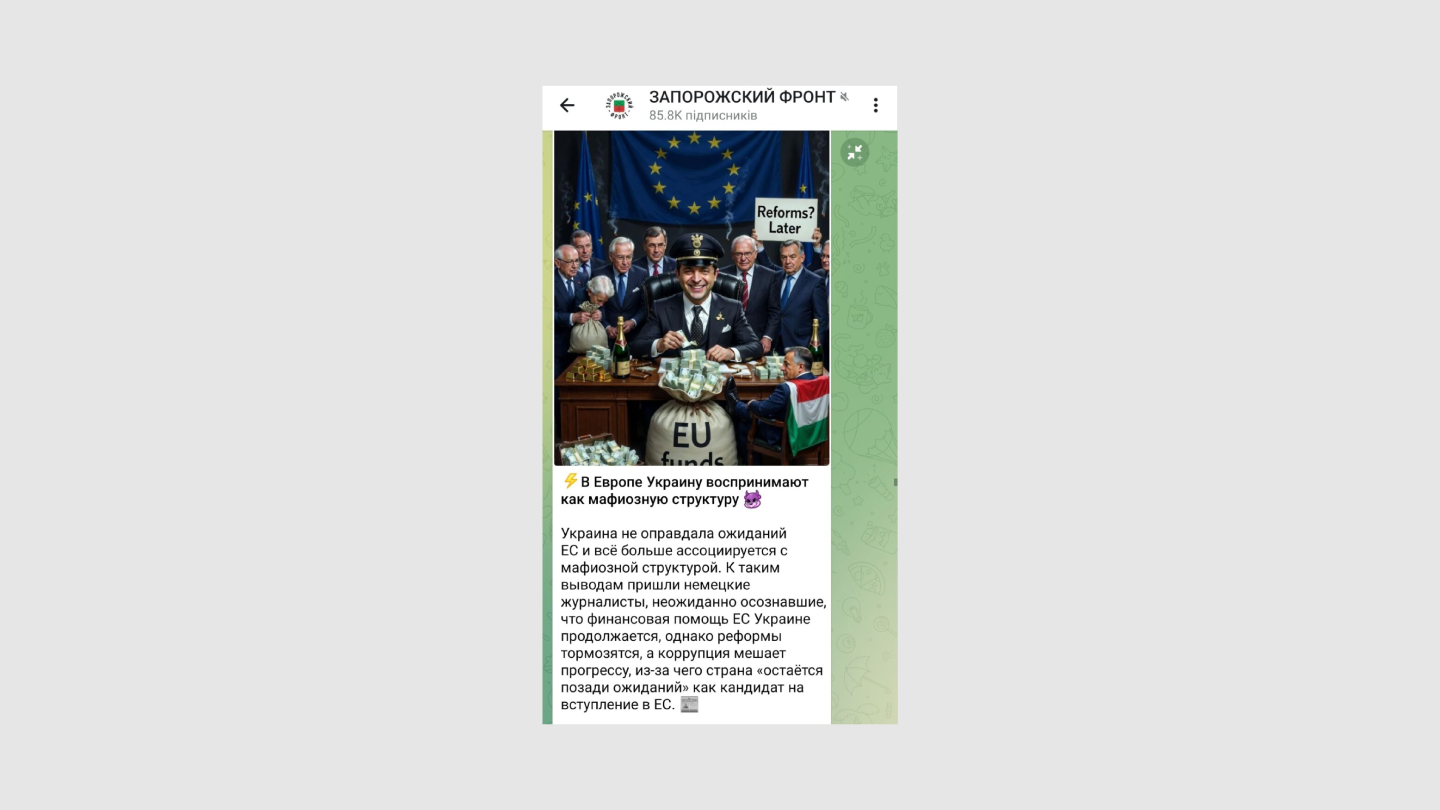 Source: Pershyi Zaporizkyi
In reality, these claims are manipulative and are based on exaggerating the real problems and misrepresenting the positions of European partners. Although the topic of corruption and reforms in Ukraine is on the agenda of political discussions in the EU, criticism of specific problems does not mean that Ukraine is considered “a mafia state”. The EU continues to support Ukraine and links financial aid to reforms. Particularly, a new support package was approved in April, with requirements related to transparency, budget management, and anti-corruption reforms. Meanwhile, Ukraine continues to fulfil the requirements for EU accession, particularly in the areas of anti-corruption and judicial reform. This shows that the reform process is ongoing and that Ukraine's progress is regularly assessed during the accession negotiations.
“The EU is suffering from an energy crisis”
In spring 2026, amid the escalation in the Middle East, Russian and pro-Russian propagandists sought to convince the EU that its weakness in the face of the inevitable energy crisis was exacerbated by anti-Russian sanctions. In the context of EU-Ukraine relations, these narratives evolved into a claim that EU aid to Ukraine could be terminated due to internal problems and crises. Such messages appeared in Telegram channels in the Volyn, Rivne, Kharkiv, Odesa, and Mykolaiv regions.
In particular, this can be seen in widespread manipulative messages claiming that the EU Member States are facing the energy crisis and have only 10 days' worth of jet fuel reserves left.
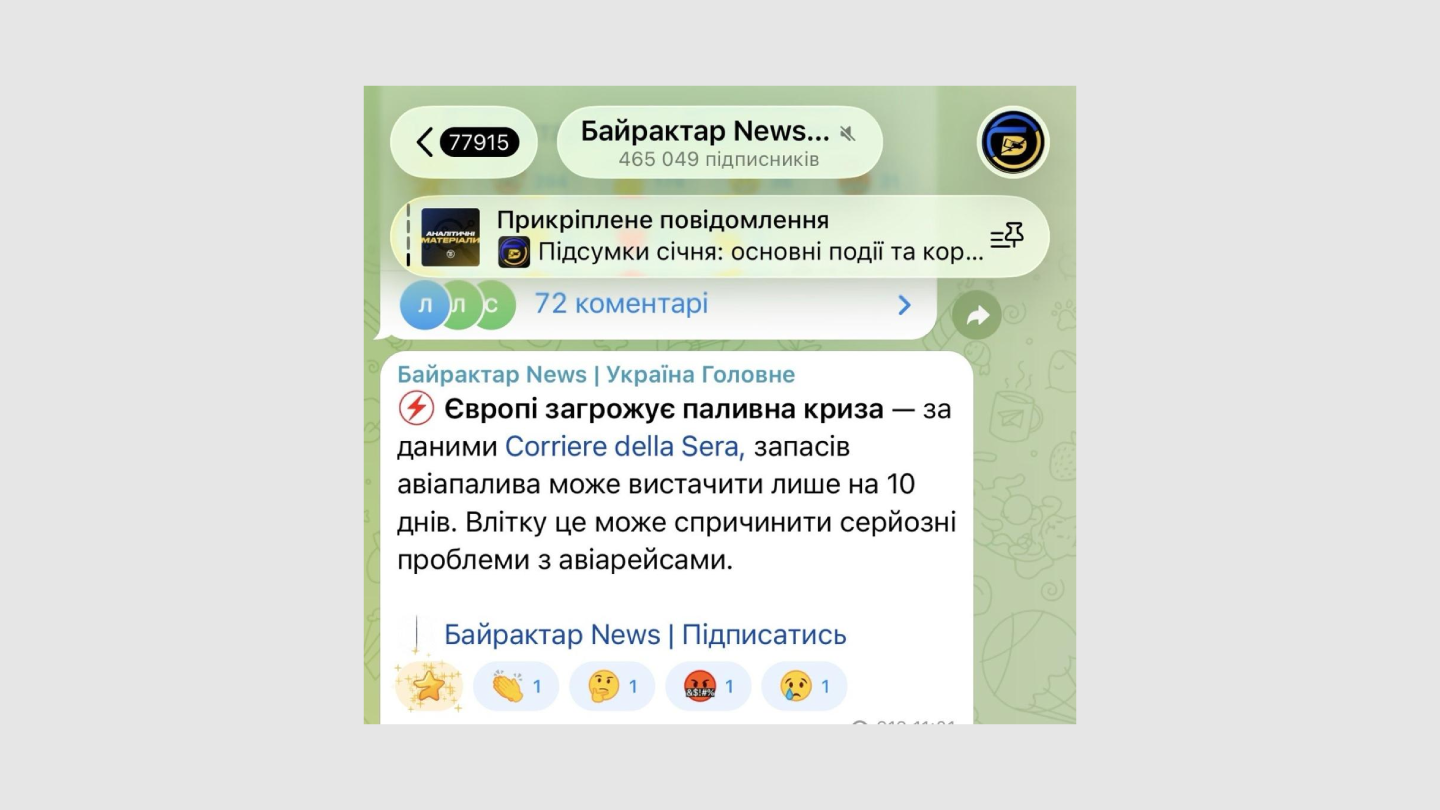 Source: Rayon.in.ua
In reality, the authors of the publication distorted these claims — they did not correspond to information from official sources. In an interview with the Associated Press, the executive director of the International Energy Agency, Fatih Birol, said that under certain crisis scenarios, the world's available jet fuel reserves could last for approximately six weeks, not 10 days. He also stressed that the main risk is a potential prolonged disruption of shipping through the Strait of Hormuz, which could lead to higher prices and economic instability in some regions. Therefore, claims that the European Union has only 10 days' jet fuel reserves are based on a distortion of international experts' assessments. As of now, the European Union has not reported any jet fuel shortage.
The claim about the “reserves left only for 10 days” has also been taken by Odesa resources. In its turn, the authors of the publication accused the President of the European Commission, Ursula von der Leyen, of “clinical Russophobia” because she allegedly does not let to buy the Russian gas even despite negative consequences for the EU economy. They also called for “liberation of Europe from colonial existence and elimination of the EU”. As in the previous example, such statements do not correspond to realities.
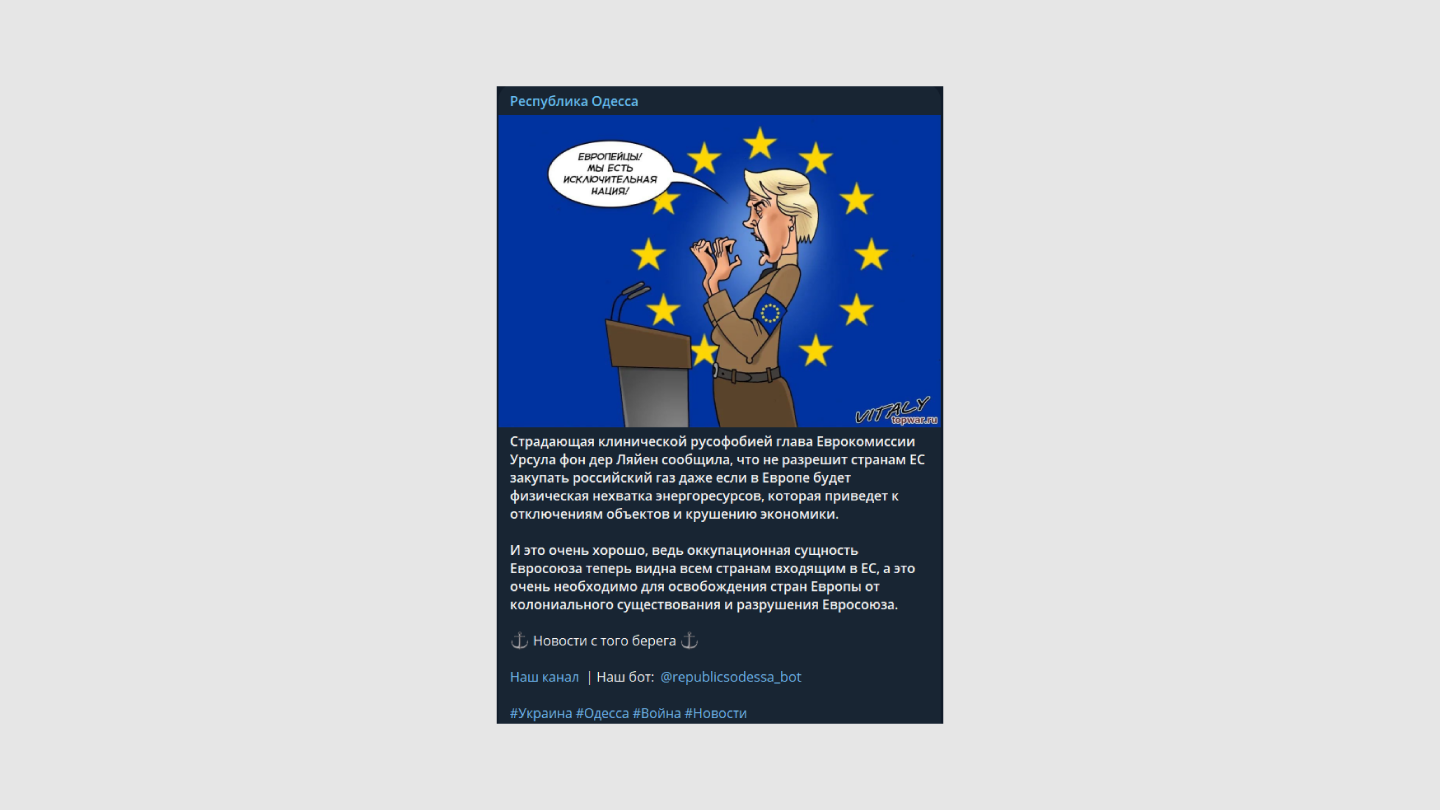 Source: Informer
“Ukrainians are dying for the EU interests”
Russian and pro-Russian propagandists keep convincing that the EU is interested in the deaths of Ukrainians and solves its own problems through the war. Everything to undermine European integration efforts and strengthen negative attitudes among Ukrainians towards European integration. Such emotional claims strengthened by war fatigue and fear for the nearest may create a negative image of the EU in readers’ eyes. However, it is worth remembering that this is a classical Russian manipulation.
In particular, a post accusing the EU of “solving the problem of the ageing of the population with the flow of Ukrainian refugees” has appeared in one of the Facebook groups in Cherkasy.
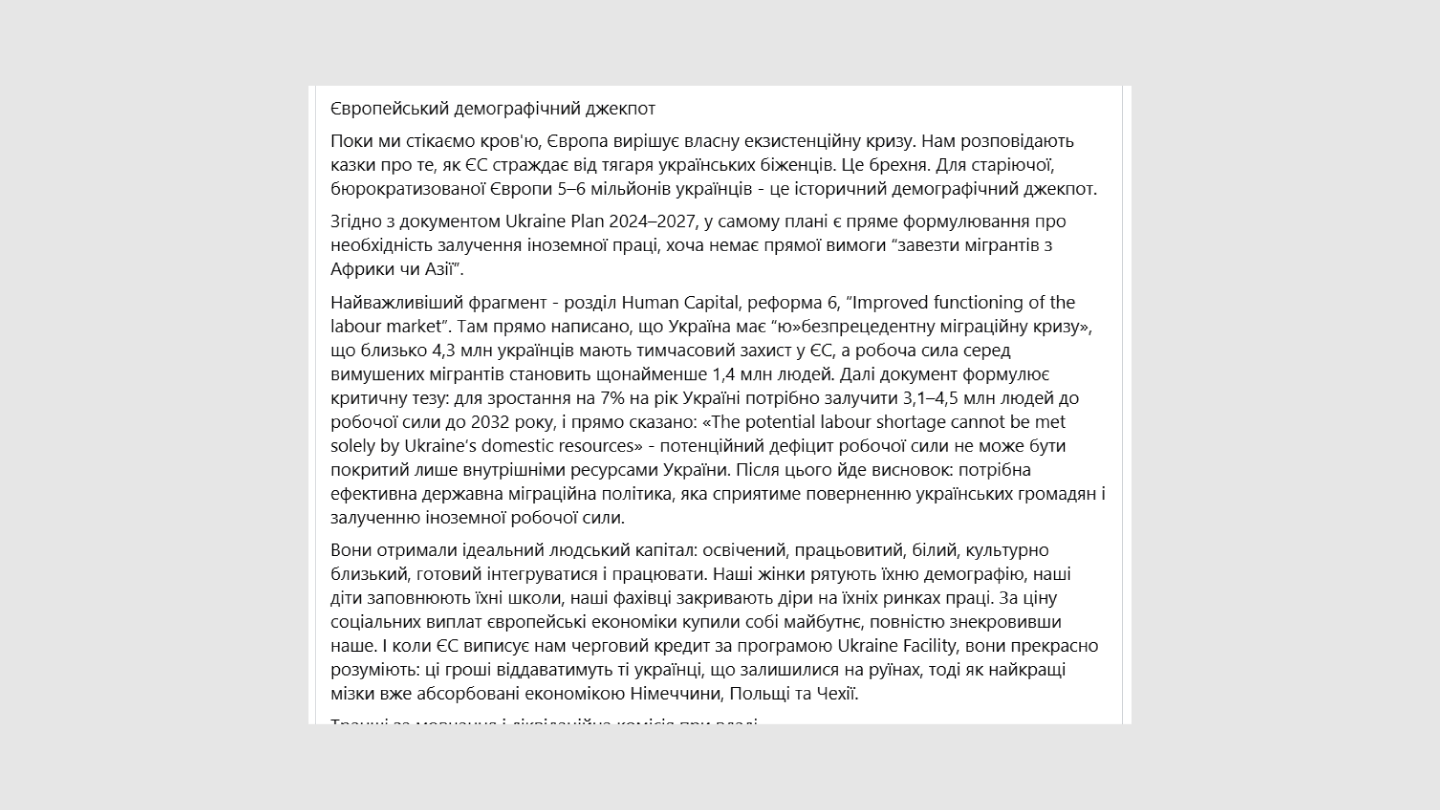 Source: 18000
The post creates a false image that the EU profits from the war in Ukraine, as the EU Member States gain “human capital that is educated, hard-working, white, culturally close and ready to integrate and work” as a result of the war. However, this information is manipulative and not supported by facts.
Meanwhile, one of the pro-Russian sources targeting Kyiv Region published a post with the claims that Ukrainians are dying for the safety of EU citizens, getting nothing for this sacrifice.
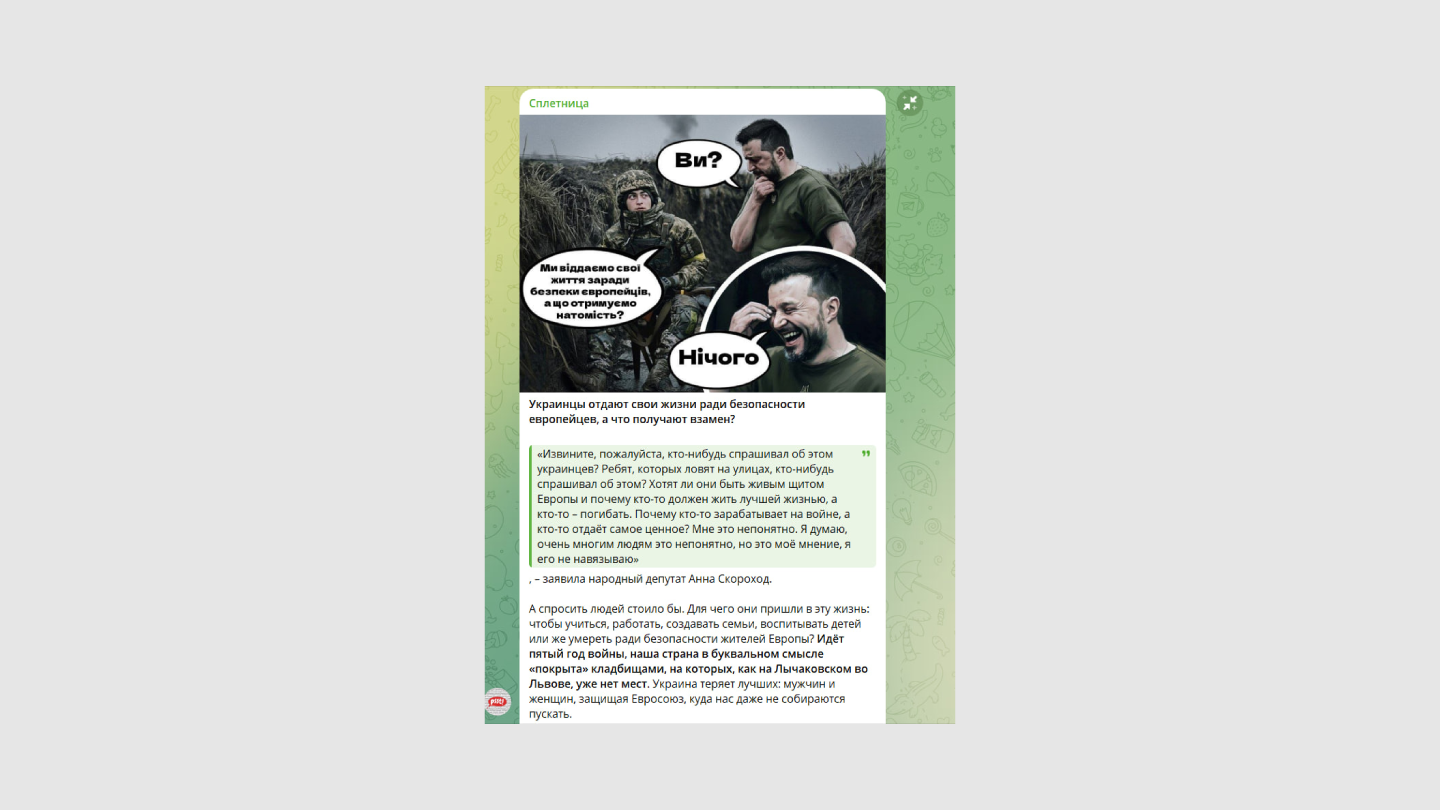 Source: Rubryka
In reality, this message shifts the emphasis from Ukraine’s fight for its independence, sovereignty and territorial integrity to the “protection of EU interests”.
“Ukraine will not be admitted to the EU”
As can be seen in the previous examples, Kremlin and pro-Russian propagandists deliberately work on undermining Ukraine’s European integration and on imposing the idea that the EU has allegedly “betrayed Ukraine”. This is all done to indirectly push Ukrainians to the compromise with Russia and the idea of the union of “three fraternal Slavic peoples of Ukraine, Russia and Belarus”.
In particular, one of the propagandistic resources operating in Chernihiv and Sumy regions claimed that Ukraine will not be admitted to the EU and mocked the entire idea of Ukraine’s EU Membership.
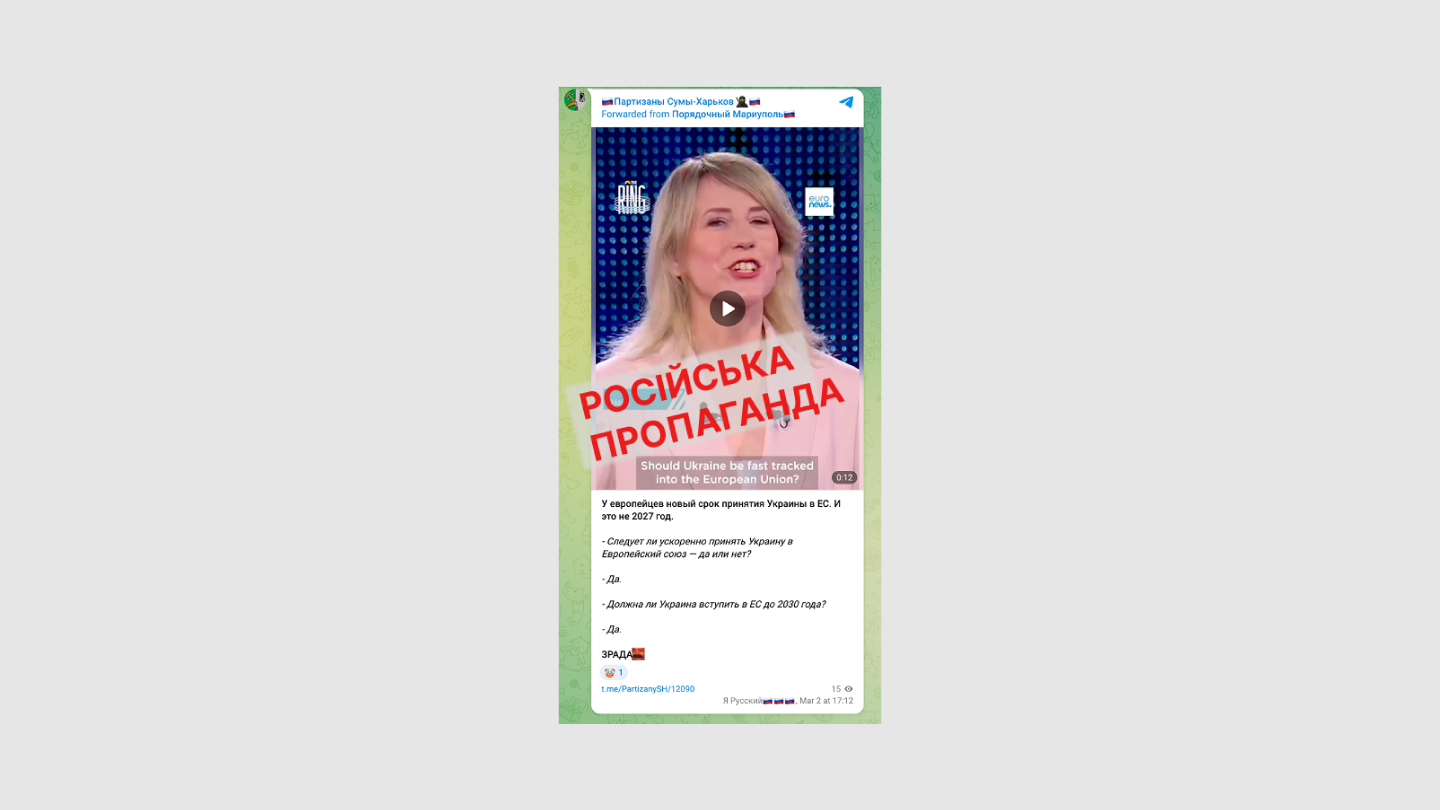 Source: Kordon Media
However, this message is manipulative. Propagandists are promoting the narrative that the EU is prolonging Ukraine’s EU accession, ignoring the complexity of this process. EU Membership has been a lengthy process for each current EU Member State, including the implementation of reforms, the adaptation of national legislation, and political decisions by all EU Member States.
On 15 June, Ukraine and the EU officially opened accession negotiations on Cluster 1 “Foundations of the European Union Accession Process”, the first of 6 clusters on the way to Ukraine's EU accession. Therefore, the European integration process is ongoing, and Ukraine keeps implementing the reforms on its path to EU Membership.
Disinformation targeting Ukraine-Hungary relations
Spring 2026 was also marked by the parliamentary elections in Hungary. That is why the disinformation targeting Ukraine-Hungary relations has reached a new level and found numerous reflections in regional Telegram channels.
In particular, the authors of publications on the Volyn Telegram channel have turned to history and, citing data from “Politico”, accused Hungary of planning to occupy not only Transcarpathia but also Bukovyna and Galicia to restore Austria-Hungary.
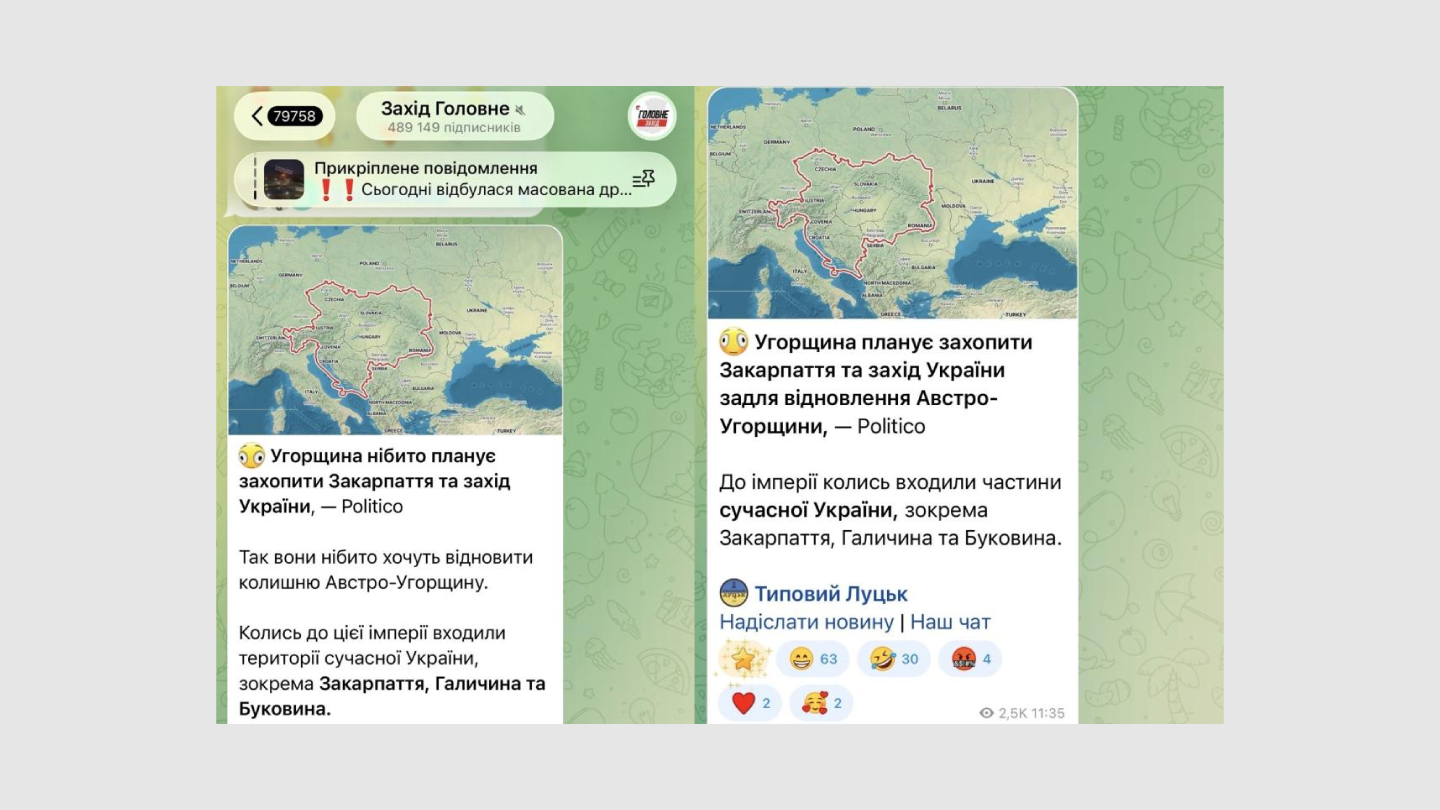 Source: Rayon.in.ua
However, these claims bear no resemblance to reality. “Politico” has published an article titled “Magyar wants to return Austria-Hungary to the map”. However, the publication did not refer to any territorial claims to Ukraine. Instead, the article focused on the idea of strengthening economic and political cooperation among Central European countries.
“German firefighters have shot a parody on TRC in Ukraine”
The video disseminated in Telegram channels of TOT of Zaporizhzhia Region is another example of disinformation targeting Ukraine-EU relations. The authors of the publication stated that German firefighters have allegedly shot a humorous video with a parody of the work of Ukraine’s Territorial Recruitment and Social Support Centres, to engage volunteers in the city of Immenstadt.
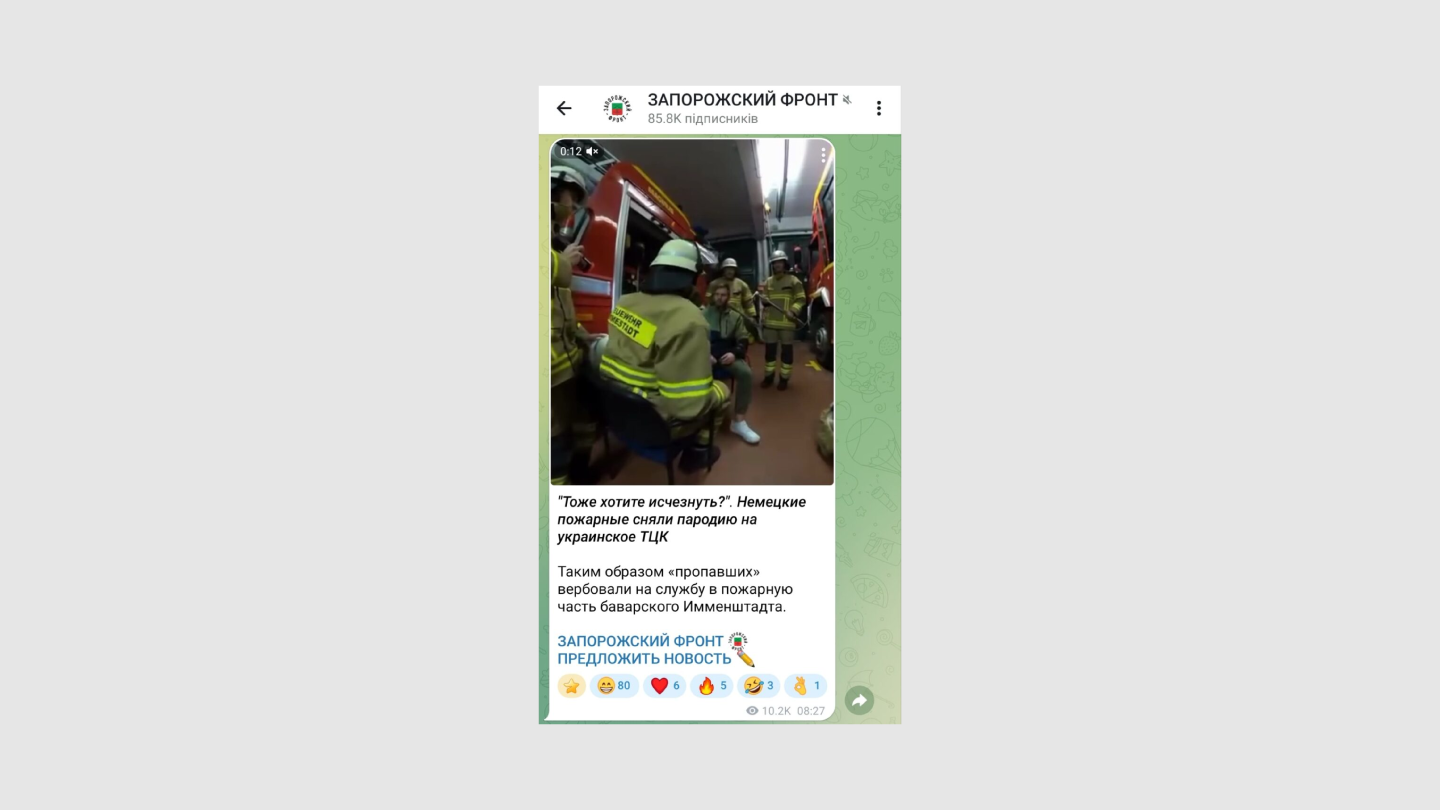 Source: Pershyi Zaporizkyi
Meanwhile, the analysis has shown that the local fire team actually created the original video, but it has no connection to either Ukraine or TRC. The humorous video referred to the campaign aimed at engaging volunteers in the fire service, prompted by a shortage of workers in volunteer fire teams.
“The European Parliament called for the termination of the support of Ukraine”
Lastly, it is worth mentioning the false claims allegedly made by the EU institutions. In particular, claims alleging that the European Parliament is demanding the termination of support for Ukraine and the return of Russian athletes to international competitions have been disseminated on the TOT of Zaporizhzhia Region.
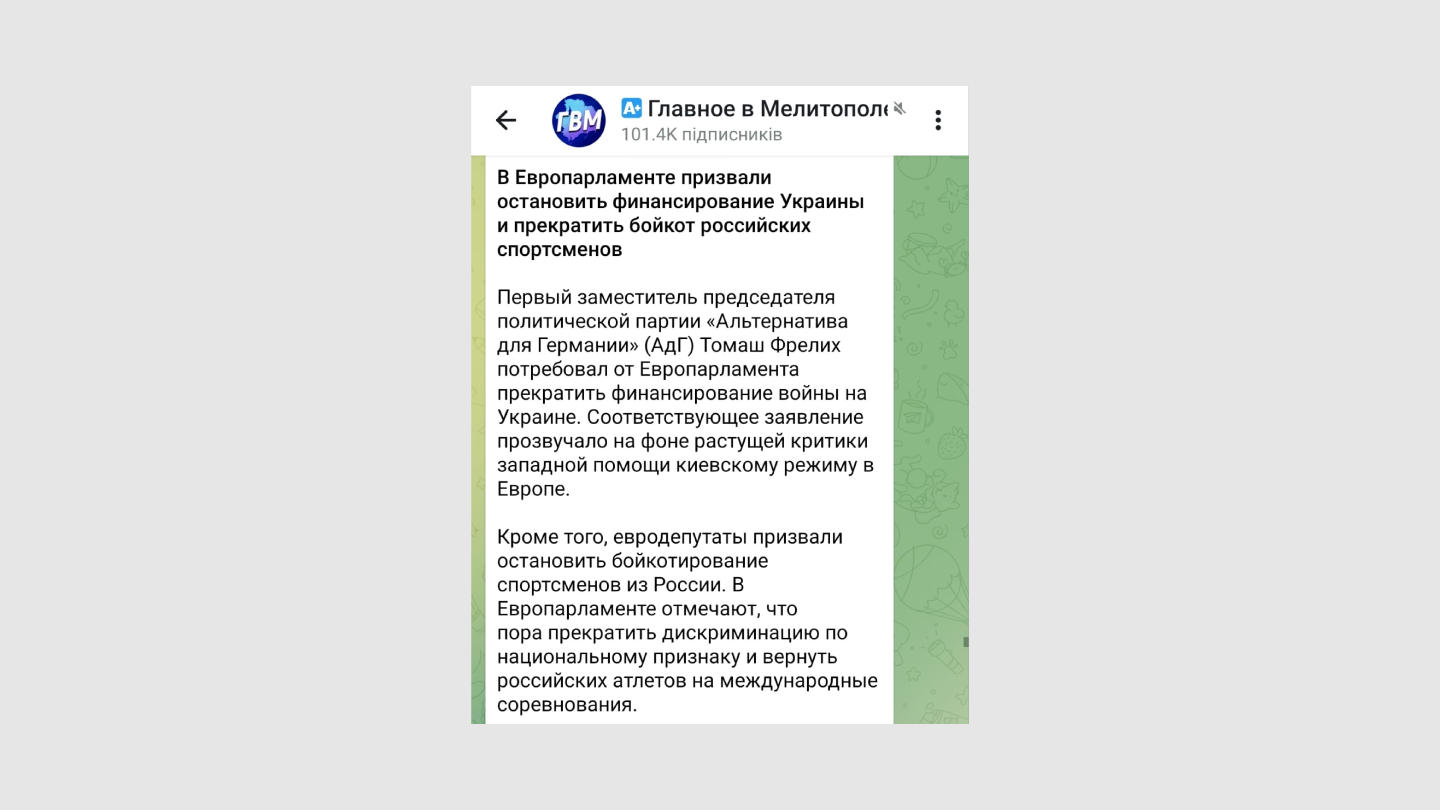 Source: Pershyi Zaporizkyi
In reality, the “news” is based on the claim of the German Member of the European Parliament Tomasz Froelich, who represents the party “Alternative for Germany” (AfD). This political party is continuously standing up against the support of Ukraine and anti-Russian sanctions. In his claim, the politician really criticised the support for Ukraine and called for a revision of the status of Russian athletes. However, he represents the position of a separate political force, not the entire European Parliament.
The official EU position is stable — support of Ukraine during the war. This is proven with consistent political decisions and approved packages of financial and military aid.
Read the full versions of the articles prepared by the journalists of the Regional EU Disinformation Resilience-related Network during the monitoring:
- “The Kremlin (Again) Threatens With Terror. How Russia Is Trying to Undermine EU-Ukraine Relations”, by online media Zaxid.net
- “How Is Disinformation about EU-Ukraine Relations Disseminated in Volyn: the Analysis of Popular Spring Fake news”, by a national network of hyperlocal media Rayon.in.ua
- “Refugees Without Housing and Return of Men to Ukraine: How Clickbait in Ukrainian Media Create a Negative Image of the EU“, by informational agency Rubryka
- “ ‘The West Has Left Ukraine’, ‘The EU Is Lying’: How Russian Propaganda Is Trying to Turn Ukrainians From European Partners”, by online media Kordon Media
- “’Forced Deportation and Recognition of Occupation’: Which Fake News and Manipulations about EU-Ukraine Relations Were Disseminated in the Cherkasy Region”, by Cherkasy informational agency 18000
- “Nazism, Eurovision and Energy Crisis: How Fakes about EU-Ukraine Relations Were Disseminated in Spring 2026”, by online media Informer
- “Secret Europe’s Nuclear Weapon’ and ‘AFU Deserters in France’: Which Lies about the EU Were Disseminated by the Enemy in Spring in Zaporizhzhia Region”, by informational platform Pershyi Zaporizkyi
- “How Europe ‘Is Preparing an Attack’ on Russia and How It Refers to Hitler. An Overview of Russian Lies and Manipulations”, by online media 0629.com.ua
- “Spring Disinformation about the EU: anti-Ukrainian Protests in France, Neglect of the King of Sweden and a Total Ban of Social Media”, by online media Gwara Media
- “Deportations, Technical Examination and ‘Hunting’ on Men: What Is Really Discussed in the EU”, by online media Galka.if.ua
- “From ‘Polexit’ to Leaving Ukrainian Refugees Without Payments: Which Manipulations about EU-Ukraine Relations Are Disseminated in the Khmelnytskyi Region”, by online media Ye.ua
- “The EU in Reflection of Occupational Propaganda. How Do Media of the Occupied Kherson Regions Shape Up the Image of the ‘Enemy EU’, by media platform Vhoru
This quarterly overview was prepared within the EU-UA Disinformation Awareness and Resilience [DARE] Project, which is funded by the European Union. Cases presented in this overview focus on messages in Ukraine’s regional information space that are identified as providing a partial, distorted, or false depiction of reality and spread key pro-Kremlin narratives. This does not necessarily imply, however, that a given outlet is linked to the Kremlin or editorially pro-Kremlin, or that it has intentionally sought to disinform. The content, findings, conclusions, and opinions expressed within this overview belong solely to the authors and do not represent an official EU position, as the information and opinions expressed are based on media reporting, monitoring, and analysis of the 12 participating media outlets (listed above).