Ukrainian Media: News Consumption and Trust in 2025 Report
Over One-Third of Ukrainians Turn to News Exclusively from Social Media
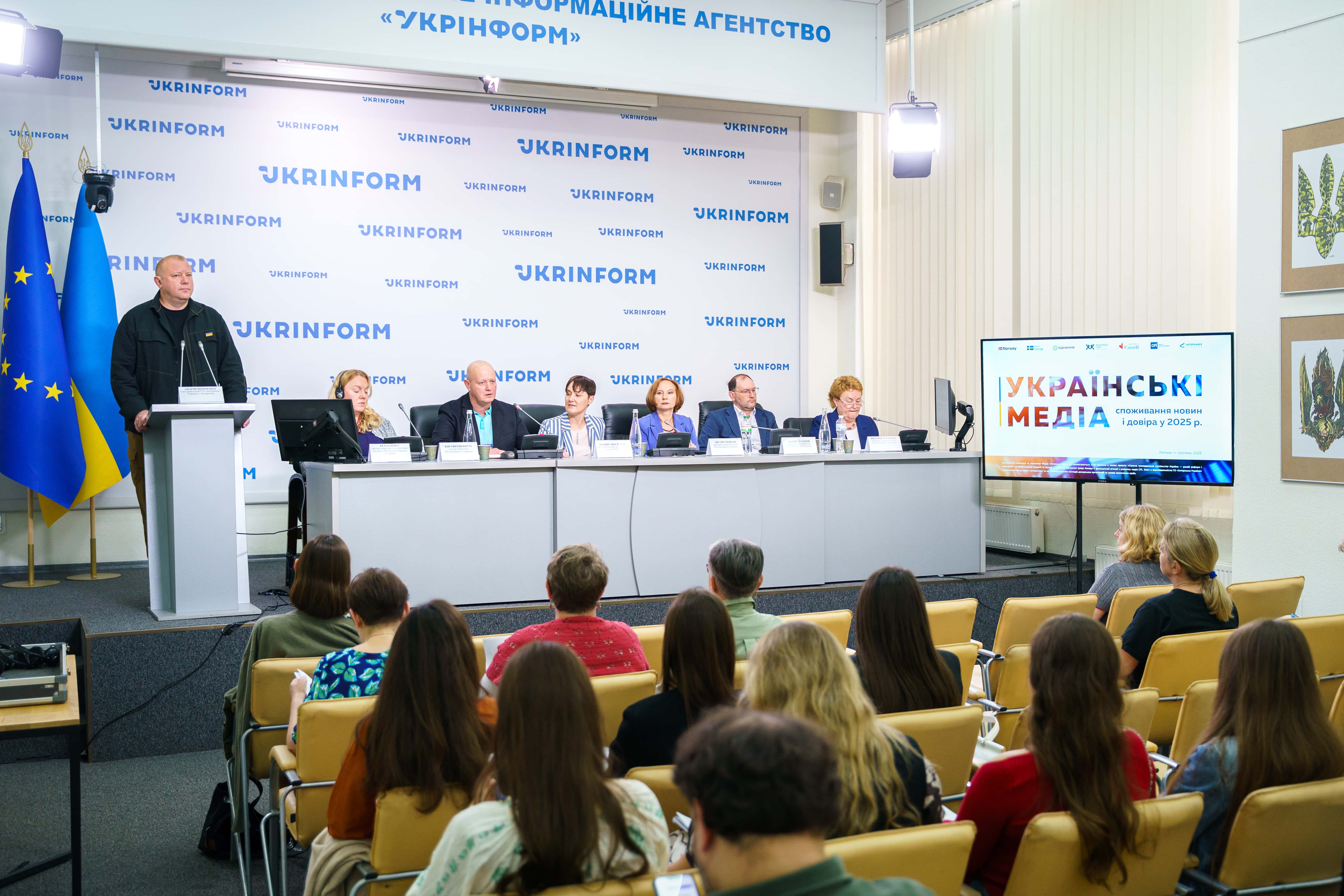
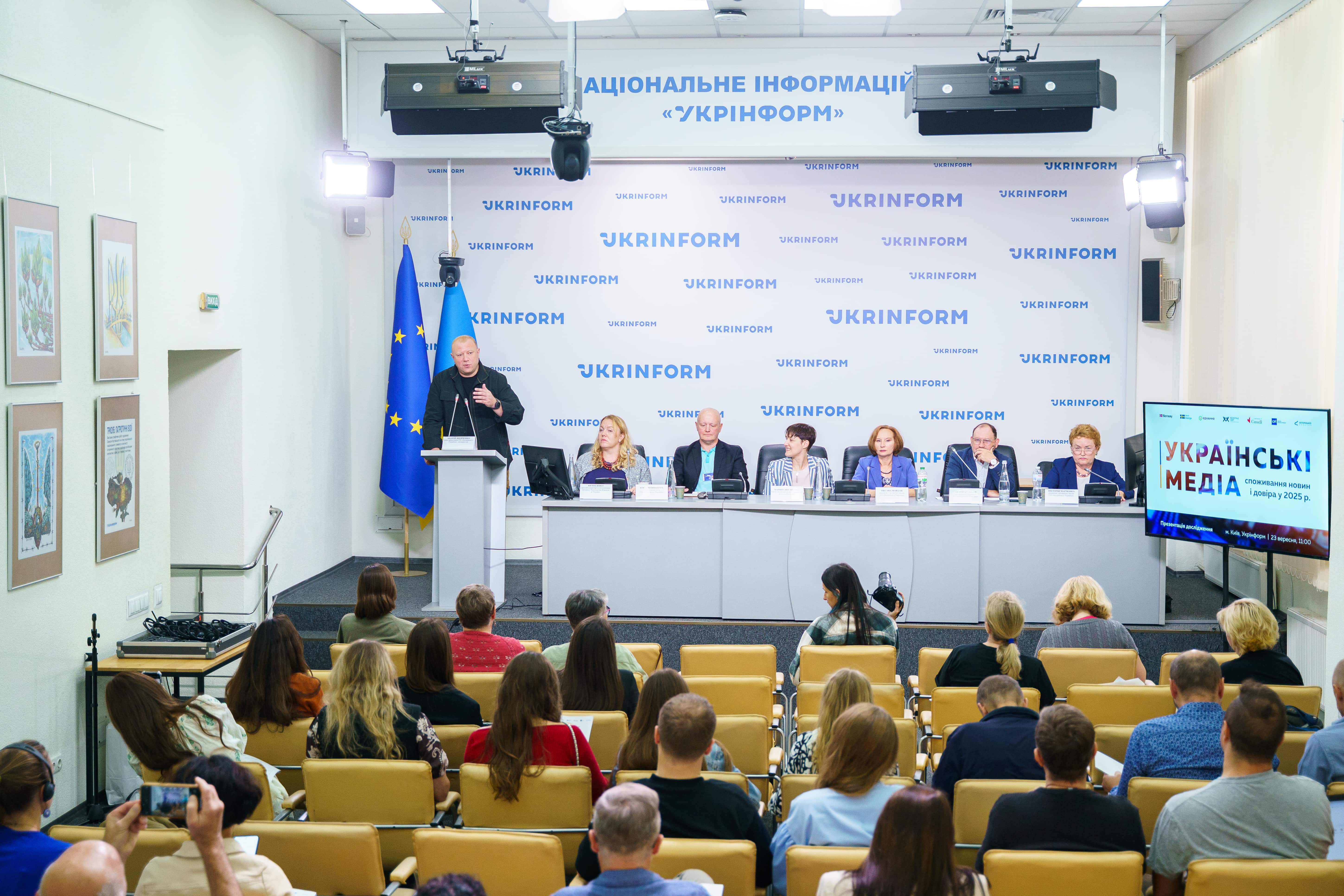
On September 23, Internews Ukraine presented the results of a national study on news consumption and trust in Ukrainian media in 2025. This study reveals key changes in Ukraine’s United News telethon’s viewership, highlights which news sources are most trusted by the public, and uncovers how well Ukrainians can spot disinformation.
Dominance of Social Media and Smartphones
Social media has emerged as the only type of media to consistently gain traction as an information source over the past decade. In 2025, 86% of Ukrainians consumed news via social platforms — a 35% increase since 2015. Television saw the most significant drop, with its audience declining from 85% in 2015 to 33% in 2025. The share of respondents using news websites dropped from 47% to 31%, radio from 35% to 13%, and print media from 31% to just 4%. For more than a third of Ukrainians (37%), social media remains the sole source of news, while 51% combine multiple sources.
An increasing number of Ukrainians consume news on smartphones — a 9% rise since 2022. In 2025, this figure averaged 91%, ranging from 74% among those aged 46–65 to 96% among 18–35-year-olds. Over the past four years, the usage of other devices for news engagement has also grown. In 2025, 41% accessed the news through a television or Smart TV (+7% since 2022), 31% via laptop (+15%), 18% via desktop computer (+7%), and 15% via tablet (+7%).
Ukrainians are more likely to follow national opposed to regional news sources: on social media, 71% opt for national resources compared to 61% for regional platforms; on news websites, it’s 77% versus 51%; on television, 79% versus 47%; and on radio, 70% versus 52%. Only in print media do regional publications significantly outweigh national ones — 80% compared to 26%.
Awareness of the United News telethon remains high at 86%, unchanged from last year. However, its total audience has grown since 2024, rising from 47% to 53%; weekly viewership also increased from 37% to 42%. Half of those aware of the telethon praise its timeliness, yet only 38% trust the information presented (+1% over the year). The same proportion (38%) believes the telethon should continue, compared with 48% who favor ending its broadcast.
Growth of TikTok, Top News Pages, and Influencers
Telegram remains the leading social network for both communication (used by 81% of respondents) and news consumption (72%), significantly outpacing other platforms. TikTok is on the rise — its user base increased from 27% in 2024 to 30% in 2025, while the share of those who use it for news engagement doubled from 4% to 6%. Meanwhile, news consumption on Viber declined by 3% (from 12% in 2024 to 9% in 2025).
75% of respondents are aware of the potential risks of using social networks, and 46% employ security settings to protect their data. 30% believe that the government may restrict access to specific social networks for certain users or ban them entirely if their activities threaten public safety. The networks most frequently named in this context are TikTok (31%), Telegram (18%), and X (9%). If social media regulation increases, the majority of the audience (57%) would seek out new news sources.
The most popular news channels on Facebook and YouTube are primarily traditional media pages: Suspilne News and Espresso lead on Facebook, while TSN / 1+1 and Channel 24 top YouTube. In contrast, on Telegram and Viber, users most often follow channels of non-traditional media like Trukha Ukraine and Blyskavka, respectively.
Among socio-political bloggers and opinion leaders on social media, Ukrainians most frequently follow Serhiy Sternenko (whose popularity grew significantly over the past year from 6% to 11%), as well as Ihor Lachenkov, Serhiy Prytula, Dmytro Gordon, and Vitaliy Portnikov.
Rising Trust in Traditional Media
Respondents express the highest level of trust in news received from family (83%) and friends (77%). Among the top three is the General Staff of the Armed Forces of Ukraine / Ministry of Defense’s media channels, which stand out considering it is a state institution with the greatest trust as a source of information. The least trusted sources are the church (39%) and local authorities (42%). Compared to 2024, trust has grown notably toward the official government website and profiles (from 41% to 47%), the Office of the President (from 44% to 51%), and traditional media (from 47% to 53%).
Media used most frequently by Ukrainians also tend to be public figures whom they trust the most. The majority trust news channels on social media, with trust in regional social media channels rising from 55% to 60% over the past year. About half of the respondents stated they trust news websites. Print media and radio have the lowest levels of trust among Ukrainians.
22% of news website users are willing to pay for access to their preferred media, as long as the cost does not exceed the price of two cups of coffee. The remaining respondents are unwilling to pay, citing the abundance of free alternative news sources.
Vulnerability to Disinformation and Awareness of Fact-Checking Services
84% of respondents are aware that disinformation circulates in the information space, and 75% of them believe they are able to identify it. However, only 6% of those familiar with fake news correctly assessed the authenticity of all three proposed news items, while 78% identified at least one correctly.
81% of Ukrainians know about paid-for (sponsored) content, with 73% confident in their ability to detect it. For 45%, knowing the media owner is important, yet fewer than one-third feel they actually have access to this information. In 2025, more respondents reported knowing the owners of regional media (rising from 9% in 2024 to 23% in 2025) and social media channels (from 21% to 32%). More than half of respondents had encountered at least one of the following narratives: “Martial law benefits Ukrainian leadership by delaying elections,” “The Ukraine-U.S. mineral agreement puts Ukraine under external control,” and “Mobilization of men over 60 and women is due to losses in the Ukrainian army.” On average, 46% accepted these narratives as credible.
Recognition of fact-checking services is increasing; 39% of Ukrainians (+3% year-on-year) are aware of platforms like StopFake, Detector Media, Bez Brekhni (Without Lies), and others, but only 37% of those who know about them have actually used such tools. 72% say they receive sufficient or even excessive information about the war. A majority (54%) do not feel fatigued by these reports, with trust in such materials also at 54% (+3% over the past year). Ratings for the accuracy, reliability, and completeness of war coverage have improved significantly compared to 2024.
11% of respondents report personally consuming news from Russian media, and 16% admit they have someone in their circle who does so. Key motivations include a desire to understand how Ukraine is portrayed (46%) and to hear alternative viewpoints (22%). The share of those who believe Ukrainians choose Russian media for news in Russian has doubled since the start of the full-scale war, from 4% to 8%. However, trust in Russian media among their Ukrainian audience remains low.
Methodology
The study was conducted by InMind on behalf of Internews Ukraine. Between May and August 2025, InMind surveyed 1,649 respondents in Ukrainian cities with a population of over 50,000. The margin of error at a 95% confidence level does not exceed 2.5%. In addition to the survey, five focus group discussions were held with participants from Kyiv, Lviv, Odesa, Dnipro, Kharkiv, Khmelnytskyi, and Poltava.
More research findings
For media inquiries, please contact Nadiia Ushchapivska at nushchapivska@internews.ua.
The study was carried out with the support of the Askold and Dir Fund, administered by ISAR Ednannia as part of the “Strong Civil Society of Ukraine: Driver of Reform and Democracy” project, with funding from Norway and Sweden, as well as with support from the Government of Canada and the French media development agency CFI. The content is the sole responsibility of Internews Ukraine (Ukrainian Media and Society Foundation) and does not necessarily reflect the views of the donor organizations or the governments of the aforementioned countries.
We extend our sincere gratitude to the former USAID ‘Media Program in Ukraine,’ implemented by Internews Network, for its high-quality contribution to this research for over more than a decade.