Results of Russian disinformation monitoring during December 2024–February 2025
The impossibility of the EU integration of Ukraine, threats to state sovereignty, the status of Ukrainian refugees, and other false stories about EU-Ukraine relations
The European Union's delegation to Ukraine continuously supports the Regional EU Disinformation Resilience-related Network of Journalists, which investigates Russian propaganda in different regions of Ukraine. As of now, these are 12 regional media partners that monitor pro-Kremlin propaganda in their regions, improve their skills in effectively countering informational manipulations, and debunk false stories.
From December 2024 to February 2025, the Network’s members and the DARE Project team detected and analyzed key pro-Kremlin falsehoods disseminated in the Ukrainian informational environment, particularly on social media, and defined major trends in EU-Ukraine relations-related disinformation.
Despite slight regional differences, most narratives are repeated in different regions and sources. That indicates a coordinated disinformation campaign targeting Ukrainians' trust in the EU and aiming to discredit the country’s ongoing European integration processes.
Key Takeaways
- Alleged European integration threats to the sovereignty of the EU Member States and candidate countries, an accusation of the EU Member States of “fueling the war” in Ukraine, imaginary plans of “division” of Ukraine's territories between its neighbors and Russia, disinformation about Ukrainian refugees in Europe remain key narratives of Russian propaganda related to EU-Ukraine relations.
- False stories about European integration and EU-Ukraine relations are disseminated in all regions of Ukraine. They are especially visible in the temporarily occupied territories of Ukraine (TOT), aiming to reassure Ukrainians remaining there that Russian occupation is better than EU membership.
- Pro-Kremlin propagandists use various disinformation tactics to convince people of the authenticity of false stories and manipulations. In particular, they present separate quotes of pro-Russian politicians or Eurosceptics as an official position of the European Union, use emotional manipulations, disseminate conspiracy theories about so-called secret plans of European elites on Ukraine, and create visual false news.
- In addition to direct Russian narratives, messages about the alleged provision of EU financial aid to Ukrainians, conducting sociological surveys about the negative experiences of Ukrainian refugees, and establishing a coordination chat aiming to help Ukrainians in different EU Member States were disseminated in the Ukrainian segment of Telegram. All of them aim to collect users' personal data or promote suspicious Telegram channels.
- As a result of monitoring, the DARE project team has distinguished some regional peculiarities in disinformation narratives about EU-Ukraine relations. In particular, narratives about Ukrainian regions “returning” to Poland were disseminated in the Lviv, Ternopil, and Khmelnytskyi regions. Simultaneously, narratives about the French military’s plans to occupy and establish control over ports were disseminated in the Odesa region.
Key Results of Monitoring
Accusations of the EU of Russophobia and a desire to prolong the war
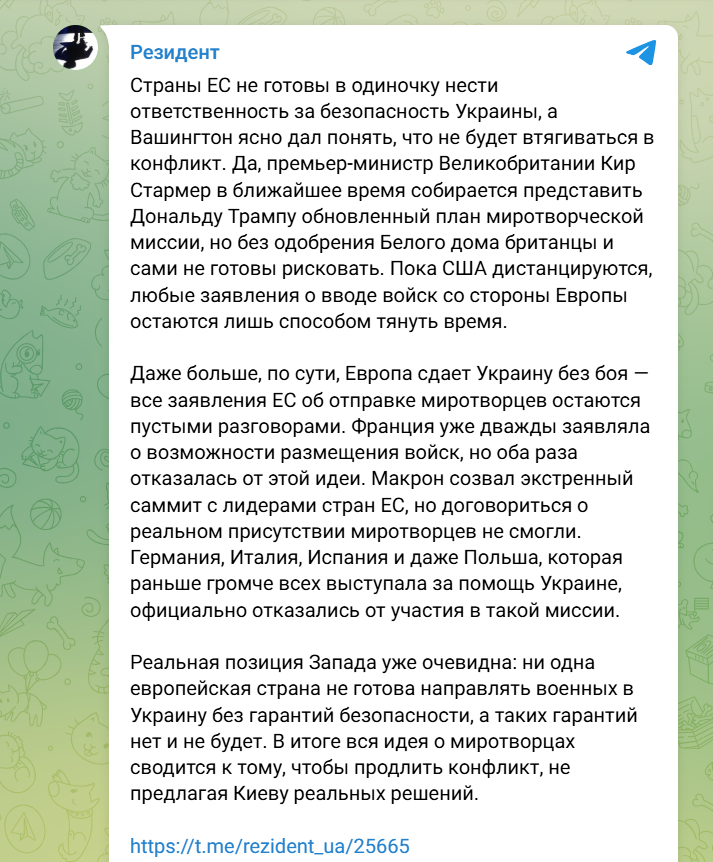
Accusations of the European Union's wish to prolong the war against Russia using Ukraine are one of the most visible disinformation narratives detected during the monitoring period. Similar messages were detected in regional and nationwide pro-Russian Telegram channels, indicating a coordinated campaign aiming to discredit the EU as Ukraine's partner. Simultaneously, opposite messages about the EU “betraying” Ukraine were also disseminated in the reporting period because of the change in the US political course and the alleged negative impact of anti-Russian sanctions on the economies of many EU Member States. This happened even though the EU remains a reliable partner for Ukraine. As of March 2025, the general amount of support provided by the European Union to Ukraine is estimated at more than 116 billion Euro.
For example, the statements of pro-Russian public figures, which were disseminated within the network of regional and nationwide Telegram channels, were detected in February 2025 in the Lviv region. Their major message was that the EU is not planning to end the war and is ready, therefore, to continue to fight with Russia using Ukraine as a proxy. Similar narratives aim to disrupt the trust in the European Union as Ukraine's partner and convince Ukrainians that further cooperation is unprofitable and exploitative for Ukraine, though stable and fair peace in Ukraine, as well as territorial integrity and state sovereignty of Ukraine, are the direct interests of the EU. In particular, these principles were stated in the conclusions of the Euro Summit that was held on 20 March 2025.
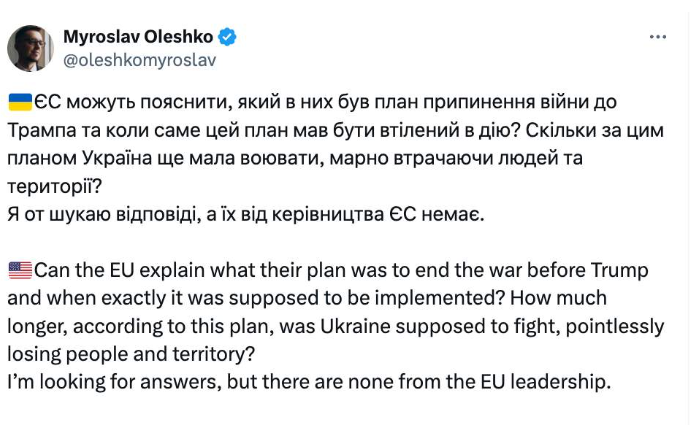
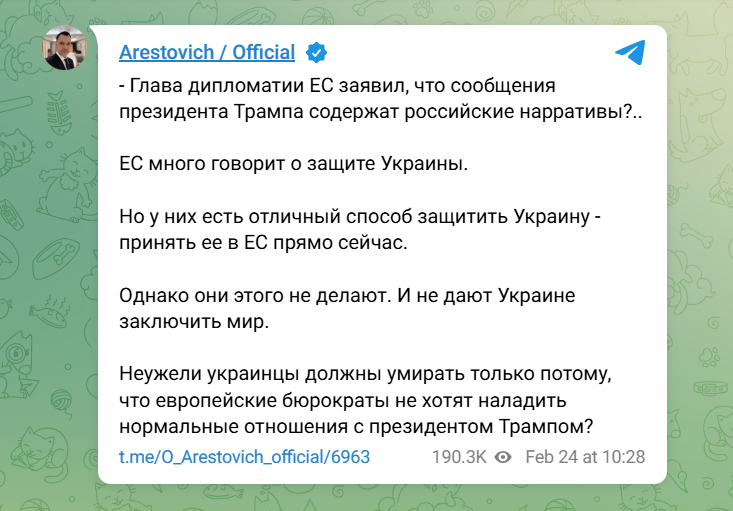
Another case detected in February 2025 proves the previous conclusion. The author of one pro-Russian Telegram channel claimed that Ukrainians “do not have to die because of failures of European bureaucrats,” and the European Union itself does not let Ukraine sign a peace agreement with Russia.
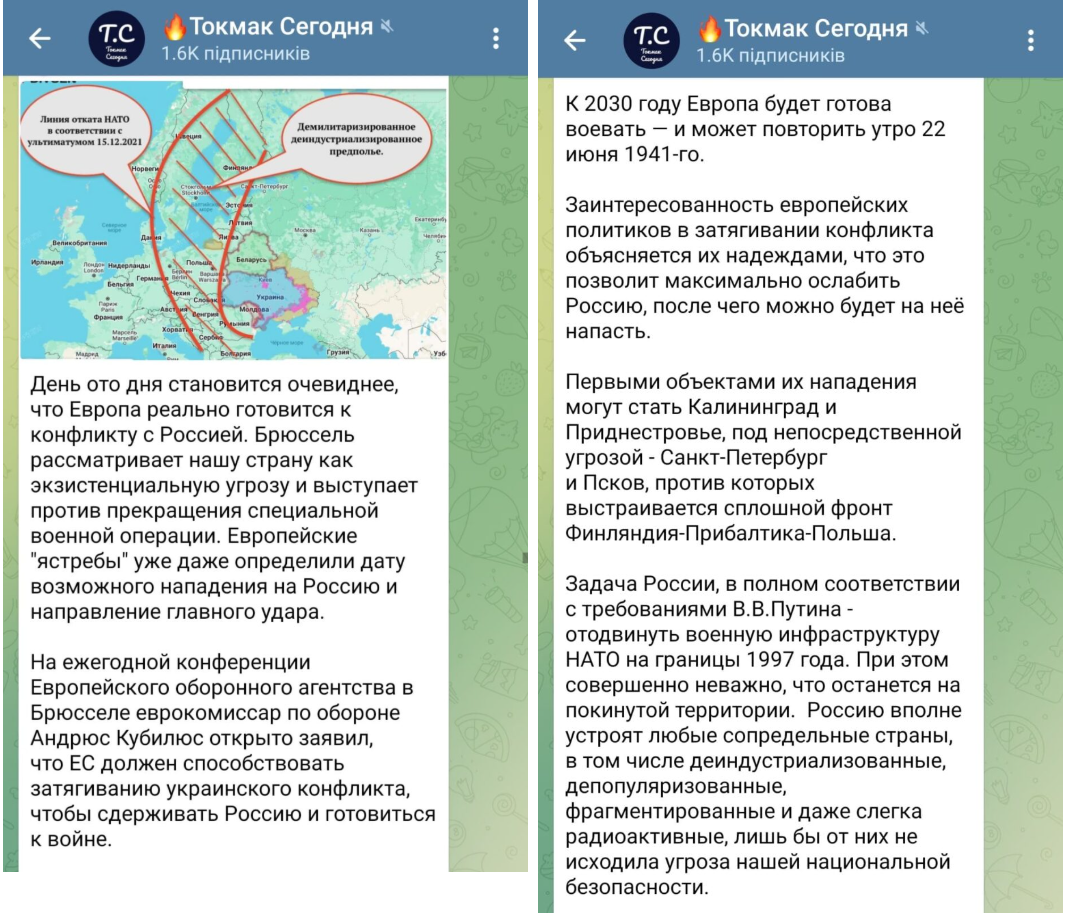
On the other side, Telegram channels targeting Ukrainians operating in the TOT of the Zaporizhzhia region disseminated the message about the EU getting prepared for the war with Russia and planning to attack its territories in the near future. In addition to demonization of the European Union and shifting responsibility for Russia's war against Ukraine, such publications aim at justifying further the Kremlin's demands about the redistribution of influence in Europe and the return of Central and Eastern European countries to the Russian zone of influence. It is worth noting that there is no evidence of “preparation of the attack on Russia by the EU” except for the words of Russian propagandists.
The European Union Threatens State Sovereignty and National Economies
Another huge Russian propaganda narrative concerns the alleged threat of EU membership to the state sovereignty and national economies of Member States and candidate countries. The narratives aim to convince Ukrainians that EU integration was a “mistake” and that the European Union exploits countries for their resources.
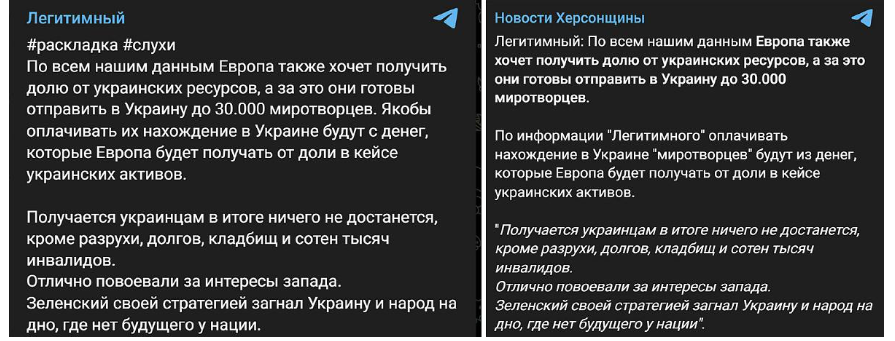
For example, the messages about the European Union's willingness to gain a stake in Ukrainian resources as a price for sending its peacekeepers to Ukraine, and therefore, “leaving Ukrainians with debts and decline of the country,” were detected in the Kherson region. In its turn, there is no evidence of agreements on the provision of Ukrainian resources for the involvement of peacekeepers from the EU countries. However, political actors of the EU member countries, in particular, Germany's ex-chancellor Olaf Scholz, stated that the support of Ukraine, which was attacked by Russia, had to be without demands “to pay” for the provided aid. Therefore, this message is a disinformation campaign discrediting the EU-Ukraine relations.
In addition to this, messages about “destruction of the Ukrainian industry” because of increasing imports from the EU Member States that will lead to the closure of Ukrainian enterprises were disseminated in nationwide Telegram channels. In reality, the EU is continuously supporting Ukrainian businesses regarding special projects. 15 such initiatives were implemented in Ukraine in 2024. The program EU4Business on the support and renewal of Ukrainian small and medium enterprises also keeps working.
Disinformation about the Division of Ukraine between EU Member States
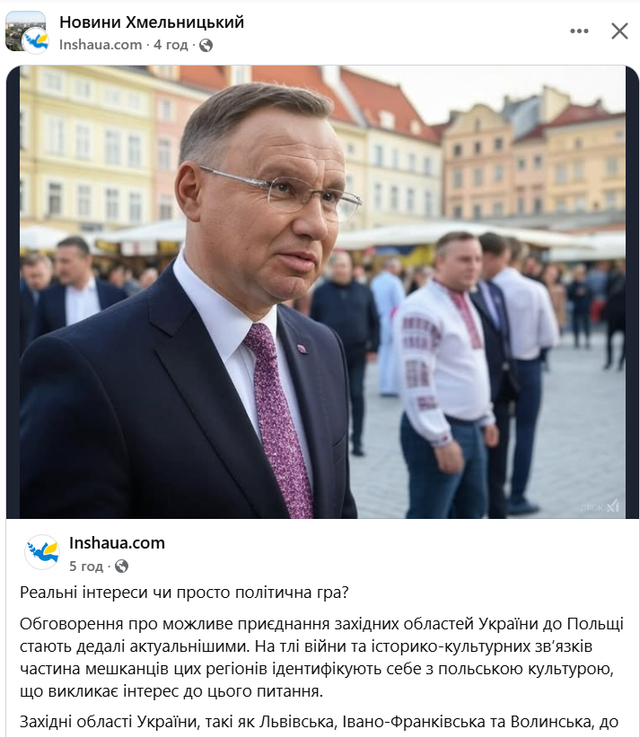
Messages about plans for the division of Ukraine's territory between Russia and the EU Member States are another narrative of Russian propaganda. These are the narratives that have a visible local peculiarity. For example, the messages about Poland's plans to annex Western regions of Ukraine were disseminated in Lviv, Ternopil, and Khmelnytskyi regions. However, the claims about “plans on the annexation of Ukrainian lands to Poland” were refuted by the Spokesperson of the Ministry of Foreign Affairs of Poland, Lukasz Jasina, in 2022. This narrative aims either to fuel historical revisionism inside Poland through the network of local far-right media, and political and civil figures, or to disrupt Ukraine-Poland relations and demonization of Poland in the Ukrainian informational space.
On the other side, the Telegram channels of Odesa and Mykolaiv regions disseminated narratives about the occupation of Odesa, Mykolaiv, and Kryvyi Rih by the foreign military as a part of the “division of Ukraine.” The messages about plans to give Odesa to French military units were disseminated in these regions. Similarly to the previous message, there is no evidence of the existence of such plans. Moreover, the falsehoods about sending the French military to Ukraine were refuted by Ukraine's Center for Countering Disinformation in May 2024.
Telegram channels targeting TOT of Donetsk and Luhansk regions wrote about “the division of Ukraine into 2 parts” between Russia and the United Kingdom. In reality, it referred to the Politico article where the “German scenario” was mentioned among other possible scenarios of the end of the war. According to this scenario, the territories that are not under Russian occupation may strengthen the collaboration with the EU Member States and potentially join NATO, whereas the territories that are occupied by Russia will be left behind till gaining a diplomatic solution is gained. It is worth mentioning that this article did not reflect the positions of political leaders and was rather an analysis of possible scenarios of the event's development rather than real plans.
Generally, the aim of these narratives is to strengthen despair and manipulation of Ukrainians` fears to convince them that the partners have completely left Ukraine and are trying to gain maximum profit from its defeat in the war.
Disinformation about the Ukrainian Refugees in the EU Member States
During the monitoring, false stories and manipulations regarding the state of Ukrainian refugees in the EU were detected. In particular, the members of the Regional EU Disinformation Resilience-related Network detected messages about the alleged closing of the borders of some EU Member States for Ukrainian refugees, their deportation to Ukraine, and their involvement in criminal activity because of their unwillingness to find a job.
For example, the messages about Norway allegedly closing its borders for people fleeing the Western regions of Ukraine and cutting any help for them were disseminated in the Telegram channels of the Volyn and Rivne regions. It is worth noting that even though Norway is not an EU Member State, its government usually joins the EU's policy regarding support for Ukraine.
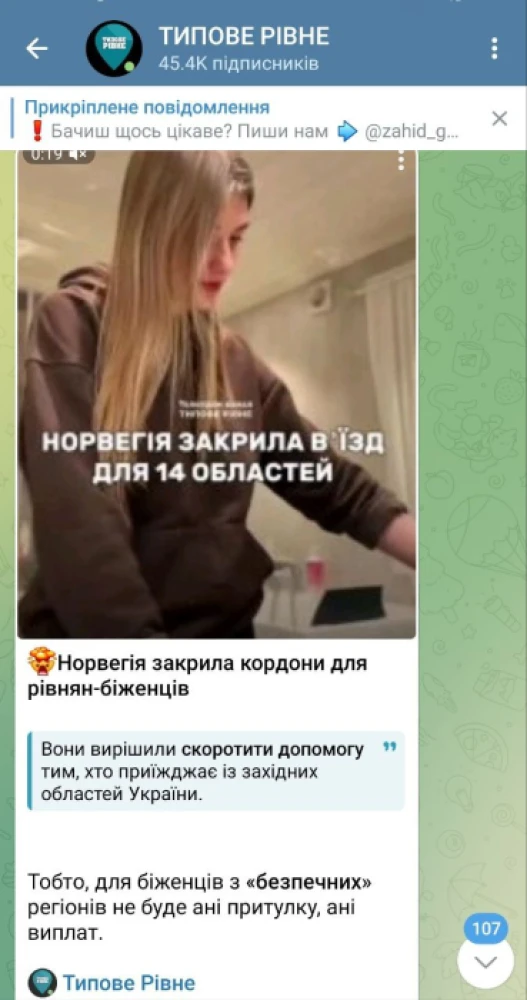
However, such messages appeared to be a manipulation. The state government defined 14 relatively safe regions of Ukraine. Simultaneously, refugees from these regions can still obtain a protection status in Norway, but with a more precise review of their personal cases. Moreover, the changes are not related to Ukrainians or their close family members who have already obtained collective protection in Norway, as well as to those who came to the country within the Medevac scheme. Therefore, such messages are manipulative and aim at creating a negative image of European states through emotional manipulations.
Messages about alleged efforts of the Ukrainian government to cut the provision of help to Ukrainians abroad are another example of disinformation about Ukrainian refugees in the EU Member States. Such messages were detected in the Ivano-Frankivsk region. In reality, these claims were refuted by Ukraine's Ministry of Foreign Affairs Spokesperson Heorhii Tykhyi, stating that Ukraine's government did not demand the cancellation of help for Ukrainians and men of conscription age had access to consular services. The Ministry of National Unity of Ukraine also came up with a similar statement that Ukraine did not aim to return its citizens forcibly or create any artificial limits for Ukrainians abroad. Instead, Ukrainian state institutions would work to save the national and cultural identity of Ukrainians abroad. Generally, such messages are disseminated in Russian and pro-Russian sources in Ukraine and abroad to demonize Ukraine and then accuse the EU Member States of “ignoring” mass human rights violations in Ukraine.
Collection of Personal Data of Ukrainians in Telegram
In addition to direct disinformation narratives, it is worth pointing to attempts to collect personal data and engage audiences with suspicious Telegram channels under the cover of anonymous surveys, the creation of coordination chats by Ukraine's embassies in different EU Member States, and the provision of financial aid. Such cases were detected in Sumy, Volyn, Rivne, Chernihiv, Cherkasy, and Kirovohrad regions. In turn, in the Kharkiv region, such messages were disguised under the alarmist news about imposing restrictions on Ukrainians' maximum period of staying in the EU Member States.
Visual Falsehoods
Another important finding is visual disinformation. In particular, this refers to the creation of fake cover pages of allegedly international media with propagandistic messages complying with the Kremlin's agenda. For example, fake covers of French journals Charlie Hebdo and Courrier International with satirical images of Ukraine's and French presidents were detected in the Kharkiv region. However, as a result of fact-checking, it was detected that such covers do not exist on official websites or social media pages of these media.
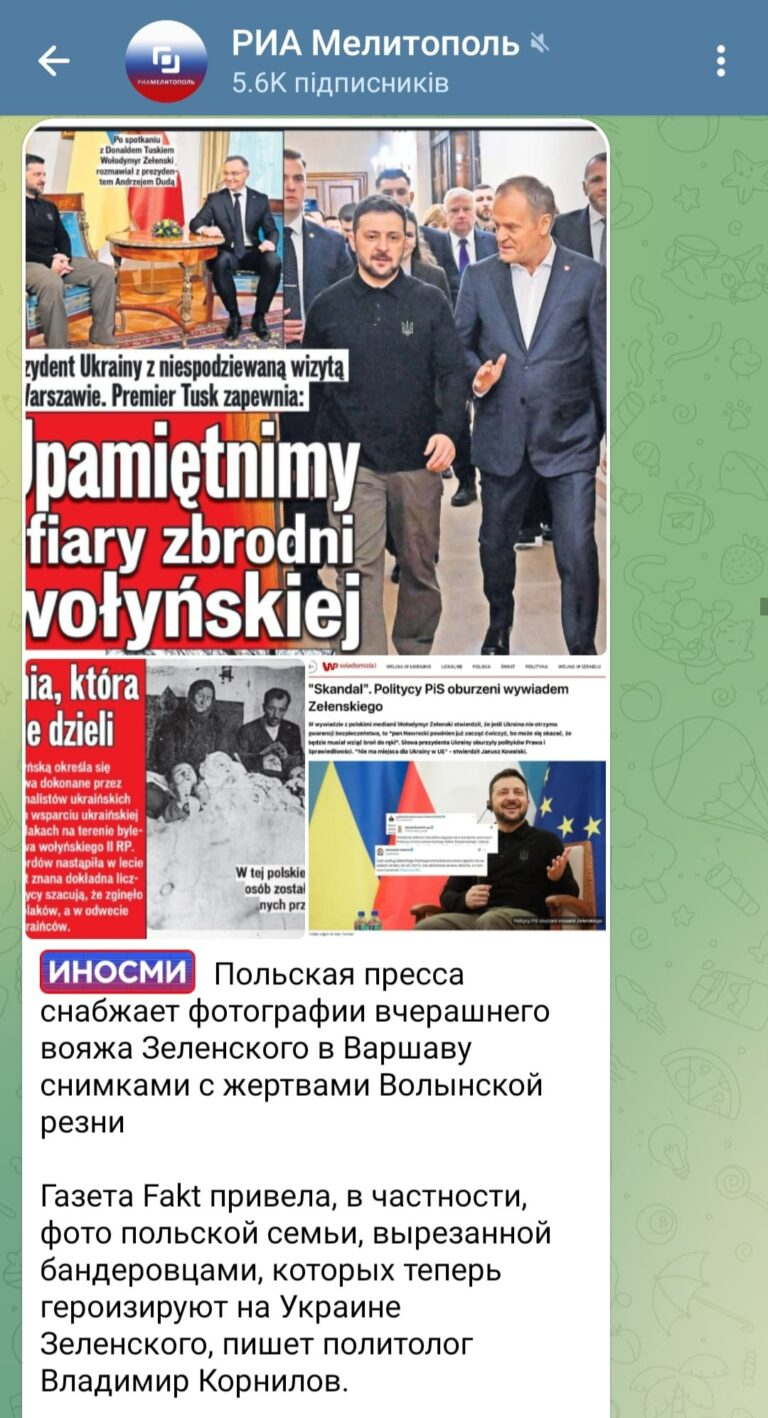
Moreover, Telegram channels on TOT of the Zaporizhzhia region disseminated a fake image of the alleged cover page of the Polish newspaper Fact, where the photo of Volodymyr Zelenskyy's visit to Poland was united with the slogan “We remember the victims of the Volyn tragedy.” This falsehood is very demonstrative, as it appeals to historical revisionism and the strengthening of hatred between the Ukrainian and Polish nations through speculations on historical events.
Claims of pro-Russian public figures and politicians
Lastly, some pro-Russian Telegram channels presented positions of politicians, pro-Russian or EU-sceptical public figures, as positions of the entire EU towards Ukraine. For example, the messages with claims of the Polish far-right politician and the candidate at presidential elections Slawomir Mentzen, Hungary's Prime Minister Viktor Orban, Germany's former Minister of Finances Oskar Lafonten and a deputy of the far-right party “Alternative for Germany” Katrin Ebner-Steiner were detected in regional Telegram channels in Volyn, Rivne, Zaporizhzhia, Dnipropetrovsk, Lviv and Ternopil regions. However, such claims repeat the Kremlin's propagandistic narratives and do not reflect the position on Ukraine of the EU member countries or of the EU itself.
They aim to impose the vision that all the EU Member States are allegedly tired of Ukraine and keep to the pro-Russian position. Therefore, Ukraine has to refuse the EU integration, and the perspectives for EU membership, and stop resisting Russia.
List of publications:
Based on the results of anti-European information manipulations and disinformation monitoring, the members of the Regional EU Disinformation Resilience-related Network of Journalists produced and published the following pieces:
- ”Russophobia and 'Austrian General Staff’. How Russia is trying to destabilize relations between Ukraine and the EU Member States” by the Zaxid.net online media
- ”Behind the scenes of false stories: what lies about the EU Member States were disseminated in the Volyn and Rivne regions” by the national network of hyperlocal media Rayon.in.ua
- ”Inefficient sanctions, Ukraine fatigue, and Ukrainian 'thugs': how Russian disinformation works against EU-Ukraine relations” by the Rubryka informational agency
- ”Russian falsehoods: how Russian propaganda sets residents of the Sumy region against the EU” by the Kordon Media online media
- ”Raw material appendage and payments for refugees: what disinformation on the EU-related issues was disseminated in the Cherkasy region” by Cherkasy informational agency 18000
- ”Mercenaries in 'Bristol', “fight” for Odesa and NATO on the defense of ports: what false stories about the EU were disseminated in the Odesa region” by the Informer online media
- ”Medical experiments, “revival of Fascism” and attack on Russia: what false news about the EU Russian propagandists disseminate in the Zaporizhzhia region” by the Pershyi Zaporizskyi online media
- ”Zelenskyy is a killer, the Brits divide Ukraine into two parts, and Ukrainians prepare Maidan in Washington. What did Russian propaganda lie about” by the 0629.com.ua online media
- ”Digest. Winter disinformation about the European Union” by the Gwara Media online media
- ”Ukraine will refuse the dollar: false stories and manipulations in the Prykarpattia informational space” by the Galka.if.ua online media
- ”The annexation of Western regions to Poland and threats to the EU: what Kremlin's narratives are disseminated among residents of the Khmelnytskyi region” by the Ye.ua online media
- ”Lie as a weapon: what falsehoods about the EU are disseminated in the occupied Kherson region” by Vhoru media platform
The overview was prepared within the EU-UA Disinformation Awareness and Resilience [DARE] Project, which is implemented by the EU Delegation to Ukraine.