

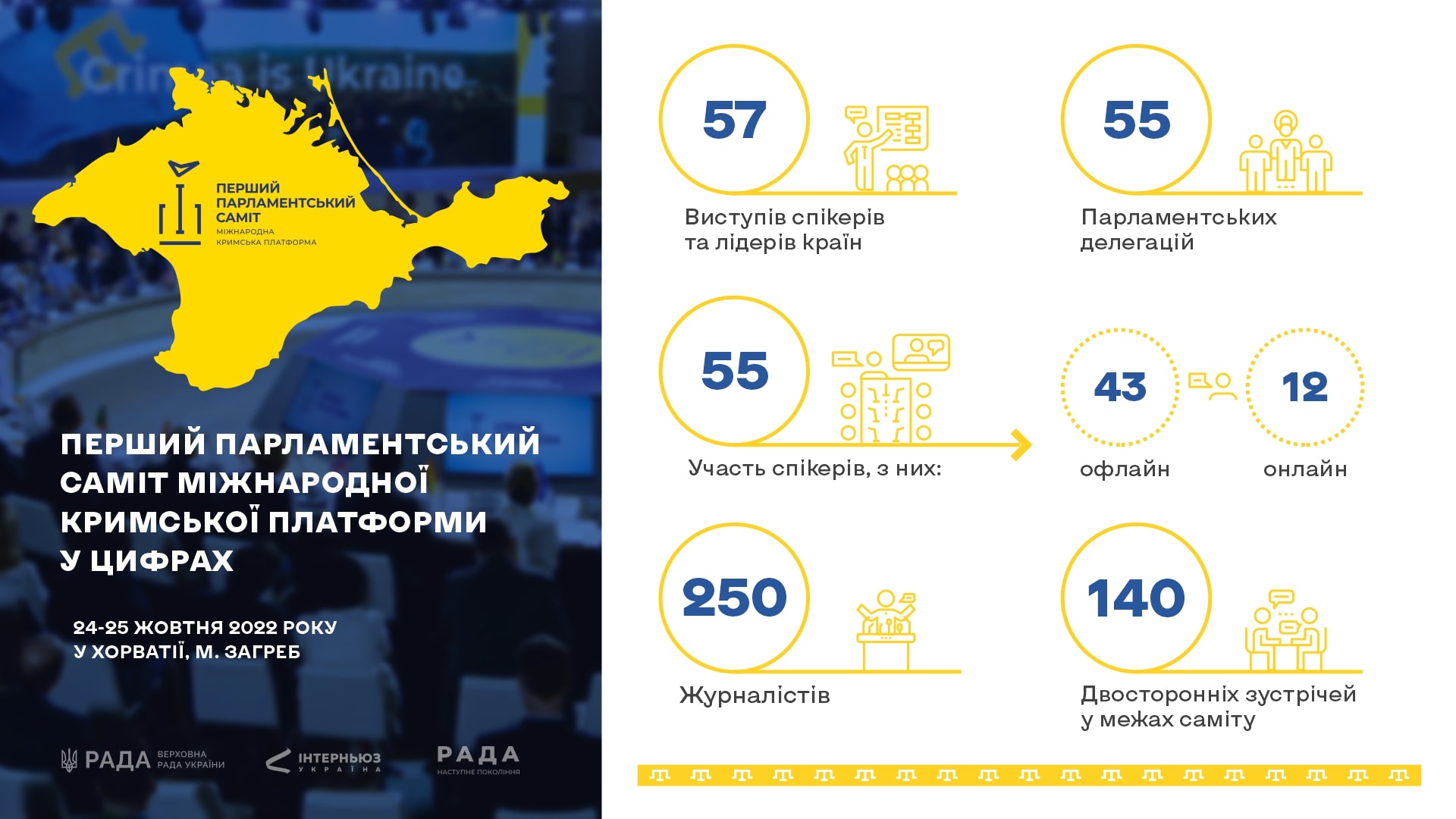
The world will not recognize the attempt to annex Crimea and will provide comprehensive support to Ukraine to restore its territorial integrity!
It is the final statement of the First Parliamentary Summit of the International Crimea Platform, which took place on October 24-25 in Zagreb. The Verkhovna Rada of Ukraine (VRU) and the Sabor (Croatian Parliament) organized the summit, in which delegations from over 50 countries and international organizations participated.
Ruslan Stefanchuk, Speaker of the Verkhovna Rada of Ukraine, emphasized that establishing the parliamentary dimension of cooperation regarding Crimea's de-occupation is important: "By protecting Ukraine, you are also protecting your own states and peoples. We must unite and rally around democratic values, not false totalitarian ideals. The time of truth has come - the strength of our unity must become a decisive response to the front of evil forces, which we must overcome together for the sake of the future."
Representatives of the delegations agreed that they would increase the sanctions pressure on russia and try to overcome the negative impact of the Russian occupation on the Ukrainian peninsula. Nancy Pelosi, the United States House of Representatives speaker, noted that the broad and high representation at the summit demonstrated strong international parliamentary unity around Ukraine.
Summit participants condemned the russian federation for:
USAID RADA: Next Generation Program joined in organizing and participating in the First Parliamentary Summit of the International Crimea Platform. At the request of the Verkhovna Rada leadership, Program provided organizational, information, and analytical support for the summit and was also a co-organizer of the expert panel.
These links allow you to download information products developed by the Program for the First Parliamentary Summit of the International Crimea Platform:
Igor Kogut, Program Director, and Tetiana Bibik, Program Deputy Director, also visited the Croatian Parliament. They had meetings with the heads of departments responsible for interaction with citizens and the department for European affairs and international cooperation. Both parties agreed to continue their partnership in Ukrainian legislation adaptation to EU law and conducting training events to strengthen VRU Secretariat capabilities, particularly regarding the parliamentary committees' work, parliamentary control implementation, governmental-parliamentary interaction, and the parliamentary communication strategy.
On October 26, leaders of the VRU Secretariat and the Croatian Parliament's service signed a Memorandum on cooperation regarding European integration issues. The document sets the institutional framework in which USAID RADA: Next Generation Program could assist Ukraine's Parliament and engage experts and representatives of the Croatian Parliament's service for training and transferring their experience to Ukrainian colleagues.
Since May 2022, USAID RADA: Next Generation Program has been cooperating with Croatian partners on the issue of European integration, which became especially relevant after Ukraine acquired EU candidate status. Within this partnership, work consultations and trainings were held regarding practical legislation adaptation issues and the necessary institutional and normative changes in the work of the national parliament.