Event
USAID “RADA: Next Generation” Program presented the Index of the Quality of Legislative Process
On May 26, USAID “RADA: Next Generation” Program (RANG) presented the Index of the Quality of Legislative Process, a special tool to evaluate the quality of the law-making process in a parliament. The Index assessed the VRU’s 6th session (August 2021 - January 2022) that was held before russia’s full-scale invasion.
118 respondents took part in the Index’s questionnaire: 20 politicians, 45 members of the Parliamentary Secretariat’s staff, 36 representatives of the executive authorities and 17 experts from CSOs.
Overall legislative performance of Ukraine’s Parliament was evaluated under 3.30 points, and the following indicators were assessed as follows:
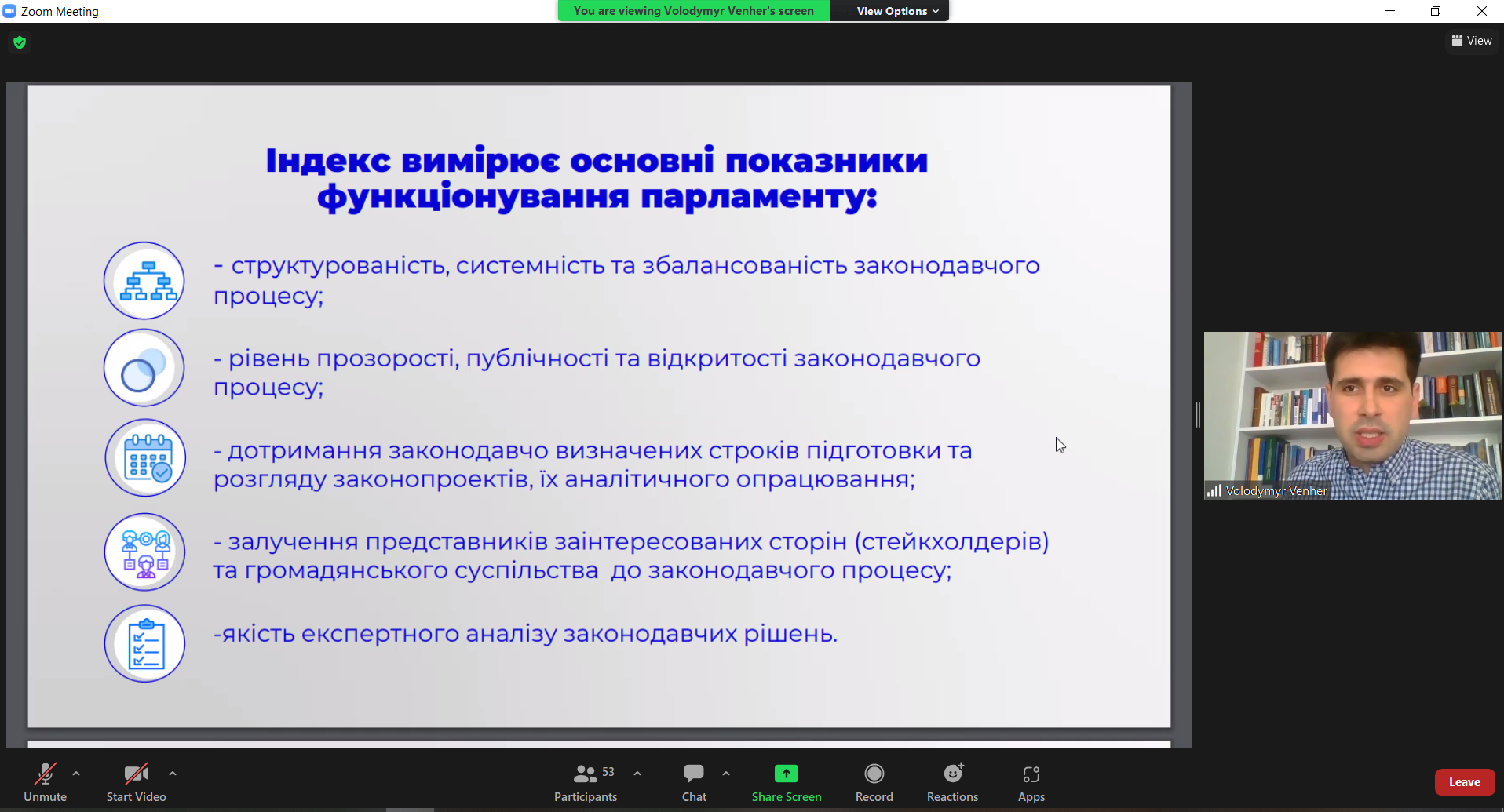
- Structure, consistency, and balance of the legislative process - 2.97 points;
- The level of transparency, publicity, and openness of the legislative process - 3.63 points;
- Compliance with the defined deadlines for the preparation and consideration of bills, and their analytical processing - 3.29 points;
- Involvement of stakeholders and civil society representatives in the legislative process - 3.41 points;
- Quality assessment of expert analysis of legislative decisions (including expert analysis content) - 3.23 points.
Thus, the participants of the meeting agreed that planning and consistency are the spots of the legislative process needing more progress and development. In contrast, the level of transparency received the highest points. In particular, the respondents admitted that the VRU’s website is accessible and user-friendly. However, CSOs suggested that there were many steps to take to make the Parliament more open to the public.
The other indicated problem was thatMPs often ignore recommendations of legal and scientific expertise prepared by the Parliament’s Secretariat. At the same time, most respondents indicated that the Secretariat's analytical capacity should be strengthened.
Overall, nearly 60 participants took part in the presentation of the Index. The Index will be presented for future VRU’s sessions. The participants also discussed the possibility of developing a special analysis of the legislative process in wartime.
It should be noted that the Index is a self-assessment tool of the legislative procedures, their effectiveness, and compliance with international parliamentary standards. It measures the quality of VRU’s legislative process based on the five indicators mentioned above.
The indicators are assessed by points from 0 to 5 by four groups of respondents: politicians (MPs and their aids), Parliamentary Secretariat’s staff, executive authorities (ministries, agencies, etc.), and civil society. The final score of the Index and report with respective recommendations are made based on the respondents’ answers.