

Ukrainian police and the military found more than 20 bodies of civilians in the cars, whose owners had been trying to escape the “grey zone” in the Kupiansk region. 13 of the bodies were found to be those of children.
One of the chambers was set up in a cellar in the village of Pisky-Radkivski, whereas another chamber was located in a police station in Velykii Burluk. According to Ukrainian law enforcement officers, russians kept local residents in inhumane conditions, beating and abusing them.
According to a local resident, the russian occupiers dug trenches and forced people they suspected of collaborating with the Ukrainian Armed Forces to collect the bodies of killed civilians from the streets of the town for reburial.
russian occupiers took the ZNPP official to an unknown location on September 30 and released him two days later, with the IAEA coming out against his abduction. According to IAEA Twitter, “Mr. Murashov is now with his family and will not continue at ZNPP.” Enerhodar’s exiled Mayor Dmytro Orlov, who spoke to Mr. Murashov after his release, said the plant official told him he had spent two days “in solitary confinement in the basement, with handcuffs and a bag on his head”.
On October 5, putin instructed the russian government to "acquire into federal ownership" atomic objects of the ZNPP. A day later, the russian occupiers stole the plant’s seal, which was used to certify ZNPP officials’ signatures on the documents. President of Ukraine Volodymyr Zelensky discussed the situation at the plant with IAEA Director General Rafael Grossi, calling the illegal seizure “an act of raidership”.
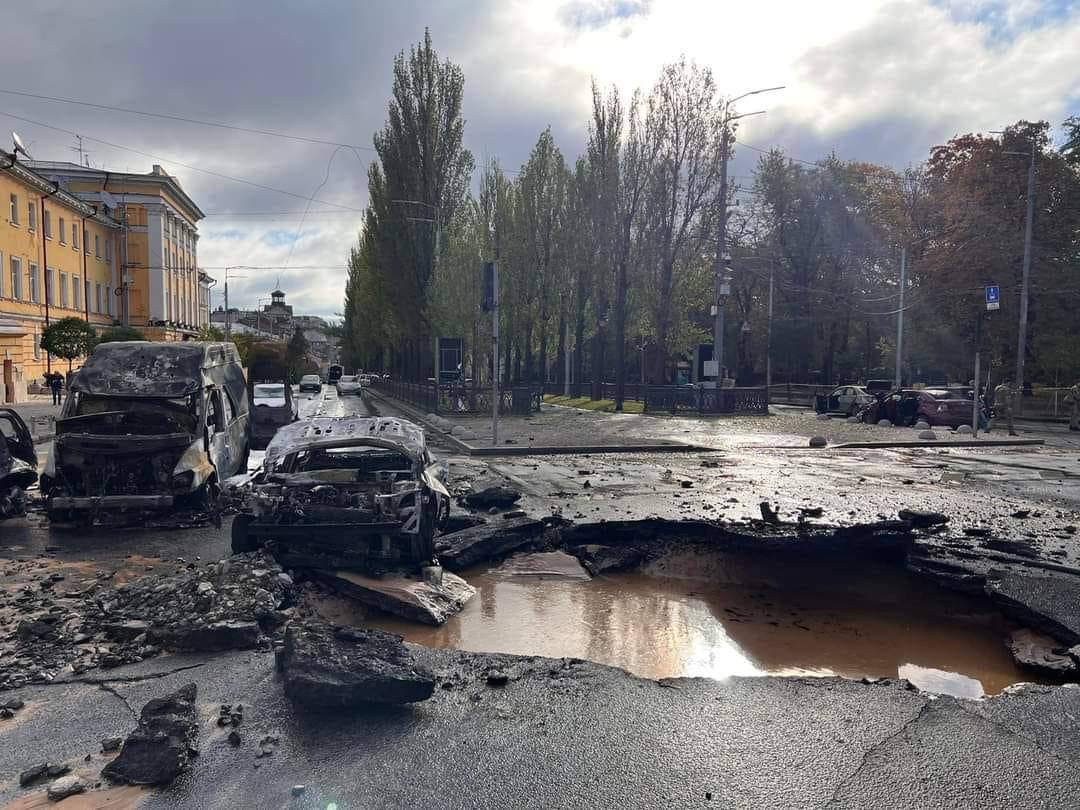
The russian military fired seven missiles at residential buildings in the city, damaging them and starting the fire. Ukraine’s State Emergency Service workers managed to rescue 25 people from the rubble.
The attacks resulted in the death of 19 people and injuries in 108 more. russian terrorists damaged 199 objects, including private houses, residential buildings, and critical infrastructure objects, namely energy facilities.
Senators Lindsey Graham and Richard Blumenthal introduced a standalone bill and an amendment to the National Defense Authorization Act that would cut off US aid to any country that recognizes the results of illegal referenda to incorporate four Ukrainian regions into russia.
“No economic aid, no military aid to any country that recognizes this annexation. It is a land grab. It's a steal," Mr. Blumenthal told reporters, commenting on the draft legislation.
Speaking to reporters at a joint news conference with Senator Richard Blumenthal introducing legislation that would block US assistance to any country that recognized russia’s sham referenda in Ukraine, Mr. Graham stated that, from his point of view, the use of a nuclear weapon by russia in Ukraine would be an attack on NATO itself, as the radiation would not be confined to Ukraine. Should that be the case, the US and its Western allies would have to devise an “overwhelming” response that would be “catastrophic” to russia, the Senator concluded.
The relevant information was released on the website of the White House on September 30.
The bill, titled “Continuing Appropriations and Ukraine Supplemental Appropriations Act, 2023,” provides the fiscal year 2023 appropriations to Federal agencies through December 16, 2022, for continuing projects and activities of the Federal Government and includes supplemental appropriations to respond to the situation in Ukraine. In particular, it envisages the allocation of $3 billion for military assistance to Ukraine, including training, provision of equipment, weapons, and logistical support; $1.5 billion for replenishment of stocks of American equipment provided to Ukraine; $2.8 billion for further military, intelligence and other defense assistance to Ukraine.
On October 5, at a plenary meeting of the European Parliament, President Roberta Metsola stated that the European Union should deliver tanks to Ukraine for it to be able to regain its territory, namely the German-designed Leopard II tanks. Addressing the concerns of several EU states regarding donations’ possibly compromising their own national defense capabilities, Ms. Metsola contended that Leopard tank deliveries "would not significantly dent" individual countries' overall preparedness. She repeated her call on October 7, at the informal EU leaders summit in Prague.
The EP President also reiterated continued support for Ukraine’s territorial integrity by reaffirming the non-recognition of russia’s sham referenda and called for speeding up the procedure of having Ukraine join the bloc.
In a resolution adopted on October 6, Members of the European Parliament stated that the results of the sham referenda conducted at gunpoint to annex the Donetsk, Kherson, Luhansk, and Zaporizhzhia regions were “null and void” and called on EU member states to adopt additional severe sanctions.
They also hailed the courage of the Ukrainian people defending their country and European values, urging the EU member states and other countries to increase massively their military assistance to Ukraine, particularly in areas requested by the Ukrainian government.
As for the recent russian threats to use nuclear weapons, MEPs called on member states and international partners to prepare a quick and decisive response should russia conduct a nuclear strike on Ukraine.
The Summit took place on October 6-7 and was centered around the interparliamentary discussion of the new and emerging global challenges. Ms. Kondratiuk presented Ukraine’s position at the panel discussion dedicated to food, energy security, and economic challenges and had a series of meetings with G20 Parliamentary speakers, during which she discussed the military, financial, and humanitarian aid to Ukraine, sanctions pressure on russia, and the post-war rebuild of Ukraine.
President of the European Parliament Roberta Metsola gave a commentary to Euronews on the events of October 10, calling russia’s attacks “sickening” and amounting to war crimes. She stressed that “appeasement has never worked and appeasement will never work” and claimed that the EU “must respond to Ukraine's demands” for heavy weaponry.
Appeals:
Draft laws adopted in the second reading:
According to him, the parliamentary summit should demonstrate the unity of the international community in upholding the norms of international law and strengthening Ukraine's institutional capacity regarding the return of Crimea. "I am talking about the creation of a group to support the Crimean platform in many European parliaments, and the creation of a separate group U4C (United for Crimea), which will unite parliamentarians from different countries," Kornienko stressed.
Ukraine’s State Bureau of Investigations issued a suspicion of treason to Renat Kuzmin, dt.ua reports. He is accused of posting propaganda materials against Ukraine in the mass media before and after the russian full-scale invasion.
Namely, it:
mainly through narrative development and info production for social media, both in English and Ukraine daily.
On October 3-4, Program in cooperation with the EU-funded project Association 4U conducted the first part of training to introduce the basics of EU law and issues on harmonization of the domestic legislation with the EU law. The training started with opening remarks from Marc Ellingstad, Director of USAID Democracy and Governance Office, Mykhailo Teplyuk, Head of the Main Legal Department, and Xavier Camus, Head of the Good Governance and Democratisation Section at the EU Delegation to Ukraine. 40 members of the newly established sub-committees on EU integration within VRU’s Committees and the Research Service participated.
The next training will take place on October 10-11 due the high demand from the VRU (80 people registered to participate in training).
The course consists of 10 sessions for high-school students and university students and it will present civil rights, activities of the Verkhovna Rada of Ukraine, and democratic values. The first session took place on October 7 and attracted more than 600 participants from all regions of Ukraine and IDPs abroad.
On October 5, Head of Practice Accountability at Westminster Foundation for Democracy (WFD), Franklin De Vrieze presented the research “Making the Law Count: post-legislative scrutiny as a new approach to law implementation and the oversight role of European parliaments. More than 60 people took part in the event, among them, the Committees` Secretariat staff, VRU’s legal department.
upon a request from the VRU Secretariat.
in cooperation with the EU Delegation in Ukraine and Natolin4CB. The main aim is to raise awareness among the VR staff about the educational opportunities.