

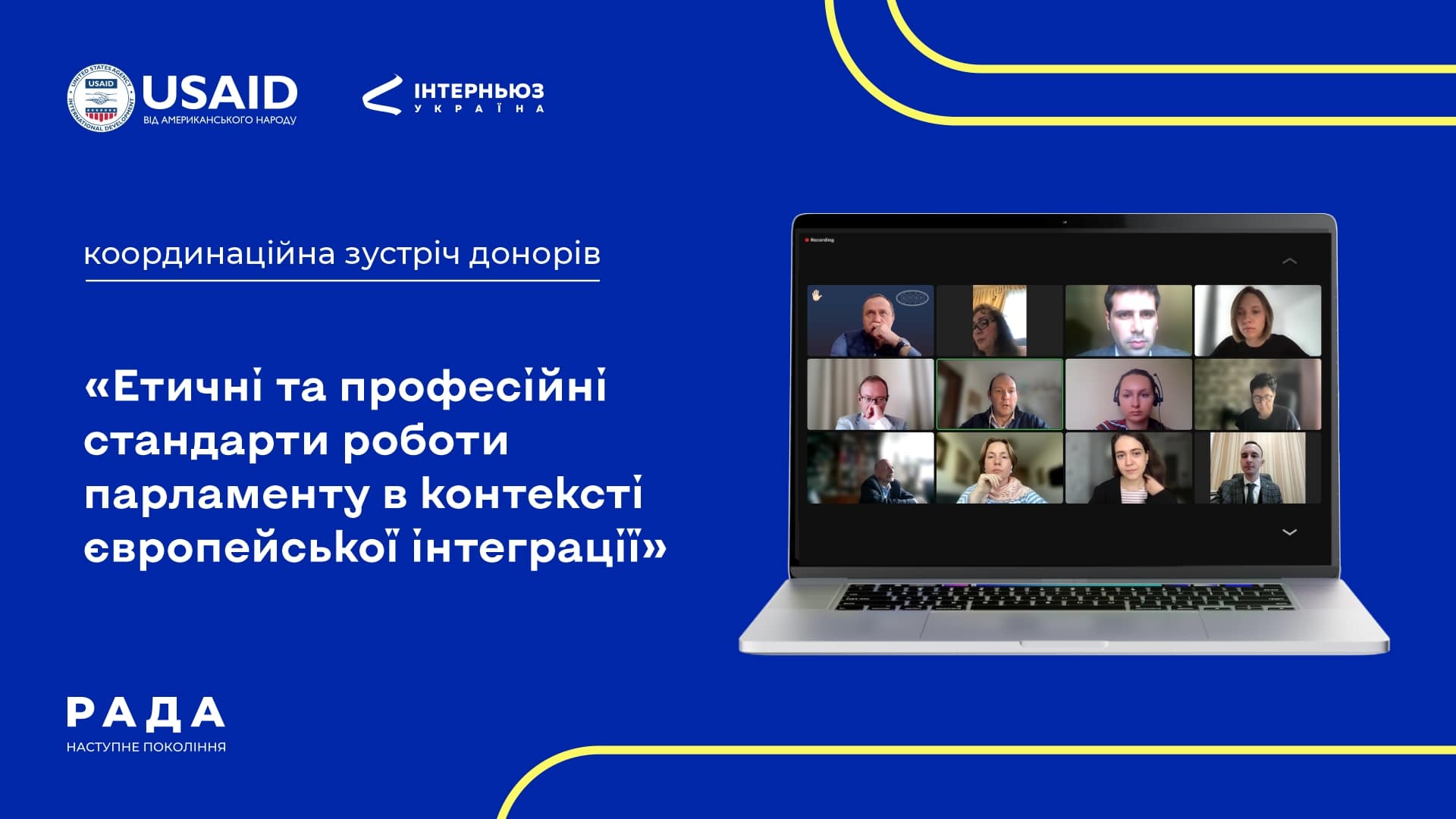
"Coming back to ethical principles is also a struggle against Russia, against its nihilism and immorality," said Ukrainian MP Viktoriya Podhorna during a donors coordination meeting.
On October 26, USAID RADA: Next Generation Program held an international parliamentary technical assistance coordination meeting on the topic: "Ethical and professional standards in the work of the parliament in the context of European integration." Forty-four participants joined discussions on the Code of Ethics for Ukrainian MPs.
Marcin Walecki, expert on parliamentary ethics at Westminster Foundation for Democracy, presented which aspects of MPs’ work could be covered in the MPs’ Code of Conduct, which helped develop a common understanding of the Code of Conduct and ethics standards utilizing best international practices and expertise.
Victoria Podhorna, MP, Head of the sub-group on the Code of Ethics and status of MPs of the Working Group on the preparation of comprehensive proposals for amendments to the laws of Ukraine in the field of parliamentary law, said that the draft Code of Ethics would be presented by November 10. The Code not only establishes ethical principles but also attempts to regulate ethical behavior MPs. The subgroup proposes to create a separate committee on ethics, which will have the right to recommend sanctions against people's deputies in the amended Code. Also, Podgorna hopes that the Code of Ethics in combination with anti-corruption legislation will help to confirm trust in Ukrainian MPs.
A discussion on the lobbying issue occurred between the participants of the coordination meeting. Walecki and Podhorna argue it should be regulated by a separate law, not in the Code. The participants also discussed who and how (anonymity issue) could complain about MPs' ethical violations. Podhorna invited those present to participate in further discussions of the Code as soon as it is presented.
USAID RADA: Next Generation Program also presented the results of the conducted Legislative Quality Index at the International Parliamentary Technical Assistance Coordination Meeting. Volodymyr Venher, Legislative Capacity Building Senior Expert, noted that the new methodology, based on self-assessing, was applied to evaluate the work of the seventh session of the VRU’s ninth convocation. 75 people participated in the survey, namely politicians, the VRU Secretariat, civil society, and other stakeholders.
The legislative process received the lowest average scores for the indicators "legislative capacity" and "quality of expertise," and the highest one was for "observance of procedures." The demonstrated results of the index of the seventh session proved that the Verkhovna Rada could exercise its powers during wartime, as the index did not decrease compared to the previous session.