USAID “RADA: Next Generation” Program restored the coordination of donor community for the strengthening parliamentary representation in Ukraine
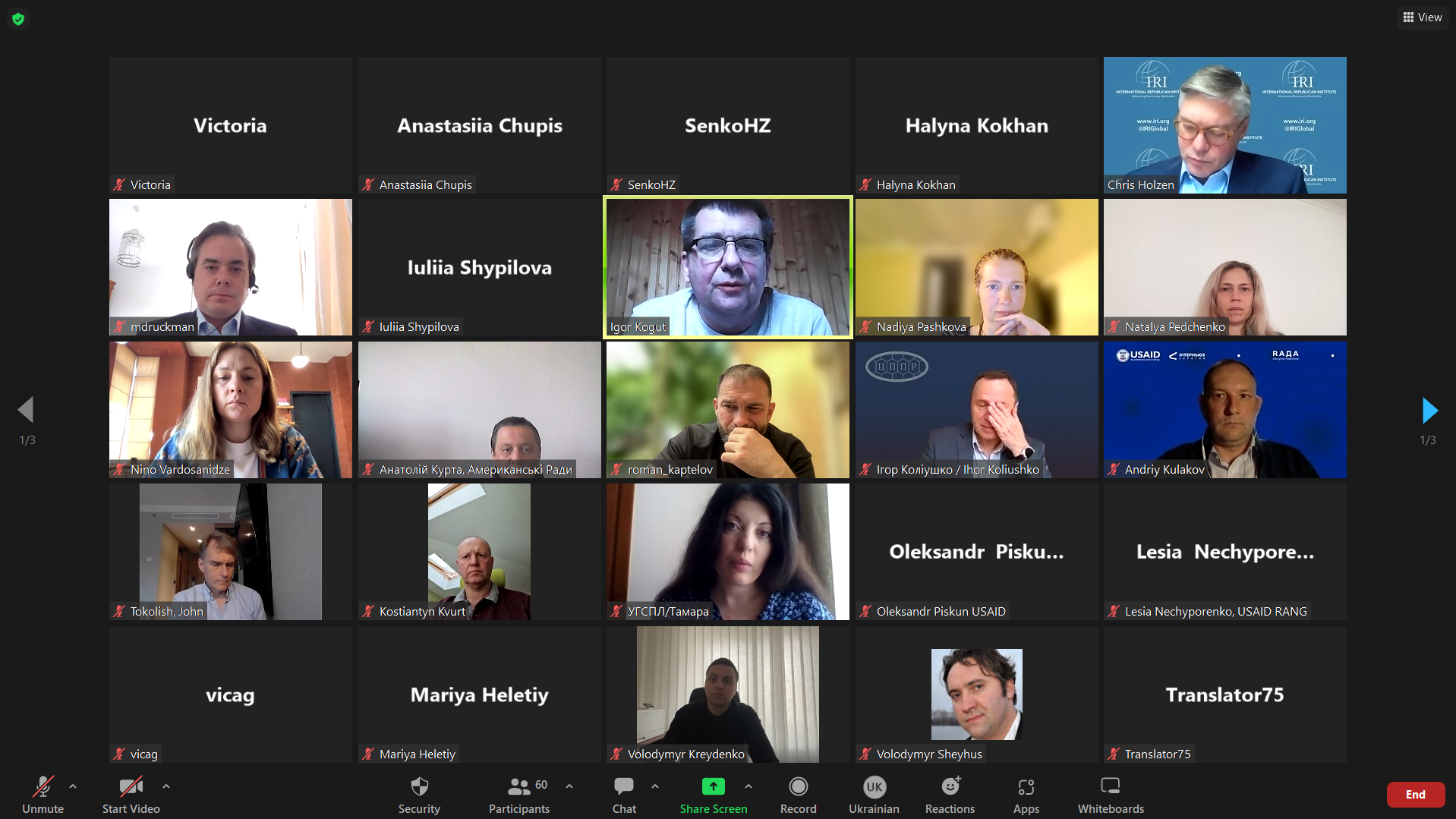
On May 25, the International Parliamentary Technical Assistance Coordination Meeting (IPTAC) took place in an online format. The goal of the meeting was to discuss the challenges that MPs face in the performance of the representative function, as well as the pressing issues and needs of the regions; to present the activities and coordinate the efforts of international technical assistance projects and programs under martial law. The meeting started with opening remarks of Oleksandr Piskun, Democracy Project Management Specialist Office of Democracy and Governance USAID, Ihor Kohut, Director of USAID RADA: Next Generation program, and Kostiantyn Kvurt, Head of the Board of the Internews Ukraine.
In her turn, Lesia Nechyporenko, USAID RANG’s Lead on Parliamentary Representation, outlined how USAID RANG reshaped its activities in supporting the activities of MPs in constituencies. In particular, she described the activities of information-consultative hubs on providing legal aid, crisis planning, IT tools, coordination, and support to MPs teams.
The presentation of the results of a sociological study by the International Republican Institute (IRI) became helpful for understanding the position of constituencies on pressing political issues. Admittedly, 97% of respondents responded that they believed in the victory of Ukraine. In addition, 95% positively evaluated the future of Ukraine. It should also be noted that the level of trust in the Verkhovna Rada of Ukraine showed the highest numbers since the IRI’s had started its first sociological studies. 64% of all respondents strongly approved or at least somewhat approved VRU’s activities, while 72% of young respondents (18-35 years old) approved of Ukraine’s Parliament.
Moreover, MPs present at the meeting described the needs of their respective constituencies. Volodymyr Kreidenko, Deputy-Chair of the Committee of the Verkhovna Rada of Ukraine on Transport and Infrastructure, said that the provision of humanitarian assistance was among the most pressing issues for all regions of Ukraine. He also mentioned the need to establish centers that would consult people on acquiring social benefits and compensations for damage caused by hostilities.
Iryna Konstankevych, First Deputy-Chair of the VRU’s Committee on Humanitarian and Information Policy, electoral district no. 23, Volyn region, proposed that it would be helpful to increase the media literacy population in times of hybrid warfare, helping ordinary people detect fake news and hostile disinformation. She mentioned the population needed training in civil protection and first aid to protect their lives.
Nataliia Pipa, Secretary of theVRU’s Committee on Education, Science and Innovation, electoral district no. 115, Lviv region; and Roman Kaptielov, Member of the VRU’s Committee on Budget, electoral district No. 36, Dnipropetrovsk region, agreed with their colleagues and added that efforts should be paid to providing accommodation and securing the basic needs of IDPs displaced to other regions.
Victoriia Hryb, Member of the VRU’s Committee on Energy, Housing and Utilities Services, electoral district no. 105, the Luhansk region, added that people in occupied territories and those who flew aboard needed informational support and constant communication with areas under Ukrainian control. Further on, Mrs. Hryb said that she was working on legislation on collaboration with the enemy and the legal status and benefits of civil victims of war. Thus, she would be grateful for technical assistance on that legal acts.
The issue of relocation of enterprises to safe areas was raised by Halyna Vasylchenko, Member of the Committee on Finance, Tax and Customs Policy. She mentioned that enterprises that were relocated from hostilities areas faced the need to find new business facilities, additional investments for relocation, legal consultations, and accommodation for their employees.
Serhii Hryvko, Member of the Committee of the Verkhovna Rada of Ukraine on Social Policy and Veterans Affairs, Chernihiv oblast, argued that attention should be paid to restoring damaged infrastructure, including power stations, and the development of the system for bomb shelters.
All MPs agreed that legal aid was one of the crucial needs for their activities in constituencies, including legal consultations for the local population, law drafting, and legal expertise.
The meeting ended with presentations by technical assistance programs that described how they adapted to wartime. For instance, Oleksandr Medvediev, the USAID Competitive Economy of Ukraine Program, listed the Program’s activities supporting Ukrainian business, Tamara Kharchylava, Ukrainian Helsinki Human Rights Union, explained that their organization shifted its focus mostly to victims of war and war crimes, and Nadiya Pashkova, IFES, mentioned their activities on analyzing issues with elections in war and postwar period.
Participants agreed on creating a database that would include contacts and profiles of programs of technical assistance for prompt communication between stakeholders.
Overall, 60 participants took part in the IPTAC. IPTAC meetings will be further held on a regular basis.