
Program products
Parliament under Conditions of War: Ukraine’s Example. Report on 10th session of VRU
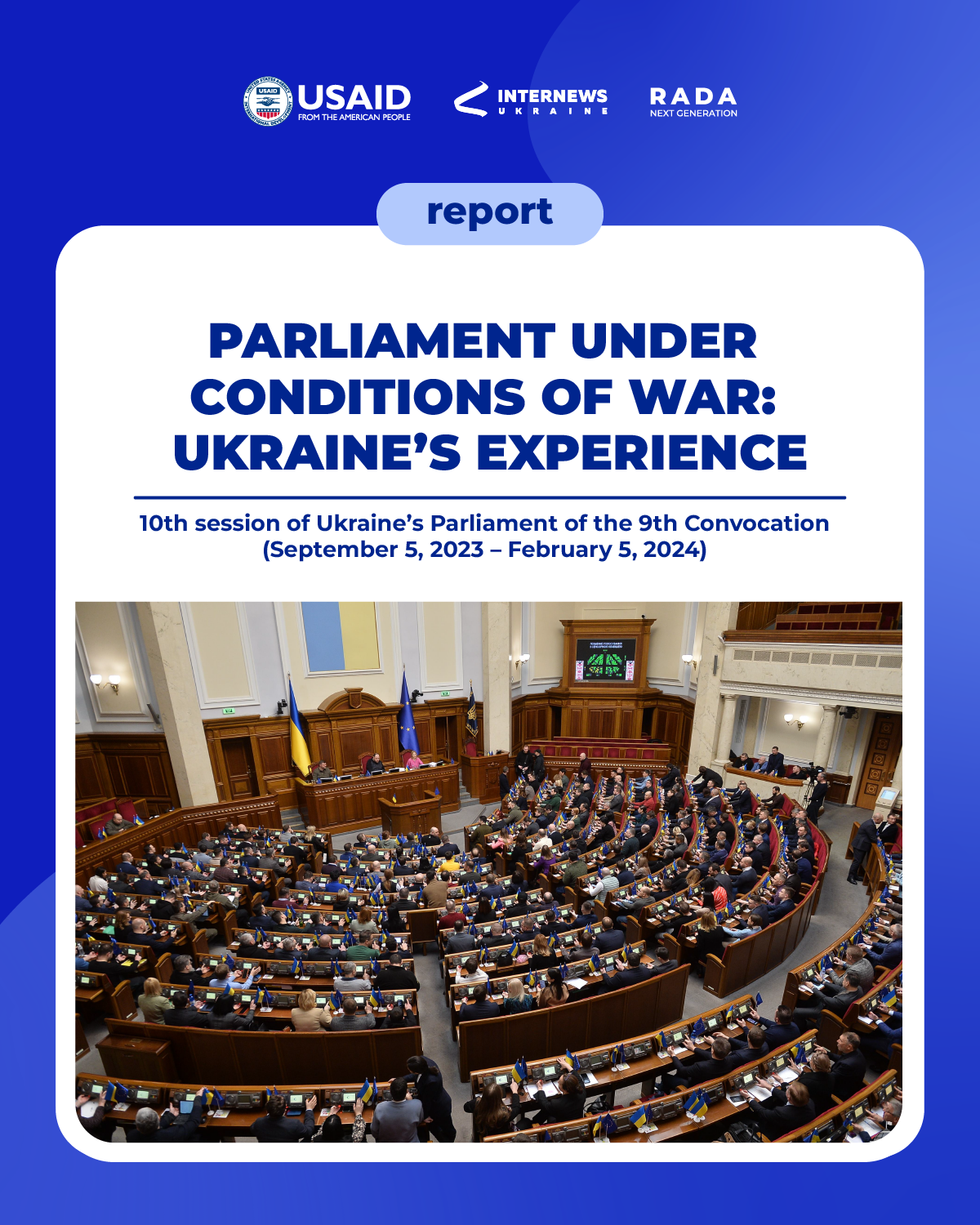
The work of the Parliament in war conditions is a rather difficult task in the organizational as well as constitutional and legal aspects. The collegial nature of the legislative body’s work and the nature of the body’s parliamentary procedures require special efforts to organize its work in such extraordinary circumstances as war. In view of this, constitutional regulation in many countries provides for the partial delegation of rule-making functions from the Parliament to other bodies of power. Ukrainian legislation does not provide for any exceptions or opportunities for delegating legislative powers.
According to the Constitution of Ukraine, the Verkhovna Rada of Ukraine can and must work even under martial law. The fact is that Ukraine belongs to the continental legal system, where the weight of normative regulation by parliamentary acts (Laws) is exceedingly high. Article 92 of the Constitution of Ukraine provides for a large number of areas (issues) which can only be regulated through the adoption of Laws by the Parliament. Therefore, the absence of an effective Parliament, even in wartime, would lead to significant difficulties for the entire national legal system.
Even in the second year of the full-scale war, the Verkhovna Rada of Ukraine continued to exercise its constitutional powers. During this time, the work of the Parliament has been constantly changing and developing, adapting to current conditions and security challenges.
This Report presents empirical data on the work of the Verkhovna Rada of Ukraine for the period of the 10th session (data covers the dates from September 5, 2023, to February 5, 2024). The study is a continuation of the previous iteration of the paper “Parliament under Conditions of War: Ukraine’s Example,” which covers the period from February 24, 2022, to June 30, 2023 (some data was related to the period from February 24, 2022, to May 31, 2023).
Information for the Report was collected from open information sources, primarily from the official web portal of the Verkhovna Rada of Ukraine, the websites of the secretariats of the parliamentary Committees and web resources of other separate bodies of state power. To form the research methodology and collect information, the experts conducted a series of interviews with the leadership of the Verkhovna Rada of Ukraine and individual parliamentary Committees.
The main objective of this research is to present the main facts and quantitative indicators of the work of the Verkhovna Rada of Ukraine. In view of the above, the authors of this Report also deliberately avoided drawing any clear-cut and unambiguous conclusions regarding the revealed facts of recommendations for the Parliament, focusing primarily on identifying the main trends in the work of the Verkhovna Rada of Ukraine in the conditions of the full-scale invasion without providing an assessment or an in-depth analysis of such trends.
The research was conducted by a group of experts of the USAID Program “RADA: Next Generation.” The development of the structure of the Report, the general coordination of the work and the review of the research results were carried out by Volodymyr Venger. The operational management of the research, the interviews with the Committees and the preparation of the final text of the Report were the responsibilities of Stanislav Ivasyk. The research itself was performed by Bohdana Doroshenko, Maksym Bondar, Stanislav Ivasyk, Andriy Kulakov, Diana Ihnatenko, and Diana Ishchenko.
The research is made possible by the generous support of the American people through the United States Agency for International Development (USAID). The contents do not necessarily reflect the views of USAID or the United States Government. The materials were published within the USAID RADA: Next Generation Program, which is a five-year initiative (2021-2026) implemented by the NGO "Internews-Ukraine".
Download