

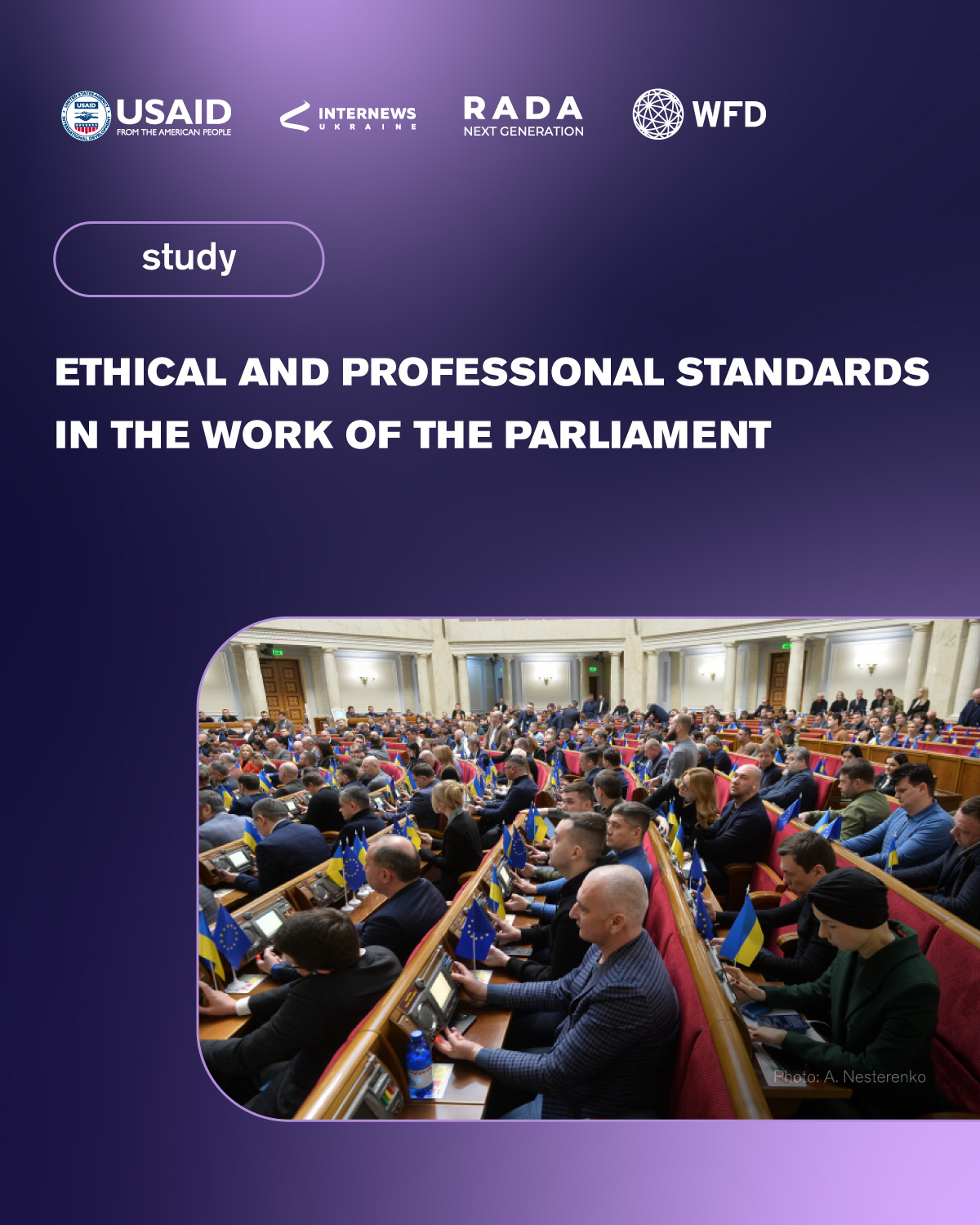
This study identifies the main issues and possible obstacles that need to be taken into account when developing parliamentary standards of conduct, in particular, a code of conduct. The best experience of other European parliamentary democracies in this field is also analyzed.
The author examines the new challenges caused by russia’s aggression against Ukraine, as well as the opportunities associated with Ukraine's prospective membership in the EU. At the same time, he did not seek to fully and comprehensively assess the entire legislative framework and institutional norms regulating behavior in the parliament, or relevant provisions in the fight against corruption in Ukraine.
The author also recommends that the Verkhovna Rada implement a far-reaching reform of the supervisory mechanism by adopting a new code of ethics and creating a supervisory ethics committee endowed with the necessary means, procedural tools and operational independence for the effective performance of its functions.
In general, scandals related to the dishonest behavior of parliamentarians highlighted the need for exemplary behavior of politicians and forced parliaments to develop detailed rules for such behavior. Ukraine is no exception, and its parliament needs a modern regulatory tool that sets standards and provides guidelines for the behavior of MPs, as well as an institutional mechanism for responding to unacceptable behavior.
Formation of a regime of ethics and proper behavior is a political process. Therefore, the current political context should determine both the content of the new comprehensive regime of parliamentary ethics and its formation. Reform-minded parliamentarians should consider political and public concern over ethical standards as an opportunity to improve the VRU's public image in order to achieve the level of legitimacy required for any parliament. It should always be remembered that public office is nothing without public trust.
All rights to this work, including copyright, belong to the Westminster Foundation for Democracy (WFD). The publication was prepared by Marcin Walecki, PhD, an expert with more than 20 years of experience in promoting democracy and governance, working in more than 40 countries around the world.
These materials are made possible by the generous support of the American people through the United States Agency for International Development (USAID). The contents do not necessarily reflect the views of USAID or the United States Government. The materials were published within the USAID RADA: Next Generation Program, which is a five-year initiative (2021-2026) implemented by the NGO "Internews-Ukraine".
Download