

"We’ve gotten very emotional calls. People called and thanked us for being able to solve their problems. Especially the elderly. They lived through enormous stress, were confused, and faced difficulties using modern gadgets. That's why they were most in need of our advice on various issues: what kind of transport they needed to reach this or that city, where to stop, who to ask for help, etc.," hotline coordinator Viktoriia Fedina said in describing her work.
This hotline in Pavlohrad District of Dnipropetrovsk Oblast was launched in late July 2022. It aimed to help internally displaced persons (IDPs) forced to evacuate from Donetsk and Kharkiv Oblasts due to Russian aggression. Just two months after Russia's full-scale invasion of Ukraine began, the city of Pavlohrad was home to more than 10,000 refugees.
Therefore, according to the area’s parliamentary representative, Ukrainian MP Roman Kaptelov, there was an urgent need to "supervise efforts in the district and help local communities to interact with IDPs."
With the financial, organizational, and operational support of the USAID RADA: Next Generation Program, Kaptelov's team established a coordination center. "There is a single phone number that IDPs call. Then the hotline operator gets to know their needs and redirects the IDPs to a specific service or department in a specific community or city," explained Vadym Havrylitse, Mr. Kaptelov’s assistant.
The hotline acts as an intermediary between IDPs and municipal services, volunteer centers, medical facilities, and other key local facilities. It provides consultations and helps IDPs meet their needs for clothing, housing, transport, medical services, hygiene products, and more. In addition, when a caller makes a request for legal or psychological help, hotline operators can refer them to relevant USAID initiatives or programs.
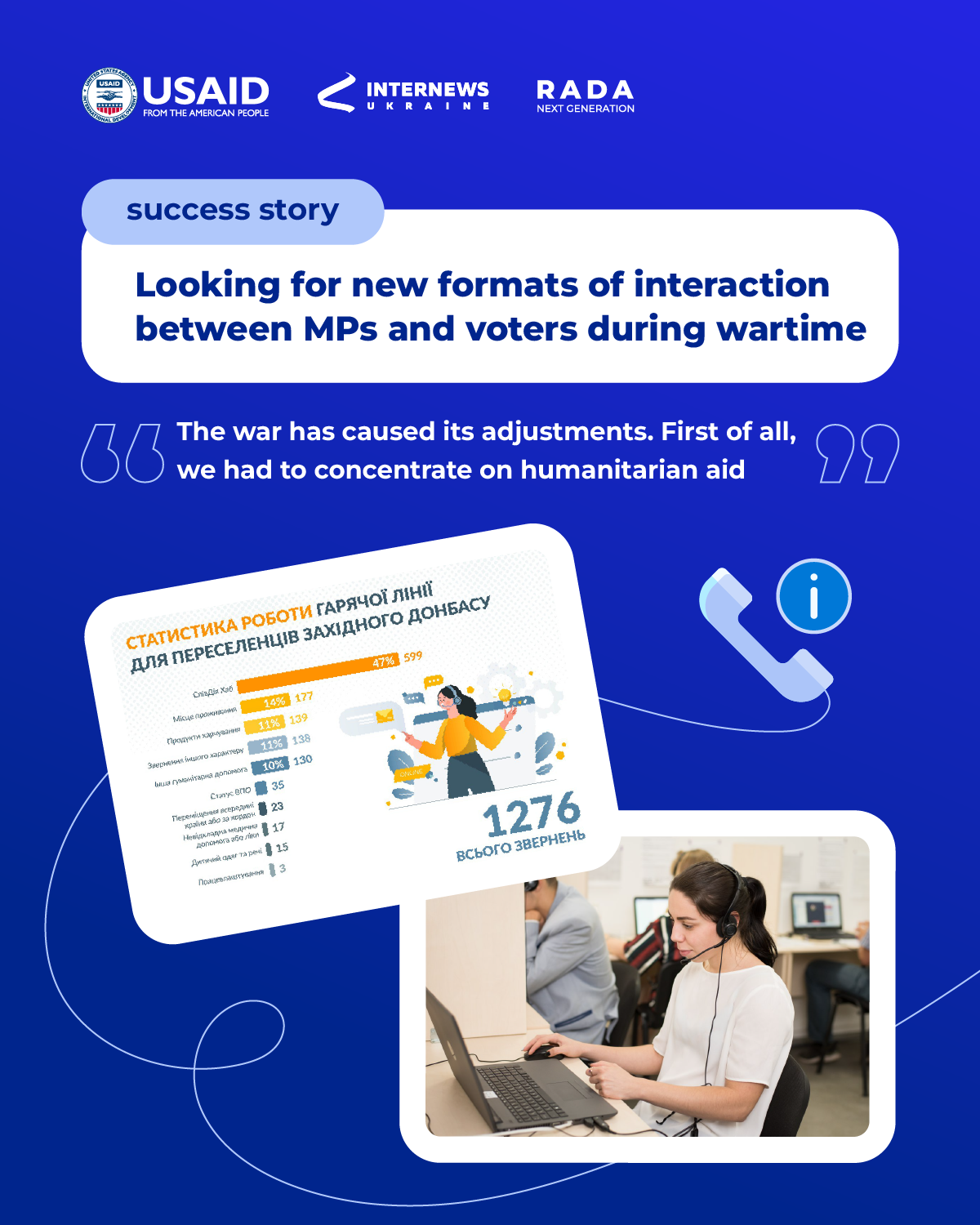
As of late 2022, the Pavlohrad District hotline had received close to 2 500 calls. According to Fedina, the requests mainly were for humanitarian aid and housing, as people arrived without belongings or specific plans after having fled combat zones in a hurry. These days, IDPs are increasingly looking for items to winterize their homes.

Viktoriia shared a story that particularly moved her: "Recently, we received a phone call from a man originally from occupied Lysychansk. He evacuated and settled in an old house without heating, so now he needs at least something to winterize his new home. The current situation with electricity is very tough. That's why a potbelly stove is vital to have in a house. We put him in contact with the nearby humanitarian centers, and they have been able to help him there. The man was so modest and kind and thanked us many times. I was touched."
Almost half of all calls concern the local SpivDiya Hub. It is a service where IDPs and local citizens can receive humanitarian aid. Hotline operators help IDPs, especially those who are older and do not have touch-screen phones, to fill out an application on the Hub’s website. They can also track the application's status. Thus, IDPs can call at any time to ask about the progress of their applications.
Vadym Havrylitse noted the hotline not only helps IDPs, but also provides benefit to local communities. The ability to assess and quickly meet IDPs' needs allows the local government to distribute resources in the district evenly and to keep the city manageable. "In order to prevent the problems that happened in Lviv [a Ukrainian city that faced many local problems due to the influx of IDPs], we monitored the occupancy of Pavlohrad city and assessed how many vacant housing spaces there were. With this data, we were able to recommend that IDPs settle in nearby communities, assuring them that the living conditions were not worse and the location was really close."
Havrylitse added that the hotline has become so popular that people from other districts have even started calling. He believed there is great potential in scaling up the project. The hotline could cover other districts of Dnipropetrovsk Oblast. Moreover, assessing the hotline’s activity and the types of requests it receives allows local authorities to better understand people's needs in Pavlohrad District. This, in turn, makes MP Kaptelov’s constituent services more targeted and effective.
"The war has caused its adjustments. First of all, we had to concentrate on humanitarian aid," said Havrylitse in explaining how the office’s work has changed since the start of the war.
Russia's aggression changed everything in the blink of an eye. From the average citizen all the way to MPs, Ukrainians have united in.